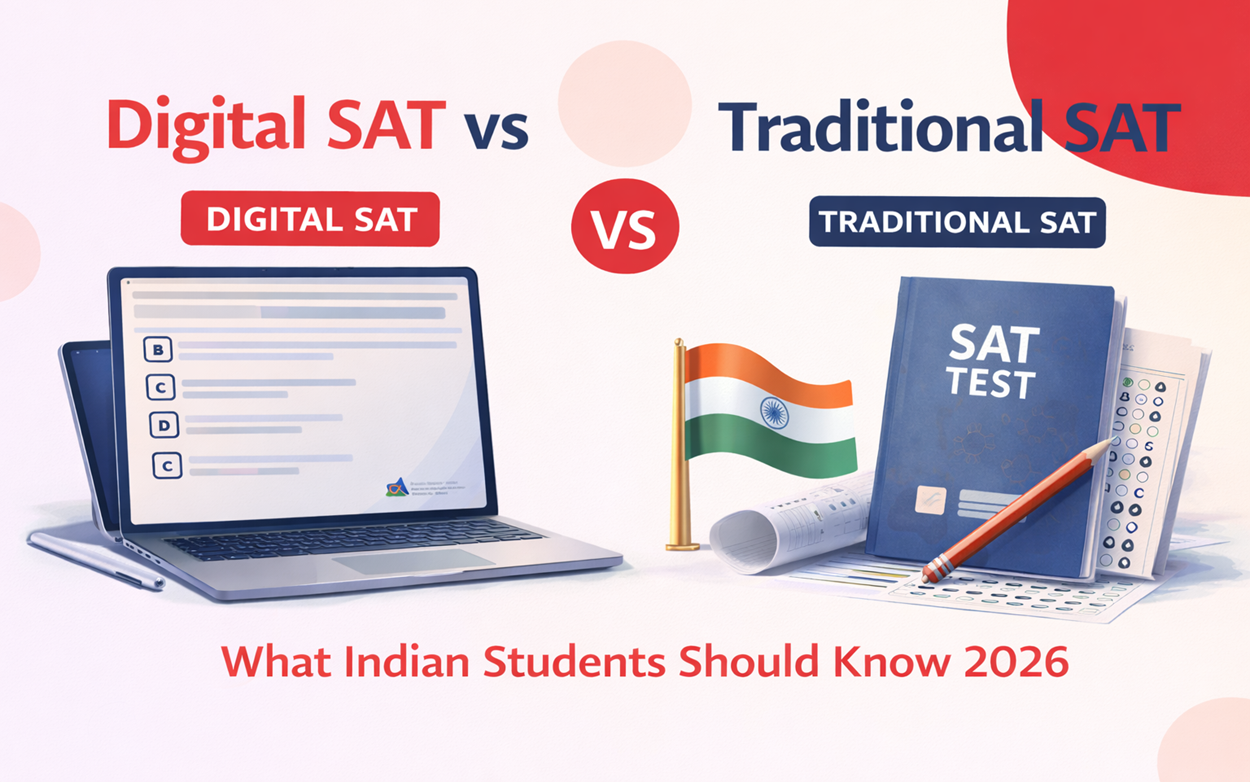
In March 2025, the College Board completed the transition of the SAT from paper-and-pencil to a fully digital format. That change isn’t just about swapping pencils for screens; it affects timing, question delivery (adaptive testing), on-test tools (built-in calculator), score reporting speed, and the way you should prepare. If you’re an Indian student planning undergraduate applications in 2026 or soon after, understanding these differences is essential to choosing a test date, planning preparation, and avoiding surprises on test day.
Quick summary about the highlight differences
- Mode of the Test- The most significant change is that the Digital SAT is taken on a laptop or tablet using the Bluebook app, while the Traditional SAT was a paper-and-pencil test. Students no longer fill in bubbles by hand; everything is done digitally.
- Test Duration- The Digital SAT is shorter, lasting about 2 hours and 14 minutes, compared to the Traditional SAT’s 3-hour duration. This makes the test less tiring and more focused.
- Structure and Format- The old paper SAT had long sections, but the Digital SAT is divided into two adaptive modules per section, one for Reading and Writing and one for Math. Your performance in the first module affects the difficulty of the second.
- Question Count- The Digital SAT has fewer questions (about 98) compared to the Traditional SAT’s 154 questions, giving students more time per question and reducing stress.
- Reading Passages- The Digital SAT features shorter reading passages, each followed by a single question. The older paper version included long passages with multiple questions, which often led to fatigue.
- Calculator Usage- A significant improvement is that the Digital SAT allows a calculator throughout the entire Math section, while the Traditional SAT restricted it to one math portion only. The digital version even includes a built-in graphing calculator.
- Adaptive Testing- The Digital SAT is adaptive, meaning the difficulty of your second module depends on how well you perform in the first. The Traditional SAT was non-adaptive, giving the same set of questions to everyone.
- Tools and Interface- The Digital SAT offers on-screen tools like a timer, flag-for-review button, highlighter, and formula reference. These tools weren’t available in the paper test, where students relied only on their booklet and pencil.
- Scoring and Results- Both tests use the same 400–1600 scoring scale, but the Digital SAT delivers results within days, unlike the paper version, which takes 2–3 weeks to release SAT scores.
- Test Security- The Digital SAT is more secure, as each student receives a unique test form generated digitally. The Traditional SAT had the same booklet for all students, which increased the chances of question leaks.
- Overall Test Experience- The Digital SAT is faster, wiser, and more convenient. It’s designed to reduce fatigue, improve accuracy, and adapt to student performance — making it a more modern and efficient version of the exam.
What does “adaptive” actually mean, and how does it affect you?
The Digital SAT uses section-level adaptation: you take a first module of a section, then the performance there determines the difficulty level of the second module for that same section. (You don’t get an individualized next-question adaptation like some computer-adaptive tests; adaptation happens between modules.) The practical effects:
- Doing well in Module 1 usually gives you a harder Module 2 (more opportunity for higher raw scores).
- Missing many questions in Module 1 will typically route you to an easier Module 2.
- You cannot return permanently to earlier modules’ questions once you’ve submitted them (the navigation behavior differs from paper). Practice the pacing and decision strategy for each module.
Format and timing detailed comparison
- Overall Structure- The Traditional SAT was a paper-based test with two main sections-
o Evidence-Based Reading and Writing (EBRW)
o Math
However, the Digital SAT also has two sections: Reading and Writing and Math, but each section is now split into two adaptive modules. This means the test automatically adjusts the difficulty of the second module based on how you perform in the first.
- Total Test Duration-
o The Traditional SAT lasted about 3 hours (180 minutes), excluding breaks.
o In contrast, the Digital SAT is much shorter, lasting only about 2 hours and 14 minutes (134 minutes). This reduction makes the digital test less tiring and more time-efficient.
- Section-wise Timing-
In the Traditional SAT, timing was as follows-
o Reading Section: 65 minutes
o Writing and Language Section: 35 minutes
o Math (No Calculator): 25 minutes
o Math (With Calculator): 55 minutes
o Total: 180 minutes
In the Digital SAT, timing is now-
o Reading and Writing: 64 minutes (divided into two 32-minute modules)
o Math: 70 minutes (divided into two 35-minute modules)
o Total: 134 minutes
- Number of Questions-
o The Traditional SAT had 154 questions in total, while the Digital SAT now includes only about 98 questions.
o This allows students to spend more time analyzing each question and reduces pressure during the test.
- Adaptive Module System-
o Each section in the Digital SAT (Reading and Writing, Math) starts with a first module that contains a mix of easy, medium, and complex questions. Depending on how well a student performs in this module, the second module becomes either more challenging or slightly easier.
o This adaptive format helps create a fair and accurate measure of each student’s ability level. The Traditional SAT did not adapt; all students answered the same set of questions regardless of performance.
- Breaks Between Sections-
o Both versions offer a short break between major sections. In the Digital SAT, the break usually comes between the Reading & Writing section and the SAT Math section.
o However, the overall test day is shorter because of reduced total time and automated check-ins on the testing software.
- Navigation and Timing Control-
o In the Traditional SAT, students flipped through pages and marked answers on paper. They could skip and return to any question easily.
o In the Digital SAT, you can navigate freely within a single module, but once you finish and move to the next module, you can’t go back.
The test screen also shows a countdown timer, ensuring students can manage time effectively.
- Time per Question-
o Because of fewer questions and a shorter format, students now get slightly more time per question on the Digital SAT.
o This is particularly beneficial for non-native English speakers, such as many Indian students, who may need a few extra seconds to process reading and math problems.
- Result Processing Time-
o The Traditional SAT required several weeks to process and report scores due to manual scanning and evaluation.
o The Digital SAT, being entirely online, delivers results within days, making it convenient for students applying to universities with tight deadlines.
| Explore More: SAT Exam 2026: Registration, Exam form, Date, Syllabus, Pattern, Fee |
Summary of Format and Timing-
|
Aspect |
Traditional SAT |
Digital SAT |
|
Mode |
Paper-based |
Computer-based (Bluebook App) |
|
Total Duration |
~3 hours |
~2 hours 14 minutes |
|
Sections |
2 (Reading/Writing + Math) |
2 (Reading/Writing + Math) |
|
Modules per Section |
None |
2 Adaptive Modules |
|
Total Questions |
154 |
About 98 |
|
Breaks |
Between major sections |
Between major sections |
|
Navigation |
Can skip and return anytime |
Can move within module only |
|
Result Delivery |
2–3 weeks |
Few days |
What about the scoring system, what stays the same and what changes?
- Scale- Still 400–1600 (two-section scores 200–800 each).
- Raw-to-scaled conversion- Because of adaptive modules, raw score conversion is determined via equating across test forms so colleges can compare applicants fairly. In short, a 1300 on the paper SAT and a 1300 on the digital SAT should have the same meaning to admissions officers.
- No penalty- Like the paper SAT, there is no penalty for wrong answers; answer every question you can attempt.
- Faster reporting- Digital delivery speeds grading and reporting, so you’ll typically see results in days instead of weeks.
Registration, test dates and availability in India-
- The College Board posts international test dates and registration deadlines well in advance; registration for the 2025–26 test year is open on their site. Check the official SAT dates and deadlines page for exact India dates and registration cutoffs.
- Most Indian test centers now administer the Digital SAT. The College Board provides a list of authorized centers and whether they run weekend or school-day administrations. Local coaching centers and school coordinators often post center availability after the College Board opens registration.
Device, app, and test-day logistics-
- The College Board uses the Bluebook™ app for student testing. You will either use your own laptop/tablet with the Bluebook app installed or borrow a device provided by the test center if you don’t have one. Install and test the app in advance if you’re using your own device.
- Bluebook has an on-screen timer and digital tools for marking and review within modules. Get comfortable with the interface; highlighting, flagging, and on-screen math tools are different from paper.
- Bring a valid ID and arrive early. The basic rules about calculators, permitted refreshments, and identification still apply, but you won’t carry an answer sheet; everything is captured digitally.
What should be the preparation strategies to achieve success in the Digital SAT?
- Practice on a screen- Simulate real conditions using the Bluebook practice tests and full-length digital practice tests. Speed and screen-reading stamina are different skills. The College Board and many test-prep companies now offer official/realistic digital practice tests; use them.
- Module strategy-
o Strong start: Because Module 1 performance affects Module 2 difficulty, aim for accuracy at the beginning. Don’t waste time agonizing over a single question early on.
o Pacing: Practice pacing for each module separately; smaller chunks mean you’ll need mental resets between modules.
- Use of calculator- Since calculators are allowed across the entire math section, be fluent with a digital calculator. But calculators can slow you down; practice deciding when mental algebra is faster.
- Reading strategies- Expect shorter passages with one question per passage sometimes; practice rapid comprehension and moving from passage to question efficiently. Use tools like on-screen highlighting to mark keywords.
- Tech reliability and backups- If you are using your own device, ensure the battery is full, power settings turn off sleep mode, and that the Bluebook app is updated. Test once before test day.
- Psychological prep- The test is shorter, which reduces total fatigue, but the adaptive element can feel unfamiliar. Do several complete digital practice tests to normalize the experience.
What are the pros and cons from an Indian student’s perspective?
Pros of the Digital SAT for Indian Students-
- Shorter and more time-efficient exam- The Digital SAT lasts 2 hours 14 minutes, reducing fatigue and helping Indian students stay focused, especially those balancing exams like JEE or NEET.
- More time per question- With fewer questions (98 vs 154), students get more time (1.4 minutes) per question, easing pacing and stress, especially for non-native English speakers.
- Adaptive format highlights actual ability- The adaptive structure adjusts difficulty based on performance, ensuring a fairer and more personalized assessment of skills.
- Built-in digital tools- Tools like the Desmos calculator, highlighter, timer, and flag-for-review make test navigation easier for students familiar with online learning.
- Calculator allowed throughout the math section- A calculator is available for all math questions, reducing errors and improving efficiency in problem-solving.
- Shorter reading passages- Passages are now 2–4 sentences long, making reading comprehension faster and simpler.
- Faster score reporting- Results arrive within days, helping students meet university deadlines or plan retakes quickly.
- Environmentally friendly and secure- Fully digital format prevents cheating and promotes sustainability.
- Consistent global testing- Same format worldwide ensures equal opportunities for Indian students.
- Aligned with online learning- Matches the digital learning habits of Gen Z students, making preparation smoother.
Cons of the Digital SAT for Indian Students-
- Limited access to reliable devices- Many students, especially from rural or smaller cities, may lack access to suitable laptops or tablets. Using borrowed or unfamiliar devices can cause technical discomfort, while power cuts or malfunctions may create last-minute stress.
- Internet and technical reliability- Although the test can run offline, it still needs an internet setup and verification. In India, Wi-Fi instability or power interruptions at centers can disrupt focus and increase anxiety.
- Screen fatigue and eye strain- Two hours of screen reading can cause eye strain and fatigue, making it harder to stay focused compared to reading on paper.
- Reduced note-taking flexibility- Students can’t underline or circle directly on the screen. Digital annotation tools are less intuitive, making note-taking harder for visual learners.
- Adaptive format feels unpredictable- Students don’t know if the next module will be easier or harder, causing psychological stress and uncertainty about performance.
- Limited offline practice resources- The shift from paper-based guides to online tools like Bluebook requires device access and familiarity, limiting preparation options.
- Typing and navigation challenges- Unfamiliarity with scrolling or highlighting may waste time. Unlike paper tests, complete visibility of questions isn’t possible.
- Limited testing centers and learning curve- Fewer centers in smaller cities force travel to metros, adding costs. New test-takers may also struggle to adapt to the digital interface and adaptive system.
What are the common pitfalls, and how to avoid them?
- Not understanding the adaptive format- Many students don’t realize that the Digital SAT format adjusts question difficulty based on performance. However, practice with adaptive mock tests to get familiar with this structure.
- Poor time management- shorter sections can make pacing tricky. At the same time, practicing under timed conditions to improve speed and accuracy.
- Neglecting digital tools- Students may ignore features like the built-in calculator or annotation tools. Moreover, learn to use all Bluebook features during practice tests.
- Over-reliance on old materials- Using outdated paper-based SAT resources can mislead preparation. Use official Digital SAT prep from College Board.
- Ignoring technical readiness- Device or software issues can cause stress on test day.
Final verdict
The transition from the traditional SAT to the Digital SAT marks a new era in standardized testing, faster, more innovative, and more efficient. For Indian students, it offers a shorter, adaptive, and technology-driven testing experience that aligns with modern academic trends. However, success depends on adapting to digital tools, overcoming technical challenges, and practicing strategically using official resources. By understanding the key differences, preparing early, and familiarizing themselves with the Bluebook app, Indian students can confidently embrace the Digital SAT and turn this change into an advantage for their global education journey.
FAQs
Q.1 Is the paper SAT still available in India?
Ans- No. The College Board completed the transition to digital testing; the paper SAT has been retired. Confirm dates and local center availability on the College Board site.
Q.2 Will colleges accept the digital SAT?
Ans- Yes, the digital SAT is the official SAT. Colleges receive scores on the familiar 400–1600 scale and have been briefed by the College Board.
Q.3 Do you need to buy a tablet for the test?
Ans- No, test centers supply devices if you don’t have a compatible one. If you use your own, confirm device and Bluebook requirements with College Board guidance well before test day.
Q.4 How quickly will you get your scores?
Ans- Typically, digital SAT scores are delivered in days rather than weeks — check the College Board for exact timelines for the test date you choose.
Q.5 Has the scoring changed?
Ans- The top-level scale remains 400–1600, but the mechanics of scaling adapt to the adaptive format to keep scores comparable.
Q.6 How is the Digital SAT different from the traditional paper SAT?
Ans – The Digital SAT is shorter (about 2 hours vs. 3 hours), adaptive in nature, and conducted on a computer, while the traditional SAT was a fixed-format, paper-based exam.
Q.7 Is the Digital SAT harder than the traditional one?
Ans – Not necessarily. The difficulty adjusts based on your performance, and the questions are designed to test the same skills as before—just in a more efficient way.
Q.8 Can Indian students take the Digital SAT from home?
Ans – No. The Digital SAT must be taken at an authorized test center under supervision, even though it’s computer-based.
Q.9 What app or software is needed for the Digital SAT?
Ans – Students must use the Bluebook™ app provided by the College Board to take the Digital SAT and practice beforehand.
Q.10 Can you use rough paper during the Digital SAT?
Ans – Yes, students are given scratch paper at the test center to work out math problems and make notes.
Q.11 How many questions are there in the Digital SAT?
Ans – The Digital SAT has two main sections: Reading and Writing, and Math, each with two adaptive modules and fewer total questions than before.
Q.12 Are calculators allowed in the Digital SAT Math section?
Ans – Yes, calculators are allowed for the entire Math section, and a built-in Desmos calculator is available on the testing app.