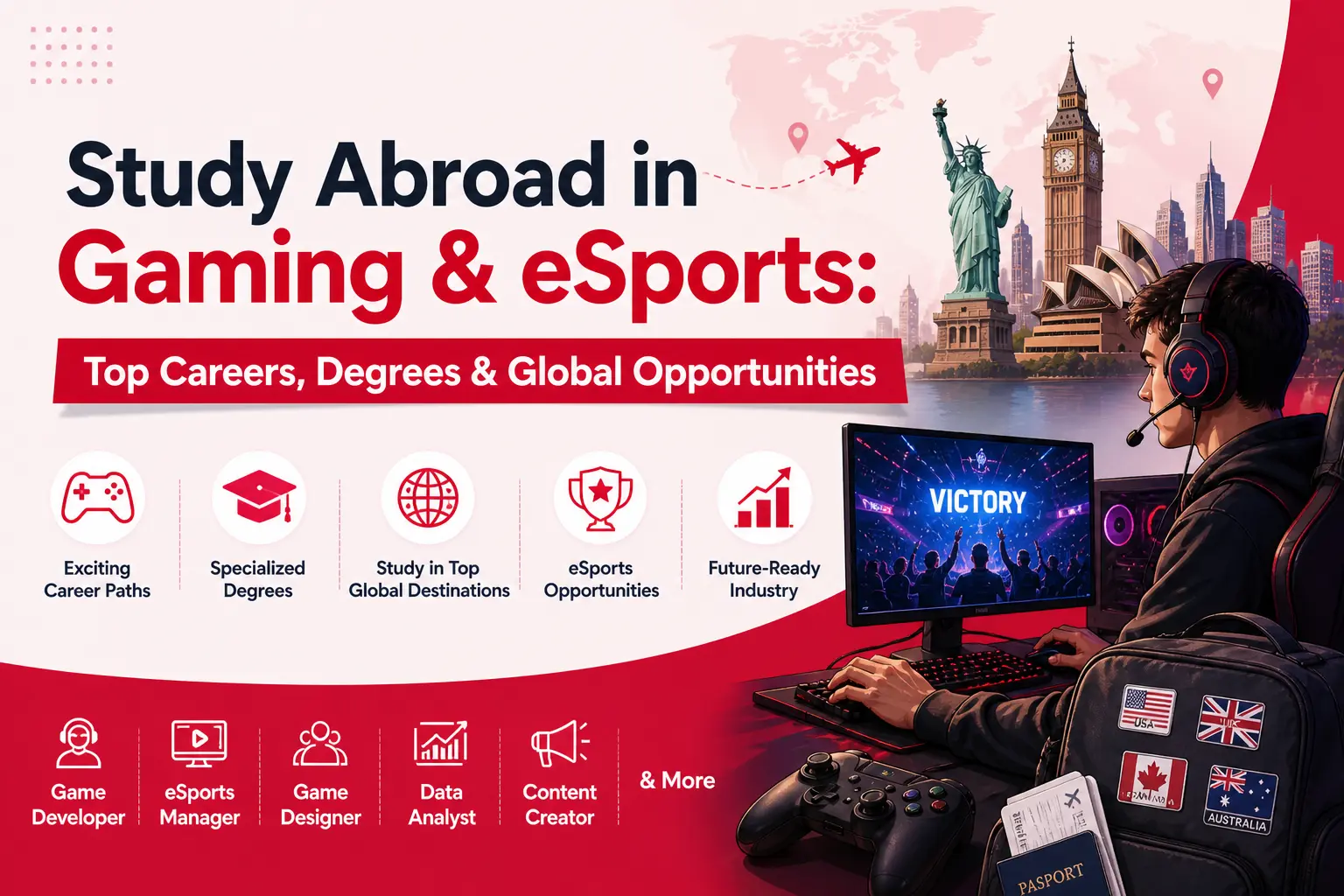
The gaming and eSports industries have quickly grown from a hobby to a multibillion-dollar worldwide business with employment options that go far deeper than standard tech skills like network engineering or software development. These days, gaming and competing in eSports are a growing cultural phenomenon; they are also potential career tracks that provide study abroad opportunities, internships abroad, and lucrative careers in business, journalism, event administration, art, design, and other fields.
What is Gaming & eSports abroad?
The research, employment, and business prospects associated with computer games, gaming for competition, and the eSports ecosystem in global settings are referred to as "gaming & eSports abroad." It includes education, career development, and exposure to industries outside of one's own nation. This is a summary:
1. Educational Opportunities- Programs in gaming, developing games, graphic design, and eSports administration are currently offered by several institutions and colleges overseas. Among the courses are-
- Game Development & Design
- eSports administration
- Interactive media and animation
- Game graphics and art
- Game programming
Specialized programs with practical experience are common in nations including the United States, Canada, the United Kingdom, Germany, and South Korea.
2. Career opportunities- Studying gaming and eSports overseas can lead to positions as a professional eSports player, a game designer or developer, an eSports event organizer, a community manager or marketing expert for gaming firms, or a content producer or streamer.
3. Industry exposure- Students who study abroad are exposed to professional networks, international competitions, and state-of-the-art gaming technology. Internships, partnerships, and practical experience are offered by nations with well-established eSports ecosystems.
For individuals who want to pursue a career in the gaming industry, gaming and eSports overseas combine training, development of skills, and knowledge in the global market.
Why study gaming and eSports abroad?
Students have a rare chance to transform their passion into an internationally competitive career by studying gaming and eSports overseas. The following are the main justifications for why it makes sense to pursue this career abroad-
- Global exposure to a rapidly expanding industry- eSports and gaming are international sectors. Students who study overseas have a broader perspective on careers by learning about global marketplaces, gaming cultures, and consumer trends.
- Access to cutting-edge facilities- International institutions provide cutting-edge gaming laboratories, motion capture rooms, VR/AR studios, and expert broadcasting settings that improve hands-on learning.
- Industry-focused curriculum- International programs are created with direct industry involvement, emphasizing practical skills like content development, designing games, esports administration, and live event production.
- A wide range of employment options outside of coding- Students may pursue jobs in esports administration, marketing, streaming, event planning, game design, analytics, and media, all of which go well beyond typical tech positions.
- Excellent networking and internship opportunities- Studying overseas gives you access to major gaming studios and firms, real projects, internships, and international esports competitions.
- Internationally recognized degrees- Degrees from nations like the United States, the United Kingdom, Canada, and Europe are respected around the world and increase one's employability in foreign markets.
- Opportunities for post-study employment- After graduation, students can obtain foreign job experience thanks to the post-study work permits offered by several nations.
- Personal development and global perspective- Students who live overseas gain independence, flexibility, ability to communicate, and cultural awareness—qualities that are crucial in the global gaming economy.
|
Explore More: |
Types of Programs: Curriculum and skills
The study options for gaming and eSports abroad are diverse and don’t just revolve around programming. Below are the major streams you can pursue:
A. Game Design and Development- These programs combine creative storytelling, art, programming, and interactive design. Topics typically include:
- Unity and Unreal Engine
- 3D modelling
- Animation and graphics
- Game mechanics
- Level design
They help build your portfolio, a significant asset for international job opportunities.
B. Esports Management- Esports management is one of the most globally popular degrees linked directly to the business of competitive gaming. It teaches:
- Event and tournament organization
- Sponsorship and brand strategy
- Marketing for gaming audiences
- Team management and player contracts
- Analytics and performance data interpretation
- Broadcasting and media rights
Because eSports is inherently global, studying these topics abroad gives you insights into different regional business models and practices.
For example, universities like Staffordshire University (UK) offer a BA (Hons) in Esports with placements and real-world projects that cover business, production, and marketing.
C. Creative Media and Broadcasting- Gaming is also a media industry. Courses combining esports and creative media prepare students for:
- Live event production
- Broadcast journalism
- Social media management
- Video production
- Commentary and public speaking
A degree like a BA (Hons) in eSports & Sports Media prepares graduates for content creation, graphic design, and media production roles.
D. Specialized Diplomas and Short Courses- Some students choose shorter paths, like:
- HND in Esports is a two-year international qualification that can lead to a full bachelor’s abroad.
- Certificate programs in game programming, 3D art, or broadcast technology.
- Workshops, bootcamps, and study abroad modules combining travel with academic credit.
This mix of options means gamers with different interests, from production to psychology to business, can find a path. Even machine learning and AI in game systems are emerging academic topics.
What career opportunities are available beyond traditional tech roles in the gaming and eSports industry?
Careers Beyond Traditional Tech focuses on positions that provide significant development, imaginative thinking, and worldwide potential without requiring rigorous coding or software engineering, particularly in areas like gaming, eSports, media, and digital businesses. Here are a few essential professional paths-
- Esports Management and Operations: Experts oversee esports teams, competitions, sponsorships, and alliances. Among the positions are league administrator, operations coordinator, and esports manager.
- Creative Roles and Game Design: These professions emphasize creativity above just coding. Game designers, level designers, story designers, animators, 3D artists, and visual effects specialists are among the options.
- Content Creation and Streaming: For gaming companies, teams, and websites like YouTube and Twitch, gamers can work as content developers, broadcasters, video editors, or social media managers.
- Media, Broadcasting & Commentary: Jobs in these fields include broadcast technicians, producers, esports journalists, shoutcasters (commentators), and digital media experts.
- Marketing, Branding & Community Management: Positions like influencer manager, community manager, digital marketing manager, and brand strategist concentrate on audience development and engagement.
- Event & Tournament Management: Live esports competitions and international gaming events are arranged by event planners, production managers, and stage coordinators.
- Data Analytics & Performance Analysis: To enhance tactics and engagement, analysts examine gameplay data, player performance, and audience behavior.
- Psychology, Coaching, and Wellness: Jobs in esports psychology, coaching, fitness instruction, and mental health promote player lifespan and efficiency.
- Entrepreneurship & Freelancing: Students can work as independent artists, editors, and strategists or launch independent gaming studios, esports enterprises, or consulting firms.
- Education & Research: There are opportunities in game research, teaching, curriculum creation, and esports training academies.
Which nations and establishments are best for teaching gaming and eSports?
- United States: With well-known firms like Blizzard, EA, and Epic Games, the US boasts a robust culture for game production. Many institutions combine esports groups, international networks, and internship possibilities to provide students with experience in the business. Graduate schools like the Florida Interactive Entertainment Academy (FIEA) concentrate on interactive entertainment and production.
- United Kingdom: Universities like Staffordshire University and Sheffield Hallam University in the UK offer specialized programs in media and esports management. Additionally, the nation boasts a sizable and well-established gaming business that is backed by robust media and creative sectors.
- Canada: In addition to having good post-study work visa opportunities, Canada is renowned for its cosmopolitan and varied campuses. Prestigious universities offer strong game art and development programs, and the independent gaming business is booming.
- Australia: With an emphasis on interactive media, innovative technology, and interdisciplinary study methods, Australia is gradually growing its gaming and eSports education industry.
- Europe (France, Sweden, Finland): With establishments like Supinfogame in France, one of the oldest game schools in the area, Europe provides a wealth of chances for gaming education. Nordic nations like Finland and Sweden are renowned for their robust international alumni networks and creative game design centers.
How can strong portfolios, internships, and visa planning help you prepare for a gaming and eSports career abroad?
- Strong portfolios demonstrate your practical skills, creativity, and real-world experience, which are highly valued in gaming and eSports careers abroad. Portfolios can include game projects, design work, animation reels, broadcast clips, or event management samples, helping you stand out to universities and employers.
- Internships provide hands-on industry exposure and help students understand how global gaming studios, esports teams, and media organizations operate. They also build professional networks, improve workplace skills, and often lead to full-time job opportunities after graduation.
- Visa planning ensures a smooth transition from studying to working abroad by helping students understand part-time work rules and post-study work options. Proper visa planning allows graduates to gain international experience and launch their careers in the global gaming and eSports industry.
What challenges do students face in the gaming and eSports industry, and how can they navigate them effectively?
The gaming and eSports industry offers exciting global opportunities, but it also comes with unique challenges. Understanding these challenges and knowing how to overcome them can help students build a sustainable and successful career.
- High competition in the industry- Gaming and eSports attract many passionate students, which makes roles in game design, esports management, content creation, and professional play highly competitive. Students can navigate this challenge by developing specialized skills, building a strong portfolio, earning relevant certifications, and continuously improving through practice and real-world projects.
- Rapidly changing technology and trends- The gaming industry evolves quickly, with new tools, engines, platforms, and trends emerging regularly. Students can stay relevant by attending workshops, enrolling in online courses, following industry updates, and gaining hands-on experience with the latest technologies.
- Limited awareness of non-tech roles- Many students assume that gaming careers are limited to coding or professional gaming, which leads to a lack of awareness about roles in media, marketing, analytics, and management. Exploring diverse career options, choosing interdisciplinary programs, and gaining internship experience can help students discover and enter non-tech roles within the industry.
- Pressure and mental health challenges- long working hours, performance expectations, and highly competitive environments can impact mental health in the gaming and eSports field. Maintaining a balanced lifestyle, seeking mentorship, practicing stress management, and prioritizing mental well-being are essential for long-term success.
- Lack of practical experience- Some students complete their studies with strong theoretical knowledge but limited hands-on industry exposure. Participating in internships, live projects, esports events, game jams, and collaborative projects helps bridge the gap between academic learning and real-world application.
- Unclear career pathways- As the gaming and eSports industry is still evolving, career progression is not always clearly defined. Students can navigate this uncertainty by setting short-term goals, building transferable skills, staying flexible, and seeking guidance from industry professionals and academic advisors.
- Visa and work permit restrictions- International students may face challenges related to work permits and post-study employment opportunities. Early visa planning, understanding post-study work options, and selecting countries with favorable work policies can help students transition smoothly into the global gaming and eSports workforce.
What future trends are shaping the gaming and eSports industry, and what lies ahead for students and professionals?
- Artificial Intelligence and Data Analytics: AI is being integrated into game design, NPC behavior, and player performance analysis. Students and professionals can explore roles in game analytics, AI-driven design, and esports performance evaluation.
- Virtual Reality (VR) and Augmented Reality (AR): Immersive technologies are creating realistic gaming experiences. Opportunities are rising for VR/AR designers, developers, and content creators.
- Mobile and Cloud Gaming: Games are increasingly accessible across devices through cloud platforms. Careers in mobile game development, UX design, and cross-platform optimization are expanding.
- Esports as Mainstream Entertainment: With growing global audiences, sponsorships, and tournaments, there’s demand for esports managers, event producers, broadcasters, and marketing professionals.
- Content Creation and Streaming: Platforms like Twitch and YouTube are central to gaming culture, creating roles in streaming, content production, influencer management, and community engagement.
- Player Wellness and Mental Health: Organizations invest in coaching, psychology, fitness, and nutrition, opening careers in esports support and wellness services.
Conclusion: Turning passion into a profession
Studying abroad in gaming and eSports opens doors to a dynamic, global industry that extends far beyond traditional tech roles. With opportunities in game design, esports management, media production, content creation, marketing, analytics, and wellness, students can pursue careers that match their creativity, strategic thinking, and passion for gaming. International programs provide access to state-of-the-art facilities, industry-focused curricula, internships, and global networks, equipping students with the practical skills and professional exposure needed to succeed. By building strong portfolios, gaining hands-on experience through internships, and planning for post-study work opportunities, students can navigate the competitive landscape effectively. Future trends such as AI, VR/AR, cloud gaming, and the expansion of esports promise continuous growth and new career pathways. Overall, studying gaming and eSports abroad allows students to combine passion with professionalism, gain global recognition, and build a rewarding career in an innovative, interdisciplinary, and fast-evolving industry.
FAQs on Study Abroad in Gaming & eSports
Q1. What is gaming and eSports education abroad?
Ans: It is a study program that combines game design, esports management, media, and business skills to prepare students for global gaming careers.
Q2. Which countries are best for studying gaming and eSports?
Ans: USA, UK, Canada, Australia, and European countries like France, Sweden, and Finland are popular destinations.
Q3. Do you need coding skills to pursue this career?
Ans: Not necessarily; there are roles in management, media, design, marketing, analytics, and content creation beyond coding.
Q4. What are the career options in gaming and eSports?
Ans: Careers include game designer, esports manager, content creator, commentator, analyst, event planner, and media producer.
Q5. How important is a portfolio?
Ans: Extremely important; it showcases practical skills, projects, and creativity to universities and employers.
Q6. Are internships necessary?
Ans: Yes, they provide industry exposure, networking, and practical experience for better job opportunities.
Q7. Can you work abroad after graduation?
Ans: Many countries offer post-study work visas to gain international experience.
Q8. Which skills are most in demand?
Ans: Creativity, communication, management, analytics, broadcasting, and technical design skills.
Q9. How are esports different from traditional gaming careers?
Ans: Esports focuses on competitive gaming, event management, broadcasting, and team operations, not just game development.
Q10. What future trends should you watch?
Ans: AI, VR/AR, cloud gaming, esports expansion, streaming, and player wellness are shaping future opportunities.