
Study Abroad Blogs
Abroad Insights: News and Tips for Students

IELTS vs Duolingo Test 2026: Which is Better for Your Visa & University?
The IELTS (International English Language Testing System) and the Duolingo English Test (DET) are the most prevalent tests to demonstrate English proficiency when pursuing international universities or visas. However, which is the better option for you in 2026? This blog will compare the two tests based on acceptance, format, cost, convenience, and which is better for universities and visas.
What is IELTS?
The IELTS is an established and globally recognized test of English competence. The British Council, IDP: IELTS Australia, and Cambridge Assessment English work together to oversee it. Candidates are evaluated on four skills: speaking, writing, listening, and reading. Students who want to improve their English proficiency and prepare for the exam can explore our IELTS preparation course for more information about IELTS coaching and test preparation.
What is DET (Duolingo English Test)?
A more recent digital-first language test that has grown in popularity because it is convenient and reasonably priced is the Duolingo English Test. It uses adaptive testing to assess candidates' hearing, reading, writing, and speaking skills in English. Students considering the Duolingo English Test can explore our Duolingo English Test course to find relevant preparation support before choosing their English proficiency test.
Which test modes are available for Duolingo and IELTS?
- IELTS: Provides test-takers with flexibility by being available in both online and offline (pen and paper) forms.
- Duolingo Test: Students can take it from any location with dependable internet connectivity because the test is only available online.
What are the costs of the Duolingo and IELTS tests?
Exam fees are one of the key ways that these assessments differ from one another. This is a breakdown of costs:
- IELTS Academic & GT (General Training Test): INR 17,000 for pen-and-paper and computer-based versions.
- Duolingo: INR 5,423 (USD 65).
Which colleges accept scores from Duolingo and IELTS?
Acceptance of the IELTS –
- Acknowledged by more than 11,000 organizations worldwide.
- Accepted in major English-speaking nations, including Canada, Australia, New Zealand, Ireland, the USA, and the UK.
- Numerous prestigious universities, such as Ivy League schools and European establishments, need it.
Duolingo acceptance-
- Duolingo's acceptance is growing, as more than 4,500 universities already accept it.
- While many US and Canadian institutions embrace it, several esteemed universities still favour the IELTS.
- While some colleges need IELTS or TOEFL for graduate applications, they accept DET for undergraduate programs.
Which Test is Better for Visa Applications?
IELTS for Visa Applications-
- Highly recommended for student visas, work visas, and immigration processes.
- IELTS Academic is widely accepted for university admissions, while IELTS General Training is used for work and immigration.
- Required for visa applications to Canada, the UK, Australia, and New Zealand.
Duolingo for Visa Applications-
- Not officially accepted for visa applications in most countries.
- Some universities accept it for admissions, but you may still need IELTS for your visa.
- UK, Australia, and Canada do not accept Duolingo for visa purposes.
What are the exam patterns and formats of the IELTS and Duolingo Tests?
The two tests have somewhat different formats.
IELTS-
- Listening: 40 questions covering social and educational contexts in 30 minutes.
- Reading: 40 questions based on various sources, including books, periodicals, and journals, in 60 minutes.
- Writing: Two assignments of 150 and 250 words each must be completed in 60 minutes.
- Speaking: A three-part, in-person interview that lasts 11–14 minutes.
The Duolingo Test –
- Onboarding and introduction: Setup and ID verification takes about five minutes.
- Adaptive test: This 45-minute test modifies its difficulty level in response to the test-taker's answers. It addresses speaking, writing, listening, and reading.
- Video interview: consists of a written response lasting three to five minutes and a spoken response lasting one to three minutes. The exam offered by Duolingo is more convenient for test-takers because it is significantly shorter, entirely online, and employs adaptive assessment.
Aspect | IELTS | Duolingo |
Sections | Listening, Reading, Writing, Speaking | Adaptive test covering Reading, Writing, Listening, Speaking |
Listening | This section involves listening to recordings of native English speakers and answering questions. There are 4 sections, each increasing in difficulty. | Listening skills are tested throughout the adaptive test with various question types, such as identifying spoken words or phrases. |
Reading | Includes three long texts that range from descriptive and factual to discursive and analytical. Questions include multiple-choice, matching, and short-answer questions. | Reading comprehension is assessed through the adaptive test, which consists of tasks like reading and understanding short and long texts, identifying missing words, and interpreting meaning. |
Writing | Consists of two tasks. Task 1 requires writing a short essay based on a graph, table, chart, or diagram. Task 2 requires writing a formal essay in response to a point of view, argument, or problem. | Writing is integrated into the test with tasks that may include writing brief responses to prompts, completing sentences, and writing a short essay. |
Speaking | Conducted as a separate part of the test, either face-to-face or via video call with a trained examiner. It involves a structured interview, a short speech, and a discussion. | Speaking tasks are included in the adaptive test, which has a video interview format. Test-takers respond to prompts by speaking into the computer's microphone. |
What is the curriculum or syllabus for the Duolingo and IELTS tests?
Speaking, writing, listening, and reading are the four fundamental language skills tested on both tests; however, the methods used to evaluate these abilities vary.
- Listening: Duolingo encourages test-takers to recognize the correct spoken words and transcribe audio recordings, whereas IELTS requires them to complete assignments based on recorded conversations or monologues.
- Writing: In an essay, IELTS test takers summarize visual data and address a point of view. On the other hand, the Duolingo practice test requires students to write a 500-word essay and fill in the blanks.
- Reading: Duolingo assessments concentrate on completing logical sentences and filling in missing words, whereas IELTS incorporates lengthy passages from novels and magazines.
- Speaking: Duolingo needs spoken responses recorded on the test site, whereas IELTS uses an in-person interview.
What is the difference between IELTS and Duolingo?
Key differences between IELTS and Duolingo
- Recognition & Acceptance
- IELTS: Accepted by over 11,000 institutions worldwide, including universities and governments, for visas.
- Duolingo: Accepted by 4,500+ institutions, mainly for university admissions, but not for visas in most countries.
- Test Format
- IELTS: Four sections – Listening, Reading, Writing, and Speaking.
- Duolingo: Adaptive test covering all skills in a single section.
- Test Duration
- IELTS: 2 hours 45 minutes.
- Duolingo: 45–60 minutes.
- Test Mode
- IELTS: Conducted at test centres (paper-based or computer-based).
- Duolingo: Online-only from home.
- Speaking Section
- IELTS: Conducted face-to-face or via video call with a human examiner.
- Duolingo: AI-based recorded responses.
- Scoring System
- IELTS: 0-9 band scale.
- Duolingo: 10-160 scale.
- Cost
- IELTS: $200–$250 (varies by country).
- Duolingo: $59.
- Result Availability
- IELTS: 3–13 days.
- Duolingo: Within 48 hours.
- Visa Acceptance
- IELTS: Required for student/work visas in countries like the UK, Canada, Australia, and New Zealand.
- Duolingo: Not accepted for visa applications.
Feature | IELTS | Duolingo English Test (DET) |
Acceptance | 11,000+ institutions & visas | 4,500+ institutions only |
Test Format | Listening, Reading, Writing, Speaking | Single adaptive test |
Duration | 2 hours 45 minutes | 45–60 minutes |
Mode | Paper-based / Computer-based | Online-only |
Speaking Test | Face-to-face/video call with examiner | AI-evaluated responses |
Scoring System | 0-9 band scale | 10-160 scale |
Cost | $200–$250 | $59 |
Results Time | 3–13 days | 48 hours |
Visa Use | Accepted for visas (UK, Canada, Australia, NZ) | Not accepted for visas |
What qualifications are needed to take Duolingo and the IELTS?
- IELTS: A minimum of 16 years old is required.
- Duolingo test: Candidates need a computer, a well-lit space, a dependable internet connection, and a government-issued ID to take the test, though there are no stringent eligibility requirements.
Which nations accept the Duolingo and IELTS tests?
Over 12,000 institutions in over 140 nations, notably highly travelled nations like the USA, Canada, UK, Australia, New Zealand, and Ireland, appreciate the IELTS exam. Meanwhile, more than 5,000 institutions embrace Duolingo. Although both tests are recognized in comparable areas, IELTS is more widely acknowledged because of its long history.
How can you apply for the Duolingo and IELTS tests?
IELTS-
- You can sign up online at official sites such as www.ieltsidpindia.com.
- Decide on a date and city.
- Fill out the virtual application and pay the required amount.
- The supporting documentation, such as a photocopy of your passport, can be sent to the IDP office or submitted online.
- After submitting the paperwork with the exam location update, you will receive an email or text message.
Duolingo-
- To use Duolingo, first register on the official website.
- Decide if you want to take the high school or university admissions test.
- If you would like to take a practice exam,
- After paying, you have ninety days to buy while taking the online assessment.
IELTS vs Duolingo English Test (DET): Pros and Cons-
When choosing an English proficiency test for studying abroad, two popular options are IELTS (International English Language Testing System) and Duolingo English Test (DET). Below is a quick comparison of their pros and cons to help you decide which is best.
IELTS: Pros
- Globally recognized – Accepted by 11,000+ universities and used for visa applications in countries like Canada, UK, Australia, and New Zealand.
- Structured exam – Separate sections for Listening, Reading, Writing, and Speaking, allowing a detailed assessment.
- Human-evaluated speaking test – Face-to-face or video-based speaking test with an actual examiner.
- Paper-based and computer-based options – Candidates can choose their preferred mode.
- Widely trusted for immigration – Necessary for PR applications in major English-speaking countries.
IELTS: Cons
- Higher cost – Typically costs $200–$250, depending on location.
- Longer duration – 2 hours 45 minutes, making it time-consuming.
- Test centre requirement – Must be taken at an official test centre.
- Slower results – It takes 3 to 13 days for results to be available.
Duolingo English Test (DET): Pros
- Affordable – Only costs $59, making it budget-friendly.
- Faster results – Scores are available within 48 hours.
- Convenient and online – Can be taken from home anytime.
- Shorter test Duration – Takes only 45–60 minutes.
- Adaptive format – Questions adjust based on performance.
Duolingo English Test (DET): Cons
- Limited acceptance – Accepted by 4,500+ universities, but not valid for visas.
- AI-based scoring – Speaking and Writing sections are machine-evaluated, which may not always be accurate.
- No structured sections – Mixes reading, writing, speaking, and listening in a single adaptive test.
- Not recognized for immigration – Countries like Canada, UK, and Australia do not accept DET for visas or PR.
What documents are required for IELTS and Duolingo?
Government-issued identification, such as a passport or driver's license, is required for both tests on test day. To register for IELTS, you must also give the test office a photocopy of your passport.
What is the validity period of Duolingo and IELTS scores? How challenging are they?
Scores from the Duolingo and IELTS tests are both good for two years. But the user experience and test format are different-
IELTS follows a more conventional and organized format.
- Because it eliminates the intimidating in-person interview portion of the IELTS, some candidates may find Duolingo's online format more user-friendly and less stressful.
- Duolingo is adaptive, meaning the questions get harder or easier according to the test-taker's performance.
What are some IELTS and Duolingo preparation tips?
The secret to acing either test is preparation.
How to Prepare for the IELTS?
- Use previous exams as practice to grasp the format.
- Expand your vocabulary and work on your grammar.
- Get comfortable using English in everyday discussions.
- Pay attention to reading various materials, including books, journals, and articles.
- To enhance essay responses, write regularly.
Preparation tips for Duolingo-
- To prepare for Duolingo, take the practice exams offered on the website.
- To understand how difficulty levels are regulated, familiarize yourself with the computer-adaptive testing system.
- Practice speaking questions and answers to prepare for the video interview portion.
Which exam is more straightforward, the DET or the IELTS?
Individual abilities determine how tough something is considered to be.
- Duolingo English Test (DET): This test may help people accustomed to using multiple abilities and quick thinking because it has a lively, flexible style that modifies question complexity in real time.
- IELTS: This comprehensive, conventional approach, which includes distinct portions for Speaking, Reading, Writing, and Listening, appeals to people who perform well in regimented settings.
Comparing the scores of the IELTS and DET -
The Duolingo English Test (DET) and the IELTS have distinct scoring schemes for gauging English competence. Each of the four IELTS sections—Listening, Reading, Writing, and Speaking- scores between 0 and 9; the average of these four values is the overall band score. Duolingo offers a thorough assessment of language proficiency using a single proficiency score that ranges from 10 to 160. To match IELTS band scores with Duolingo scores, the following comparison table has been verified-
IELTS Band Score | Duolingo (DET) Score |
|
8.5 – 9 | 160 | |
8 | 155 – 150 | |
7.5 | 145 – 140 | |
7 | 135 – 130 | |
6.5 | 125 – 120 | |
6 | 115 – 105 | |
5.5 | 100 – 95 | |
5 | 90 – 80 | |
4.5 | 75 – 65 | |
0 – 4 | 10 – 60 | |
What dos and don'ts apply to Duolingo and the IELTS?
IELTS Dos-
- Respond to every question, even if you're not sure.
- Highlight essential words during the preparation period.
- When completing writing assignments, adhere to word limits.
- When connecting concepts in the speaking portion, use linking devices.
Duolingo Dos-
- Verify that your computer's audio device, speakers, and camera are operating correctly.
- Before beginning, spend some time going over the test regulations.
- To get acquainted with the customizable structure, finish practice exams.
Is it better to use Duolingo or IELTS?
If you are looking for a work visa, student visa, or immigration to the UK, Canada, Australia, or New Zealand, you should take the IELTS exam.
- Your university requires IELTS.
- A human-evaluated, structured test is what you prefer.
- A commonly used and recognized test is required.
If you are applying to a university that accepts DET, use Duolingo.
- A more affordable and practical exam is required.
- You would like to take the exam at home.
- You feel at ease with AI-based assessment.
Conclusion-
IELTS is still safer and more popular for university and immigration applications. While Duolingo is becoming increasingly popular, significant study-abroad countries, including the UK, Canada, Australia, and New Zealand, still do not accept it for visas. DET may be a suitable substitute if your preferred university supports Duolingo and you search for a more convenient, less expensive solution.
Your study destination, financial constraints, and the university's particular needs will influence your choice between IELTS and Duolingo. IELTS is the finest option if you need to take an English language test for immigration or a visa. Duolingo might work if you're searching for a quick and inexpensive way to get into a university, but check with your specific college.
FAQs on IELTS vs Duolingo Test 2026-
Q.1 Which test is more widely accepted, IELTS or Duolingo?
Ans- IELTS is accepted by over 11,000 institutions worldwide, while 4,500+ universities accept Duolingo but not for visa applications.
Q.2 Can you use Duolingo for visa applications?
Ans—Duolingo is not accepted for student or work visas in most countries, such as the UK, Canada, Australia, and New Zealand.
Q.3 Which test is cheaper, IELTS or Duolingo?
Ans-Duolingo is cheaper ($59), while IELTS costs $200–$250, depending on the test centre location.
Q.4 Which test is more manageable, IELTS or Duolingo?
Ans- Duolingo is shorter (45-60 minutes) and adaptive, while IELTS is more structured (2 hours 45 minutes) and requires in-depth preparation.
Q.5 How long does it take to get results for IELTS and Duolingo?
Ans- IELTS results take 3–13 days, while Duolingo provides results within 48 hours.
Q.6 Which test is better for studying abroad?
Ans—IELTS is the better choice since it is widely accepted for university admissions and visas. Duolingo is useful for university applications but not for visas.
Q.7 Is the IELTS speaking test done online?
Ans- IELTS Speaking is conducted face-to-face or via a video call with a human examiner, unlike Duolingo, which uses AI to evaluate recorded responses.
Q.8 Can you take the IELTS and Duolingo tests from home?
Ans- IELTS must be taken at an official test center, while Duolingo is entirely online and can be taken from home.
Q.9 Which test should you take for immigration?
Ans- IELTS is required for immigration to Canada, Australia, the UK, and New Zealand. Duolingo is not valid for immigration.
Q.10 Do universities accept Duolingo in 2026?
Ans- Many universities in the USA and Canada accept Duolingo, but some top institutions still prefer IELTS, TOEFL, or PTE for admissions.
Computer and Paper: Which format is better for IELTS Reading?
There are two ways that applicants can take the IELTS Reading test: on paper or on a computer. Every format has certain benefits and possible disadvantages that could affect how well you perform overall. This article helps you choose the best format for you by examining the main distinctions between the two choices.
For more information about the IELTS exam, including its format, exam pattern, registration, and preparation tips, read our complete IELTS exam guide.
IELTS on a Computer
Participants will use a computer to complete the Reading, Listening, and Writing portions of the computer-based IELTS Test. Examiners from IELTS administer the Speaking examination in person. Both the paper and computer-based versions of the test are finished on the same day. You can finish the Speaking portion up to a week before or after the other tests.
- More focus is possible in smaller spaces.
- It takes five to seven days to see results.
- You can see the word count on the screen.
- During the listening portion, each student receives a pair of headphones.
- When participants have five or ten minutes left for the writing and reading assessments, accordingly, the timer that is displayed on the monitor turns red.
- No issue with the quality of the handwriting.
- The screen displays the edit option.
- There is a navigation bar that monitors answers they have missed and displays progress at the bottom.
- Pupils can plan their time and move forward or backward as they choose.
- There is no need for them to continuously save or hit Enter because their responses will be securely stored.
- Students can change any response at any moment without any problems.
IELTS on Paper-
Students taking the paper-based IELTS test must complete the Reading, Listening, and Writing portions of the test. In this instance, speaking exams will be administered in person by qualified IELTS examiners.
- A lot of learners will value writing and drawing skills in the Writing area.
- Prior to putting the words on the response sheet, learners can swiftly circle, highlight, and practice them.
- The test is administered on paper; therefore, no fundamental knowledge of computers is needed.
- Students' performance will not be slowed down by having to enter their answers.
- At the conclusion of the listening portion, applicants will have an additional ten minutes to complete their responses to the response sheets.
IELTS on computer vs IELTS on paper: Highlights
| IELTS on Computer | IELTS on Paper |
Delivery format | Complete the test parts using a computer and the Speaking test face-to-face with an IELTS examiner | Complete the test parts on paper and the Speaking part face-to-face with an IELTS examiner |
Results | Results will be available 2 days after taking your test | Results will be available 13 days after taking your test |
Apply | Apply for the test through the computer icon. | Apply for the test through the paper icon. |
Test availability | Testing up to 7 days a week and 3 times a day | Testing up to 7 days a week and 3 times a day |
Core distinctions between IELTS on Computer and IELTS on Paper-
There are two options available for taking the IELTS exam: computer-based and paper-based. The structure and pace of each format vary, which may impact how you perceive the test.
· Order for Tests
The components are arranged differently on the paper-based IELTS. The writing portion comes first, followed by the reading portion and the listening portion. Your Spoken test may occasionally be planned immediately following these portions, but in some testing locations, it may be on a separate day. Conversely, the computer-based IELTS starts with the Listening portion, then moves on to Reading, and finally, Writing. The Speaking examination is administered before or following your computer exam on the same day.
· Duration of the Listening Test
There is also a significant variation in the listening test. If you have previously taken the paper-based test, you may recall that you listened to the tape and entered your responses in the question booklet. You have ten minutes to transfer your responses to an answer sheet following the listening portion. On the other hand, you enter your responses straight into the appropriate fields on the screen when taking the computer-based test. Although you have a few minutes to go over your responses throughout the parts, there is no more time at the completion for copying answers because you finished them as you proceeded.
Aspect | IELTS on Computer | IELTS on Paper |
Test Format | The test is taken on a computer with headphones and a microphone. | Test taken using a black ball pen and paper. |
Listening Test | Multiple-choice questions are answered on the computer. | Multiple-choice questions are answered on the answer sheet provided. |
Reading Test | Texts and questions are displayed on the computer screen. | Texts and questions are presented in a booklet. |
Writing Test | Typed on the computer using a keypad. | Handwritten on paper using a pen or Black ball pen. |
Speaking Test | Conducted face-to-face with a certified examiner. | Conducted face-to-face with a certified examiner. |
Result Delivery | Results are available within 2 days | Results delivered within 7 days. |
Score Reporting | Scores are reported as whole or half bands. | Scores are reported as whole or half bands. |
What is the best method for me to take the test?
It frequently boils down to personal preference whether to take the computer-based or paper-based IELTS exam. Because the computer version of IELTS is offered several times a day, it provides more schedule flexibility and speedier results, usually in 2 to 5 days. The ability to cut, copy, and paste text makes it easier to amend written comments. However, it calls for proficient typing abilities and could be annoying because of other test-takers typing sounds.
However, for those who prefer more conventional writing techniques, IELTS on paper offers a comfortable setting. When writing by hand instead of typing on a screen, many applicants find it simpler to focus. Additionally, the paper format gives you additional time to go over your responses following the listening portion. There isn't a simple solution to this issue, though, because everyone is unique. Students who want structured support with IELTS preparation can explore our IELTS preparation course for help with their test preparation. However, there are a few factors to take into account before deciding between the computer and paper versions of the IELTS.
· Knowledge of computers
IELTS on paper may be something to think about if you are used to writing by hand or if you are more comfortable reading larger materials on paper rather than a screen. If you have never typed your answers on a keyboard before, it could make you more anxious on exam day and lead to mistakes you could have avoided.
· Unclear handwriting
If you choose to take the IELTS on paper, you will need to ensure that your handwriting is readable and clear. The examiner's ability to figure out your handwriting is crucial. It will affect your band score if the examiner is unable to understand what you have written. Therefore, the computerized version of the IELTS may be a better option for you if your handwriting is hard to read.
· Concentration abilities
The majority of IELTS paper testing sessions are held in a large room with numerous other participants in the test. The computer version of the IELTS might be a better option if you find this distracting. There are limited applicants, and the IELTS computer version is administered in a smaller setting. The fact that you receive headphones for the test's listening portion is an additional benefit. To lessen the effect of extraneous noises, you could just wear these throughout the entire assessment.
Your tastes and level of familiarity with every form will eventually decide whether the computer-based or paper-based IELTS Reading test is preferable for you. Focusing on studying and rehearsing with the structure you feel easiest can help you perform at your best because both alternatives offer the same evaluation. To guarantee excellence on exam day, spend some time practicing in both forms, if at all possible, and select the one that best suits your skills.
FAQ's
Q.1 Can you pick between the computer-based and paper-based versions of the IELTS?
Ans- Yes, you might be able to select the format that works best for you based on the testing facility. You should confirm ahead of time, though, as not all centers provide both choices.
Q.2 Does the reading test include the same information in both formats?
Ans- Indeed, the IELTS Reading test's content is the same for both computer-based and paper-based modes. The media used to conduct the test is the only distinction.
Q.3 Is there a time benefit to the computer-based format?
Ans- The test lasts the same amount of time in both formats. On the other hand, some people feel that using a computer to navigate questions more effectively might save time, particularly when going over responses.
Q.4. How should you proceed if you are not accustomed to typing on a computer?
Ans- It would be best to take the test on paper if you have trouble typing. To assist you in getting comfortable with the computer-based form preceding the test, you can practice typing quickly and precisely.
Q.5 What is the most often used format?
Ans- Although the computer-based IELTS is becoming more and more popular in many testing facilities across the world, the paper-based format has historically been more prevalent. The availability of exam centers and individual preferences frequently determine which option is best.
Calculation of IELTS band scores and marking
One of the most widely used English proficiency exams in the world is the International English Language Testing System (IELTS). Getting a high IELTS band score is sometimes a prerequisite for studying, working, or moving overseas.
After taking the IELTS test, one anxiously awaits their score. The computer-based IELTS test results will be accessible in two business days. You should understand how the IELTS score is determined before receiving your results. Knowing your IELTS score is essential for understanding your level of English proficiency and preparing for future academic or professional prospects.
However, how are these scores determined? What are they trying to say? This article thoroughly examines the IELTS band score calculation procedure and evaluation criteria. For more details about the exam format, registration, and preparation, read our complete IELTS exam guide.
How is the IELTS band score determined?
A score of 9 represents an excellent user of English, whereas a score of 0 indicates that the test taker did not attempt the test. However, each IELTS band score offers a standardized way to evaluate language skills since it correlates to a certain degree of English proficiency. The IELTS band score chart is the same for the Academic and General Training exams.
- IELTS skill level: Expert, band score of 9- The test-taker's mastery of the language is completely functional. They demonstrate thorough comprehension by using English in a suitable, accurate, and fluid manner.
- IELTS band score: 8; proficiency level: Excellent-The test-taker's mastery of the language is fully functional, with only sporadic, illogical errors and improper usage. In new circumstances, they could misinterpret some things. They are adept at handling intricate and nuanced arguments.
- IELTS skill level: Good, band score 7- Although there are sporadic errors, improper usage, and misunderstandings in certain circumstances, the test-taker demonstrates operational command of the language. In general, they are adept at handling sophisticated language and comprehending intricate logic.
- IELTS skill level: competent with a band score of 6. Despite a few errors, improper usage, and misunderstandings, the test-taker demonstrates an effective grasp of the language. Particularly in situations they are familiar with, they can use and comprehend rather complicated language.
- IELTS skill level: modest, band score of 5- In most circumstances, the test-taker can understand the general concept and has a basic knowledge of the language, but they are sure to generate a lot of errors. In their line of work, they ought to be capable of basic communication.
- IELTS band score 4- skill level: Limited - Basic competency is restricted to scenarios that the test-taker is familiar with. They frequently display challenges in comprehension and expression.
- IELTS band score 3: Very low skill level- In very familiar circumstances, the test-taker merely expresses and comprehends general meaning. Disruptions in communication occur frequently.
- IELTS skill level: intermittent, band score 2- The test-taker finds it extremely challenging to comprehend both written and spoken English.
- IELTS skill level: non-user, band score 1-The student taking the exam is only allowed to utilize a small number of separate phrases from the language.
- IELTS skill level: 0 band score- The examinee did not try the test and failed to respond to the queries.
What about the IELTS band descriptor?
The meaning of each band score in relation to a student's ability level is displayed in the table below. A synopsis or story for every IELTS band score is also included.
Band score | Skill Level | Description |
9 | Expert user | The test taker has complete command of the language. Their use of the English language is fluent and shows a complete understanding of the language |
8 | Very good user | The test taker has complete command of the language with few inaccuracies. They handle complex situations well. They may misunderstand certain unfamiliar situations |
7 | Good user | The test taker has a good command of the English language, with occasional inaccuracies and inappropriate usage in certain situations. They understand detailed reasoning well and handle complex language well |
6 | Competent user | The test taker has an effective command of the language with some inappropriate usage and some inaccuracies. They can understand complex language well in familiar situations |
5 | Moderate user | The test taker has partial command of the English language and can deal with the overall meaning. They make many mistakes. They can handle basic communication in their field |
4 | Limited user | The test taker’s basic competence is limited to familiar situations. He/ She is unable to use complex language and has frequent problems in understanding and expression |
3 | Extremely limited user | The test taker can convey and understand only the general meaning in very familiar situations. There is a frequent breakdown of communication |
2 | Intermittent user | The test taker faces great difficulty in understanding spoken and written English. The test taker may be aware of a few isolated words or phrases that are useful in familiar situations |
1 | Non-user | No ability to use the English language. The test taker may know a few isolated words |
What about marking criteria and section-wise breakdown?
The listening, reading, writing, and speaking sections' IELTS exam band scores and scoring guidelines are as follows-
The meaning of the IELTS band score for listening-
- Structure- There are 40 questions in the Listening segment, broken down into four sections. Each section evaluates many facets of listening abilities, such as comprehending monologues and conversations.
- Marking- Points are awarded for each right response; wrong replies are not penalized.
- Band Calculation: A common conversion table transforms the raw score (out of 40) into a band score.
Raw score | Band score |
39-40 | 9.0 |
37-38 | 8.5 |
35-36 | 8.0 |
32-34 | 7.5 |
30-31 | 7.0 |
26-29 | 6.5 |
The meaning of the IELTS band score for reading-
- Structure —The reading portion also has 40 questions. Despite having differing material, the Academic and General Training modules receive comparable scores.
- Marking- Each right response earns one point, the same as in the listening portion.
- Band Calculation- A band score is generated from the raw score.
Raw score | Band score |
39-40 | 9.0 |
37-38 | 8.5 |
35-36 | 8.0 |
32-34 | 7.5 |
30-32 | 7.0 |
The meaning of the IELTS band score for writing-
At least two examiners, and occasionally as many as three or four, will mark your IELTS Writing test response to provide the highest degree of precision and equity appropriate. Qualified IELTS examiners who have undergone extensive training and supervision to ensure uniformity and superiority of marking, regardless of where the test is taken, mark the IELTS Writing test.
Structure: There are two tasks in this section:
Task 1: Composing an academic report or a general training letter.
Task 2: Composing an essay is task two.
Marking Standards: Four standards are used to evaluate the writing assignments:
Task Completion/Reaction
Cohesion and Coherence
Lexical Resource
Accuracy and Grammatical Range
Band Calculation: After combining the results of Tasks 1 and 2, Task 2 is given a higher weight, around two-thirds of the overall score.
The meaning of the IELTS band score for speaking-
The Speaking test in IELTS is just like a conversation that you would have in everyday life. In the test, you will sit in a private, quiet room with a qualified examiner who will engage you in a conversation.
While it can be difficult to speak to a stranger, make the most of it! With IELTS, the examiner can slow down for you, speed up, or even repeat or rephrase a question if you like. All you have to do is ask. The examiner is there to enable you to perform at your best. Your speaking skills are marked against some criteria, including-
Structure-The Speaking exam is divided into three sections:
The interview and introduction
The lengthy turn
Two-way dialogue
Criteria for marking- The Speaking portion is graded according to:
Coherence and Fluency
Lexical Resources
Accuracy and Grammatical Range
How to Pronounce it
How does the total band score get determined?
The four component scores are averaged and rounded to the closest whole or half band to determine the overall band score. Each component score has an equal weight. The overall band score is rounded up to the next whole band.
- The average is rounded to 6.5 if it is 6.25.
- The average is rounded to 7.0 if it is 6.75.
- The average is rounded to 6.0 if it is 6.125.
For example-
Speaking: 7.0; Writing: 6.0; Reading: 6.5; and Listening: 7.5
The mean is (7.5 + 6.5 + 6.0 + 7.0) / 4 = 6.75. So, the band's overall score will be 7.0.
How does the IELTS score calculator work?
Every IELTS part will have a band score, and the speaking, listening, writing, and reading band scores are taken into account to determine the overall band score. Band scores on the IELTS are either presented in whole or rounded to the nearest half-band. The total band score is 6.5, according to the preceding chart, which shows that the average of the four sections is 6.25, rounded to 6.5.
We have included a few hypothetical situations below to help you comprehend how the IELTS band score calculator operates. Want to calculate your estimated IELTS band score? Use our IELTS Score Calculator to check your section-wise scores and estimate your overall band score.
- If you receive a 7.75 overall band score, your ultimate score will be 8.
- You will obtain a higher final score of 7.5 if your overall band score is 7.25.
- Your final score will be eight if your overall band score is 7.85.
- Since 7 is the closest full band score, your score will be seven if your total band score is 7.1.
Why does the IELTS Scoring System matter?
To evaluate English language competency, the International English Language Testing System (IELTS) employs a special band scoring system. Each band represents a different ability level, ranging from a non-user (Band 1) to an expert user (Band 9). Scores vary from 0 to 9. This technique ensures a reliable and consistent evaluation of a test taker's abilities.
The four main language abilities assessed by the IELTS exam are speaking, writing, listening, and reading. Every component receives a unique score on a nine-band scale, which is averaged to determine the overall band score. The test is available in two variants, Academic and General Training, each with its own set of grading standards.
Setting realistic goals and succeeding on the IELTS requires an understanding of the scoring system. The system offers an objective and transparent assessment of English language competency that aids in the decision-making process for businesses and educational institutions worldwide.
Tips for getting the desired IELTS band score-
- Recognize the structure- Get acquainted with the schedule and structure of the test.
- Practice frequently- To determine your skills and shortcomings, take practice exams.
- Use authentic materials- Make use of reliable resources for IELTS preparation.
- Request review- To obtain helpful criticism, collaborate with a tutor or join a study group.
- Remain constant- To prevent uneven scores, practice each of the four talents equally.
Understanding the marking criteria and how the IELTS band score works is essential for effective planning. Understanding the criteria examiners use and how scores fluctuate can help you focus your efforts on the most crucial areas. This book gives you the insight that is necessary to get the score you want, whether your goal is migration or academic entrance.
FAQs
Q.1. What is a good IELTS score?
Ans- Your objectives will determine your IELTS score. Universities frequently need a score of 6.5 or better for academic purposes. The score needed for migration differs depending on the nation and type of visa.
Q2. Does the band calculation take partial scores into account?
Ans- Yes, the final band score is determined by rounding, and partial scores, such as 6.25 or 6.75, are counted.
Q3. Can you take the test using American or British English?
Ans- American and British English are both acceptable, but you must maintain consistency throughout.
Q4. What can you do to raise your speaking and writing scores?
Ans- Writing- Work on organizing essays, utilizing a variety of words, and avoiding grammatical mistakes.
Speaking- Practice your pronunciation, fluency, and thorough response to inquiries.
Q5. Does a misspelling impact your grade?
Ans- Spelling mistakes can indeed affect your score, particularly in the reading and listening portions.
Q6. What is the validity period of an IELTS score?
Ans- The validity of IELTS results is two years from the date of the test.
Q.7. In the event that you are unhappy with your score, can you ask for a re-assessment?
Ans—Yes, you have six weeks from the test date to request an Enquiry on Results (EOR). However, this process has a cost.
Q.8. What occurs if you receive different scores in different sections?
Ans- Since the band score is average, uneven results across parts will lead to a lower overall score.
Q9. Do band scores for General Training and Academics differ from one another?
Ans- The modules vary in substance and degree of difficulty, but the grading mechanism is the same.
Q10. What distinguishes IELTS from other assessments, such as the TOEFL?
Ans—The IELTS includes a face-to-face Speaking test and focuses on British and global English. The TOEFL includes a computerized Speaking part and places a strong emphasis on American English.
AI for IELTS: 7 Free Tools to Score Band 8+ in 2026
Preparing for the IELTS exam can be challenging, but Artificial Intelligence (AI) has transformed how candidates study. AI-powered tools offer instant feedback, personalized learning, and real-time assessments to help you improve your Listening, Reading, and Speaking skills. This blog explores seven free AI tools that can significantly enhance your IELTS preparation and help you achieve Band 8+ in 2026.
Which AI tools are needed to score 8+ in IELTS?
1. ELSA Speak (English Language Speech Assistant)
Features:
- AI-driven speech recognition to improve pronunciation and fluency.
- Instant feedback on grammar, vocabulary, and accent.
- IELTS-specific speaking exercises tailored to different levels.
Benefits:
- It helps candidates refine their pronunciation and intonation.
- Offers personalized learning plans based on performance.
- Enhances fluency and confidence in real-world speaking situations.
How to use it for IELTS?
- Practice IELTS Speaking Part 2 topics with AI feedback.
- Use daily speaking exercises to improve pronunciation.
- Compare your pronunciation with native speakers.
2. Grammarly (For Writing Accuracy)
Features:
- AI-powered grammar, spelling, and punctuation checker.
- Advanced suggestions for improving sentence structure and coherence. To identify common mistakes that may affect your writing performance, read our guide to grammar errors that reduce IELTS band scores.
- Vocabulary enhancement and clarity adjustments.
Benefits:
- Helps in refining IELTS Writing Task 1 and Task 2 responses.
- Provides real-time feedback for error-free writing.
- Enhances coherence, cohesion, and lexical resources for a higher band score. learn: how to calculate IELTS band Score
How to use it for IELTS?
- Copy and paste your essays into Grammarly for grammar and style corrections.
- Learn from AI suggestions to improve sentence structure and vocabulary.
- Use the tone analysis feature to match the formal requirements of IELTS writing.
3. ChatGPT (AI-Powered Practice Partner)
Features:
- Can simulate IELTS Speaking interviews with AI-generated prompts.
- Provides detailed feedback on essays, including coherence and grammar.
- Helps generate sample answers for IELTS Writing tasks.
Benefits:
- Offers personalized feedback on writing and speaking.
- Enables self-paced learning and practice with AI-powered responses.
- Enhances test-taking strategies through simulated IELTS interview experiences.
How to use it for IELTS?
- Ask ChatGPT to provide feedback on IELTS essay writing and refine weak areas.
- Simulate Speaking Part 3 discussions for advanced practice.
- Generate high-band model answers and learn from them.
4. IELTS Buddy (AI Writing Checker)
Features:
- AI-powered IELTS Writing Task 1 and IELTS Writing Task 2 evaluation.
- Detailed band score predictions based on IELTS criteria.
- Suggestions for improving grammatical range, lexical resources, and structure.
Benefits:
- Provides instant feedback to enhance writing skills.
- Helps structure high-scoring essays with AI guidance.
- Offers practical tips for better academic and general writing performance.
How to use it for IELTS?
- Upload practice essays to receive AI-generated scores and recommendations.
- Compare AI feedback with official IELTS band descriptors.
- Focus on the weak points identified by the AI for targeted improvement.
5. Speak AI (AI-Powered Speaking Evaluator)
Features:
- AI-based speaking practice with real-time fluency and pronunciation scoring.
- IELTS-specific speaking prompts to simulate exam conditions.
- Pronunciation analysis and fluency rating with suggestions.
Benefits:
- Helps improve IELTS Speaking Part 1, 2, and 3 responses.
- Identifies pronunciation errors and suggests corrections.
- Enhances spontaneity, coherence, and confidence in speaking.
How to use it for IELTS?
- Practice answering common IELTS Speaking questions and get AI feedback.
- Focus on fluency, pronunciation, and coherence using AI-generated suggestions.
- Record responses and compare them with high-band samples.
6. Read Aloud (AI Reading Assistant)
Features:
- AI-driven reading assistant to improve fluency and comprehension.
- Text-to-speech features that enhance IELTS Reading skills.
- Built-in vocabulary builder and pronunciation practice tool.
Benefits:
- Boosts IELTS Reading and Listening comprehension skills.
- It helps candidates understand complex academic texts more effectively.
- Encourages better pronunciation, word stress, and intonation in reading aloud.
How to use it for IELTS?
- Read IELTS Reading passages aloud and compare them with AI feedback.
- Improve speed reading by practicing with AI-generated texts.
- Learn word stress and pronunciation through AI voice analysis.
7. Test Your English (Cambridge AI Practice Tests)
Features:
- AI-powered IELTS mock tests with real-time scoring.
- Performance tracking with detailed analysis of strengths and weaknesses.
- Customizable test modules for focused learning.
Benefits:
- Provides a real test-like experience with AI-generated band scores.
- It helps candidates assess progress and identify weak areas.
- Enhances test-taking strategies with AI-driven insights.
How to use it for IELTS?
- Take full-length AI-powered IELTS practice tests regularly.
- Analyze AI feedback to adjust test strategies.
- Track improvement over time using AI-generated performance reports.
How to use AI tools effectively for IELTS preparation?
Set a Study Schedule-
- Dedicate time daily to practice all four IELTS sections.
- Use different AI tools based on individual needs for targeted improvement.
Track progress-
- Regularly assess improvements using AI-driven score predictions.
- Focus on weaker areas for structured practice and development.
Simulate Real Exam Conditions-
- Use AI tools to practice under timed conditions to build test stamina.
- Replicate exam pressure with AI-based speaking and writing simulations.
Combine AI with Traditional Methods-
- Supplement AI-driven practice with IELTS books, mock tests, and tutor feedback.
- Engage in real conversations for better-speaking fluency and confidence.
Conclusion-
With AI-driven tools, IELTS preparation is more efficient and accessible than ever before. These seven free AI-powered platforms offer instant feedback, structured learning, and personalized practice to help candidates achieve Band 8+ in 2026. By combining these tools with consistent practice, strategic study plans, and real test simulations, IELTS aspirants can maximize their performance and approach the exam with confidence.
FAQs
Q.1 How can AI tools help in IELTS preparation?
Ans- AI tools provide instant feedback on speaking, writing, reading, and listening skills, helping candidates improve accuracy, fluency, and coherence.
Q.2 Are AI tools free for IELTS preparation?
Ans- Yes, many AI-powered IELTS preparation tools, such as Grammarly, ChatGPT, and ELSA Speak, offer free versions with valuable features.
Q.3 Can AI tools accurately predict my IELTS band score?
Ans- AI tools provide estimated band scores based on IELTS assessment criteria, but human evaluation remains essential for precise scoring.
Q.4 Which AI tool is best for improving IELTS Writing?
Ans- Grammarly and IELTS Buddy provide AI-powered feedback on grammar, coherence, and structure, helping candidates refine their writing.
Q.5 How do AI tools enhance IELTS Speaking practice?
Ans- Tools like ELSA Speak and Speak AI analyze pronunciation, fluency, and coherence, offering real-time feedback to improve speaking performance.
Q.6 Do AI tools help with IELTS Reading and Listening?
Ans- Yes, AI-driven platforms like Read Aloud enhance reading comprehension and listening skills by offering interactive exercises and real-time corrections.
Q.7 Can AI replace traditional IELTS coaching?
Ans—AI tools are excellent for self-paced learning, but for the best results, they should be combined with traditional study methods and mock tests.
Q.8 Are AI tools suitable for all IELTS test formats?
Ans- Yes, most AI tools support both Academic and General Training IELTS formats, covering all four sections.
Q.9 How frequently should you use AI tools for IELTS preparation?
Ans- Regular practice (daily or a few times a week) with AI tools ensures steady improvement and better exam readiness.
Q.10 Where can you find the best AI tools for IELTS?
Ans- Many AI-based IELTS tools are available online, with free versions accessible on websites, mobile apps, and official IELTS platforms.
How much time is required for IELTS preparation
It can be not easy to prepare for the IELTS exam, particularly for people who have never taken the test before or have little English language proficiency. Your current level of English language competence, the amount of time you have available, and your target IELTS band score all affect how well you do on this test.
The question, how much time is required for IELTS preparation? is one of the most often asked by test-takers. The answer to this question is dependent on a number of variables. We will explore how much preparation time you may require and how to best study habits for the greatest outcomes in this extensive guide.
If you need structured guidance to prepare for the exam, explore our IELTS preparation course to strengthen your skills and practise the different sections of the test.
Before planning your preparation schedule, it is helpful to understand the exam format, registration process, fees, and test requirements. Read our detailed guide to the IELTS exam to explore these essential details.
What is IELTS?
The International English Language Testing System is known as IELTS. The purpose of this internationally recognized language competency exam is to evaluate the English language proficiency of people who want to study, work, or immigrate to nations where English is the main language of communication.
Listening, Reading, Writing, and Speaking are the four components of the IELTS exam. A variety of language skills, such as grammar, spelling, sentence construction, and general understanding, are evaluated on the test.
Knowing the Structure of the IELTS Exam-
Understanding the format of the IELTS test is crucial before you begin your preparation. The test evaluates four essential language skills-
Listening: Recognizing spoken English in a variety of settings.
Reading: Understanding written materials and providing precise answers to queries.
Writing: Creating reports and essays with a clear format.
Speaking: Having an organized discussion about abstract and well-known subjects.
You can adjust your study plan to fit the unique requirements of the test if you are aware of these portions.
How can you prepare for IELTS in different sections?
To get a Target IELTS band score, you need to schedule your IELTS preparation time as per the IELTS test format. The candidate's level of English proficiency determines how much time is needed for IELTS preparation. It usually lasts between six and eight weeks. It's crucial to use reliable study resources and comprehend the exam structure before creating a customized study plan.
Understanding the IELTS format, including trustworthy IELTS resources, practicing intently, getting feedback, and modifying tactics as necessary are all necessary for targeted section preparation. This method improves performance in particular IELTS exam portions and aids in skill development.
Before setting your preparation timeline, it is helpful to understand how your performance translates into a final score. Read our guide to IELTS band score calculation to understand how the four section scores contribute to your overall band.
The time needed to prepare the Listening Section-
The 40 questions in the IELTS listening test are divided into four sections, each with ten questions. Throughout the 40-minute exam, the level of difficulty rises. Both the dialogue in Section 1 and the monologue in Section 2 deal with general subjects. Several speakers address scholarly topics in part 3, focusing on facts and opinions. Finally, a lecture on an academic subject is provided in section 4.
Due to the lack of a replay option during the actual test, preparation requires a great deal of practice with mock exams. Remaining focused throughout is crucial since it guarantees correct answers in this crucial exam portion.
The time needed to prepare the Writing Section-
The exam's writing portion lasts for 60 minutes and includes two different text formats. Candidates must look at photos and write 150 words about them as part of the first writing assignment. The second task is more difficult and takes longer.
Applicants must write 250 words on a given subject, clearly stating their points and providing examples. It is advised to dedicate 20 minutes to the first work and 40 minutes to the second. The first job is writing a letter, and the second is writing an essay, in contrast to the standard IELTS. Steer clear of harsh remarks and speak politely. To improve your performance in Academic Writing Task 1, practise describing graphs, charts, and diagrams using the strategies in our guide to IELTS Writing Task 1.
The time needed to prepare the Reading Section-
You have one hour to respond to 40 questions in the IELTS reading section. Although the question formats on the general and academic assessments are similar, the text themes are different.
Newspapers, manuals, and advertising are required reading for the general test, which focuses on using English in daily situations. Reading books, journals, periodicals, and newspapers is crucial for the academic test. Both assessments consist of pairing exercises, short-answer questions, and multiple-choice queries.
The time needed to prepare the Speaking Section-
There are three sections to the 15-minute IELTS speaking exam. The test-taker first responds to inquiries about their interests, job, and family. After that, they discuss a certain subject for two minutes and respond to queries about it.
Lastly, they spend five minutes talking about the subject more broadly. Planning is much easier when you comprehend this structure. Even though the speaking exam is brief, it is important to prepare and take enough time.
How can you prepare a Customized study plan to get a good IELTS score?
A Customized study plan is essential to successful IELTS preparation. To make one, follow these steps-
Evaluate your starting point- Determine your skills and shortcomings by taking a diagnostic test.
Establish specific objectives- Establish your desired IELTS band score and calculate how much time you will need to prepare.
Set study hours: Set aside a certain amount of time each day or week for studying, depending on your schedule.
Make use of a study timetable- Plan your weekly preparation time so that each of the four abilities is covered equally.
Time frame to get success in the IELTS exam-
Short-term preparation (2-4 weeks)-
You might just need a few weeks of concentrated study to become acquainted with the test format and tactics if you are already near your target score and have a high level of English proficiency. Suitable for advanced learners or those retaking the test. You should focus on-
Taking multiple mock tests.
Reviewing test format changes.
Improving weak areas.
Recommended Study Hours: 3-4 hours daily.
Medium-term preparation (2–3 months)-
A few months of regular study and practice may be enough if you need to make moderate progress in your English. Great for students at the intermediate level who want to raise their scores. Key points you should remember are-
Develop grammar and vocabulary.
Consistently practice all four abilities.
Make use of a weekly planning schedule to monitor your progress.
It is advised to study for two to three hours per day.
Long-term preparation (3 months or more)-
A longer-term strategy is required for individuals who need to achieve a high band score or who need to improve their language abilities significantly. This could entail practicing frequently, taking practice exams, and developing a large vocabulary and grammar. It is suitable for beginners or those target for high IELTS band score (7+). Techniques which you should adopt-
Begin with basic vocabulary and grammar.
Incorporate increasingly challenging practice activities gradually.
For organized learning, look for IELTS coaching advice.
Suggested study hours start with 1-2 hours per day and increase as the test date approaches.
Weekly preparation schedule-
This is an example of a Weekly preparation schedule-
On Monday and Wednesday, emphasize reading and listening exercises.
Work on writing assignments and speaking sessions on Tuesday and Thursday.
Review vocabulary and grammar on Friday.
On Saturday and Sunday, complete lengthy practice exams and evaluate your results.
What are the tips to prepare for your IELTS test?
Practice frequently: The secret to enhancing your language abilities is practice. Allocate consistent time for honing your English speaking, writing, listening, and reading skills. You can practice and assess your progress with the help of study aids, practice exams, and internet resources.
Utilize study resources: Books, audio files, and videos are just a few of the numerous IELTS study resources that are accessible online. Use the resources from a reliable source to hone your abilities in particular fields and improve weak areas.
Pay attention to your areas of weakness: Determine your weak points and focus on them. For example, if hearing is difficult for you, work on your skills by practicing and taking listening tests.
Expand your vocabulary- Through picking up new terms and practicing their use in various situations. This will help you impress the examiners and speak clearly. Along with building vocabulary, work on avoiding common mistakes by reading our guide to grammar errors that reduce IELTS band scores.
Take practice exams: Taking practice exams is a great approach to evaluate your development and pinpoint your areas of weakness. Practice your exam-taking techniques and experience the IELTS exam setting by using the practice exams. For additional writing practice, review these IELTS Writing essay samples to understand how to organise ideas, structure essays, and support arguments with relevant examples.
Determine your present level of English proficiency- By completing a practice IELTS exam or an IELTS mock test before establishing a study plan. You will gain a better understanding of your abilities and shortcomings as a result.
Strategies for maintaining motivation-
Establish attainable goals and treat yourself when you reach them.
Participate in forums or study groups to exchange advice and experiences.
To maintain focus on the wider picture, visualize your objectives.
You can also use our IELTS Score Calculator to estimate your overall band score and identify which test sections may need more focused preparation.
Conclusion
Although the amount of time needed for IELTS preparation varies depending on personal circumstances, you can reach your desired IELTS band score if you have a well-defined strategy, put in constant work, and have access to top-notch materials. Priorities comprehending the test structure, strengthening your weak areas, and staying motivated whether you are preparing for the test in the short or long term. To guarantee success in your IELTS journey, stick to a study schedule, take practice exams frequently, and get professional advice.
How much time is required for IELTS preparation-FAQs-
Q.1 How much time does it take to get ready for the IELTS?
Ans- Between 30 and 60 days should be allotted for IELTS preparation. According to experts, preparation for the IELTS requires three to four hours every day.
Q.2 Can you spend 15 days getting ready for the IELTS?
Ans- Advanced students can prepare in 15 days, particularly if they concentrate hard on practice exams and target their areas of weakness.
Q.3 In which month is the IELTS easiest?
Ans- For IELTS, there is not a single month that is simpler. The degree of difficulty of the test doesn't change over the year. But it's important to pick a test date that gives you enough time to prepare.
Q.4 Ans- What is the most challenging aspect of IELTS preparation?
Ans- The most challenging aspect of IELTS preparation will differ for each candidate. Nonetheless, the majority of students think that the writing portion is the hardest to get ready for.
Q.5 What aspect of the IELTS is the easiest?
Ans- The level of English competence varies across candidates. However, speaking and listening are the IELTS test components that are thought to be the easiest.
Common Synonyms to Improve IELTS Score
Improving your IELTS score is not just about knowing grammar rules or writing long essays. To improve your IELTS score, particularly in the Speaking and Writing portions, using synonyms to increase your list of words is one of the best strategies. Using a variety of words helps you avoid repetition, demonstrate lexical resources (a key assessment criterion), and present your ideas more effectively. This thorough tutorial will assist you in comprehending:
|
Before working on your vocabulary, it is helpful to understand the IELTS exam format and its assessment criteria. Read our detailed guide to the IELTS exam to understand the test structure and requirements.
Why are synonyms meaningful in IELTS?
Particularly in the Writing, Speaking, and Reading portions of the IELTS exam, synonyms are crucial. This is the reason:
- Exhibits a broad vocabulary: IELTS examiners seek a vast vocabulary. One of the main scoring factors, your Lexical Resource score, may be raised by using synonyms to demonstrate your ability to express the same concept in several ways.
- Prevents repetition: If you keep using the same words (like "important," "people," or "big"), your writing or speaking may sound repetitive and less fluent. By using synonyms, you can keep your language fascinating and create diversity.
- Enhances paraphrasing abilities: Paraphrasing is crucial for both the writing and reading portions. In Reading, questions often use synonyms of words in the passage. In writing, rephrasing the task question using synonyms shows that you understand the topic and can express ideas flexibly.
- Enhances listening comprehension: In the Listening section, questions may not use the exact words you hear in the audio. Instead, they use synonyms. If you can recognize these, you will answer correctly.
- Sounds more natural and fluent: Using synonyms correctly helps you speak and write more like a native speaker. It makes your communication smooth, professional, and easy to follow.
- Raises your band score: The IELTS scoring algorithm gives points to applicants who:
- Use varied and precise vocabulary
- Avoid word repetition
- Show paraphrasing skills
Using synonyms effectively can help you move from Band 6 to Band 7 or higher in the Lexical Resource criterion. To understand how your performance is evaluated across the four test sections, read our guide to IELTS band score calculation.
Example
Without synonyms: The number of visitors to the museum is displayed in the graph. The number of people increased in 2010. In 2011, the population declined.
With synonyms: The graph illustrates the number of visitors to the museum. Attendance rose in 2010 but dropped in 2011.
The second example sounds more natural and scores higher in the lexical range.
What are the advantages of utilizing synonyms to improve your IELTS score?
Using synonyms correctly and effectively in the IELTS exam offers multiple benefits that can directly improve your score, especially in the Writing, Speaking, Reading, and Listening sections. Here are the key advantages:
Improves lexical resource score
- Lexical Resource is one of the four scoring criteria in IELTS Writing and Speaking.
- You need to demonstrate a broad vocabulary in order to receive a Band 7 or above.
- Using synonyms helps you demonstrate that you can express the same idea in different ways, which increases your lexical variety and impresses the examiner.
Reduces word repetition
- Repeating the same word multiple times (like "important," "people," "problem") can make your writing and speaking sound boring and unskilled.
- Using synonyms allows you to avoid unnecessary repetition and makes your language sound more fluent and professional.
Enhances paraphrasing skills
- In IELTS Writing and Reading, paraphrasing is essential.
- In Writing Task 2, you should restate the question using synonyms to show that you fully understand the topic.
- In Reading and Listening, the questions often paraphrase information from the text or audio using synonyms, so recognizing them can help you find the correct answers.
Improves fluency and coherence
- In Speaking, using a variety of vocabulary (including synonyms) makes your answers sound smooth and natural.
- It helps you connect ideas better and show coherence, which is another scoring criterion in IELTS.
Makes communication more precise
- Some synonyms are more suitable or precise in specific contexts.
- By choosing the correct synonym, you can convey your ideas more accurately and effectively, which can help you avoid miscommunication.
Demonstrates a higher language level
- Native speakers naturally use synonyms to express themselves.
- Using appropriate synonyms in IELTS shows that you are working towards a higher, more advanced level of English.
Increases listening and reading accuracy
- In IELTS Listening and Reading, questions rarely use the exact words from the passage or recording.
- Recognizing synonyms quickly can help you identify correct answers faster and improve your score.
Makes your responses more interesting
- Using synonyms helps add variety and depth to your answers.
- It keeps the reader or listener engaged and shows that you can communicate ideas in more than one way.
Which are the common synonyms for improved IELTS scores?
Below are frequently used words in IELTS with their suitable synonyms:
1. Increase
- Grow
- Rise
- Expand
- Climb
- Soar
- Escalate
Example: The population increased → The population grew/rose/escalated.
2. Decrease
- Reduce
- Decline
- Drop
- Fall
- Plummet
- Diminish
Example: The prices decreased significantly → The prices fell/dropped significantly.
3. Important
- Essential
- Significant
- Crucial
- Vital
- Key
- Fundamental
Example: It is essential to exercise → It is vital/crucial to exercise.
4. Show
- Display
- Demonstrate
- Present
- Indicate
- Exhibit
Example: The chart shows a trend → The chart demonstrates/indicates a trend.
5. Big
- Large
- Huge
- Enormous
- Massive
- Gigantic
Example: A big increase in sales → A massive/significant increase in sales.
6. Small
- Little
- Minor
- Tiny
- Minimal
- Slight
Example: A small decline → A slight/minimal decline.
7. Good
- Positive
- Beneficial
- Advantageous
- Favorable
- Excellent
Example: A good solution → A beneficial/effective solution.
8. Bad
- Negative
- Detrimental
- Harmful
- Unfavorable
- Damaging
Example: A bad effect → A harmful/detrimental effect.
9. People
- Individuals
- Citizens
- Residents
- Population
- Members of society
Example: People should recycle → Individuals/citizens should recycle.
10. Help
- Assist
- Support
- Aid
- Facilitate
- Contribute to
Example: Technology helps students → Technology assists/supports students.
Topic-wise synonyms for IELTS
A. Education
- School → Institution / Academy
- Teacher → Instructor / Educator
- Students → Pupils / Learners
- Learning → Studying / Acquiring knowledge
B. Environment
- Pollution → Contamination
- Protect → Preserve / Safeguard
- Damage → Harm / Destroy
- Waste → Garbage / Rubbish
C. Technology
- Computers → Digital devices
- Internet → The web / Online platform
- Develop → Advance / Evolve
- Improve → Enhance / Upgrade
D. Health
- Disease → Illness / Sickness
- Cure → Treatment / Remedy
- Medicine → Drug / Pharmaceutical
- Exercise → Physical activity / Workout
E. Work and Economy
- Job → Occupation / Profession / Career
- Money → Income / Earnings / Revenue
- Company → Organization / Firm / Corporation
- Salary → Wage / Pay
F. Society
- Crime → Offense / Illegal activity
- Rules → Laws / Regulations
- Government → Authorities / Administration
- Culture → Tradition / Heritage
Helpful advice for IELTS synonym use
- Understand the context: Not all synonyms can be used interchangeably. For example, "big" and "massive" are similar, but "massive" is not suitable for all formal academic contexts.
- Check word forms: Some synonyms may be nouns, others verbs, adjectives, or adverbs. Example: "Assist" (verb), "Assistance" (noun).
- Vary sentence structures: Instead of just replacing words, change the sentence style to show variety. Example: "Crime is increasing" → "There has been a rise in criminal activities."
- Practice paraphrasing: Regularly paraphrase IELTS questions and essay topics using synonyms.
- Use collocations correctly: Some words commonly pair together (collocations), e.g., "make progress" and "pay attention." Learn common word combinations to avoid awkward sentences.
- Learn academic vocabulary: Focus on words from the Academic Word List (AWL), which frequently appear in IELTS.
- Avoid overcomplicating: Don't use rare or difficult words to sound smart. Clarity is more critical.
- Use IELTS practice materials: When reading IELTS sample answers, note how synonyms are used naturally.
Which common mistakes should IELTS candidates avoid while using synonyms?
Using synonyms can significantly improve your IELTS score, but only when done correctly. Many candidates try to use advanced vocabulary or replace common words with synonyms without fully understanding the meaning or context. This leads to errors that can negatively affect their Writing and Speaking scores, especially in the Lexical Resource and Coherence & Cohesion criteria.
Along with choosing appropriate synonyms, candidates should avoid grammatical mistakes that affect clarity and accuracy. Read our guide to grammar errors that reduce IELTS band scores to identify common errors and learn how to correct them.
1. Using inaccurate synonyms
Choosing a synonym that doesn't convey the exact meaning in context. Not all synonyms are perfect replacements. Some may change the tone or meaning.
Right: "The government must reduce or tackle poverty."
Wrong: "The government must eliminate poverty."
In this example, "eliminate" suggests completely removing poverty, which may not be realistic.
2. Ignoring collocations
Replacing a word with a synonym that doesn't naturally pair with other words. English relies on natural word combinations. Wrong combinations sound unnatural.
Right: "Commit a crime."
Wrong: "Make a crime."
"Make" doesn't collocate with "crime" in English.
3. Overusing synonyms in one sentence
Replacing too many words with synonyms, making the sentence confusing or unnatural. Overuse of synonyms can break clarity and coherence.
Wrong: "The metropolis's administration and urban development officials must collaborate efficiently."
Right: "City planners and local authorities must work together effectively."
4. Using informal or slang synonyms in academic writing
Using casual or slang words that are inappropriate for formal essays. IELTS Academic Writing requires a formal tone.
Wrong: "Kids these days are into fast food."
Right: "Children nowadays consume a lot of fast food."
5. Choosing rare or uncommon words
Using difficult or rarely used synonyms to sound smart. Obscure vocabulary can confuse the reader and reduce clarity.
Wrong: "The populace must eschew deleterious comestibles."
Right: "People should avoid unhealthy food."
6. Using the wrong word form
Changing a word but forgetting to adjust its grammatical form (noun, verb, adjective, etc.). This leads to grammatical errors.
Wrong: "Technology has develop our lives."
Right: "Technology has developed our lives."
7. Assuming all synonyms are fully interchangeable
Believing all synonyms can replace each other in every situation. Some synonyms have different levels of intensity or emotional tone.
Wrong: "It was a gigantic issue."
Right: "It was a major or serious issue."
"Gigantic" is usually for physical size, not problems.
To improve vocabulary accuracy, candidates should also strengthen their understanding of English grammar. Read our guide to essential English grammar for study abroad aspirants to review important grammar concepts.
8. Translating directly from your native language
Using synonyms that seem correct based on your first language. Direct translations may not work naturally in English.
Wrong: "He made his homework." (from many European languages)
Right: "He did his homework."
9. Over-paraphrasing the IELTS task question
Changing too many words in the task question when rephrasing it. It can make your sentence unclear or inaccurate.
Wrong: "Numerous individuals opine that cyber usage fosters seclusion."
Right: "Many people believe the internet causes social isolation."
10. Not practicing synonym usage in context
Memorizing synonym lists without using them in real writing or speaking. Words must be used in context to be effective and correct.
Quick example: paraphrasing using synonyms
IELTS Task 2 Question: Some people think that watching television is bad for children. Do you agree or disagree?
Possible paraphrase: Specific individuals believe that viewing television has a negative impact on youngsters. Do you agree or disagree?
Strategies to improve IELTS vocabulary with synonyms
- Read IELTS materials daily (essays, articles, reports) to observe synonym use.
- Maintain a vocabulary journal with words, meanings, synonyms, and example sentences.
- Practice paraphrasing questions using appropriate synonyms.
- Use flashcards or apps like Quizlet to memorize and revise synonyms.
- Learn topic-specific vocabulary for education, environment, health, etc.
- Understand collocations to avoid unnatural word combinations.
- Practice writing essays using newly learned synonyms in context.
- Use English-English dictionaries to grasp subtle meaning differences.
- Record yourself speaking with varied vocabulary for fluency.
- Review and correct errors with feedback or model answers.
To expand your vocabulary further, explore our guide to synonyms and antonyms with meanings and examples for additional vocabulary practice. and For structured preparation and guidance on improving your English skills, explore our IELTS preparation course.
Conclusion
Mastering common synonyms is an innovative and effective way to improve your IELTS score, especially in the Writing and Speaking sections. Using appropriate synonyms helps demonstrate a wide range of vocabulary, avoids repetition, and enhances fluency and coherence. It also shows the examiner that you can express ideas clearly and naturally, which are skills that are essential for scoring Band 7 or higher. However, it's important to use synonyms accurately and in the proper context. Incorrect usage or overuse can reduce clarity and lower your score. By practicing regularly, learning topic-specific vocabulary, and understanding the nuances of word meanings and collocations, you can confidently improve your lexical resource. A strong vocabulary with well-chosen synonyms can set your IELTS response apart and significantly boost your overall band score.
FAQs on Common Synonyms to Improve IELTS Score
Q.1 What are synonyms in IELTS?
Ans: Synonyms are words with similar meanings used to avoid repetition and show vocabulary range.
Q.2 Why are synonyms meaningful in IELTS?
Ans: They help improve your lexical resource score by demonstrating variety and flexibility in language use.
Q.3 In which IELTS sections are synonyms applicable?
Ans: Synonyms are helpful in the Writing, Speaking, Reading, and Listening sections.
Q.4 Can you use any synonyms in IELTS?
Ans: No, only use synonyms that match the context and tone accurately.
Q.5 What is a common synonym for "important"?
Ans: Significant, essential, or crucial.
Q.6 How can you learn IELTS synonyms effectively?
Ans: Read widely, keep a vocabulary journal, and practice paraphrasing.
Q.7 Do synonyms help in IELTS Listening?
Ans: Yes, as questions often use words different from the audio.
Q.8 Is using too many synonyms a mistake?
Ans: Yes, overusing them can make your writing sound unnatural.
Q.9 What is the best way to practice synonyms?
Ans: Write essays and paraphrase IELTS questions using varied vocabulary.
Q.10 Do synonyms improve IELTS Speaking fluency?
Ans: Yes, they make your speech more natural and expressive.
IELTS Writing Task 1: How to Describe Graphs, Charts, and Diagrams Effectively
Your capacity to condense, explain, and analyze visual material displayed as graphs, charts, tables, or diagrams is evaluated in the IELTS Writing Task 1. It takes a combination of language competency, analytical abilities, and knowledge of the activity's particular requirements to succeed in this task. With an emphasis on explaining tables and graphs, this blog examines how to complete IELTS Writing Task 1 successfully. You will have a thorough comprehension of IELTS Writing Task 1 at the end of this article.
Understanding the overall IELTS exam format and its requirements can help you prepare more effectively for each section. Read our detailed IELTS exam guide to understand the test structure and assessment process.
What Is IELTS Writing Task 1?
You are shown a visual depiction of data in IELTS Writing Task 1. In 150 words or more, you must provide a summary of the data that highlights the main points, comparisons, and trends. The assignment assesses your capacity to
- Analyze visual information.
- Emphasize the most crucial information.
- Put your response in a logical order.
- When describing relationships and trends, use precise language.
How to describe and present IELTS Writing Task 1?
IELTS Academic assesses the level of English language competency required for a classroom setting. Candidates are shown a graph, table, chart, or diagram in Writing Task 1 to accomplish this. In addition to having a solid grasp of the various kinds of data that are visual, candidates must be able to precisely convey the information using a variety of language when asked to describe, summarize, or explain it in their candidate's words. Let's quickly review the key distinctions and parallels between tables, graphs, and charts.
- Tables- Information regarding several categories is displayed in tables.
- Bar charts- Bar charts, which are typically displayed in columns and rows, show data along two axes: one axis displays the numbers, while the other axis shows the measurement for each bar. Tables can frequently be converted into charts, but occasionally, the categories are too dissimilar to allow for this.
- Pie chart- Another method of displaying data is a pie chart, in which each part represents a proportion of the total. When combined, they stand for 100%.
- Line graphs- These line graphs illustrate the evolution of data across time.
It is crucial to use one of the following words or collocations to introduce the visual data when tackling the Academic version of Writing Task 1-
- Based on the table, graph, or chart
- The chart, graph, or table displays:
- The chart, graph, or table shows:
- Upon examining the table, chart, or graph, it is evident that
- The chart, graph, or table offers details regarding:
Following the introduction of the visual data, you will be required to explain the primary trends that are displayed in the chart, bar graph, and line graph.
How to Understand the IELTS Writing Task 1?
To comprehend IELTS Writing Task 1, you must be aware of the task specifications, be able to analyze images well, and arrange your response rationally. Develop your ability to understand grammatical structures, broaden your vocabulary, and interpret various kinds of material. You must describe the provided data in at least 150 words in Writing Task 1. The images might consist of:
1. Line graphs
2. Bar Charts
3. Pie charts
4. Tables
5. Diagrams (such as maps and process diagrams)
Your goal is to avoid expressing personal ideas while identifying important trends, drawing comparisons, and summarizing the data's salient features.
How to Approach IELTS Writing Task 1?
Examine the image: Give the image a thorough examination for one to two minutes and determine-
- What kind of information is displayed? (for instance, proportions, comparisons, and trends).
- What are the primary factors? (e.g., categories, periods).
- Which features are important? (for instance, the highest and lowest values, discernible trends).
Create a structure: Typically, a well-structured response consists of-
- Start by - restating the task statement.
- Overview: List the key themes or noteworthy aspects.
- Body 1: Pay attention to particulars.
- Body 2: Emphasize any additional information or analogies.
Compose your answer- Be succinct and stick to your plan. To convey important ideas clearly, use a variety of terminology. Using varied vocabulary helps you describe changes and comparisons without repeating the same words. Explore our guide to common synonyms for IELTS to improve your vocabulary and paraphrasing skills.
Go over your response again- Take a moment or two to make sure.
- Word count: 150 words or more.
- Spelling and grammar mistakes.
- Accurate data interpretation and logical progression
How to explain tables?
Tables frequently summarize information succinctly by displaying data in rows and columns. Here's a description of them:
Important procedures for table description-
- Determine the salient features- Seek out the greatest and smallest numbers, noteworthy variations, or patterns across time.
- Collective information- Instead of detailing every detail, group information logically.
- Make use of comparisons- Emphasize the data points' commonalities and differences.
Example Table Description
Task Prompt: The table below shows the number of international students enrolled in different universities in four countries in 2020.
Country | University A | University B | University C |
USA | 15,000 | 12,500 | 20,000 |
UK | 10,000 | 8,000 | 15,000 |
Australia | 7,000 | 5,000 | 10,000 |
Canada | 5,000 | 4,000 | 6,000 |
Sample Response:
- Introduction: The number of international students enrolled in three universities in four different countries in 2020 is shown in the table.
- Overview: In general, Canada had the lowest enrolments of any university, while University C in each nation had the most overseas students.
- Body Paragraph 1: With 20,000 international students, University C led the USA in this category. With 15,000, University A came next, followed by University B with 12,500. With 15,000 students, University C once again had the largest enrolment in the UK, followed by Universities A and B, with 10,000 and 8,000 students, respectively.
- Body paragraph 2: The pattern held in Australia, where University C drew 10,000 students, whereas Universities A and B only drew 7,000 and 5,000, respectively. With University C recording the lowest overall numbers at 6,000, Canada was followed by Universities A and B with 5,000 and 4,000, respectively.
How to explain graphs?
1. Line graphs-
Line graphs, which frequently use lines to represent data points, show changes over time. Pay attention to: • Trends (such as rising, falling, or fluctuating).
- Notable highs and lows.
- Change rates.
For example, the description of a Line Graph-
- Assignment Prompt: The number of tourists visiting a nation between 1990 and 2020 is depicted in the line graph below.
An example of a response
- Overview: The line graph shows how many tourists traveled to a nation between 1990 and 2020.
- Summary: Overall, there was a noticeable increase in tourists during this time, particularly after 2000.
- Body Paragraph 1: The number of visitors increased consistently from one million to two million between 1990 and 2000. There was a significant increase from 2000 to 2010, surpassing 5 million.
- Body paragraph 2: Although the growth rate decreased after 2010, the number of tourists kept increasing, reaching a peak of 7 million by 2020.

2. Bar charts-
Bar charts use bars of different lengths to compare quantities. Pay attention to
- The greatest and lowest values.
- Variations among categories.
- If relevant, trends over time.
Description of an example Bar Chart-
Assignment Prompt:
- The average weekly hours spent on leisure activities by men and women in 2021 are displayed in the bar chart below.
An example of a response-
- Overview: The average weekly hours that men and women spent on leisure activities in 2021 are contrasted in the bar chart.
- Summary: In every category, men spend more time engaging in leisure activities than women, with notable variations in sports and video games.
- Body paragraph 1: Women played sports for five hours a week, while males played for ten. In a similar vein, men played video games for eight hours, which is twice as long as women.
- Body paragraph 2: On the other hand, men and women spent 6 and 5 hours, respectively, on reading, indicating an equal amount of time spent on socializing and reading.

Tips for Understanding and Tackling Writing Task 1-
Gaining a high mark on the IELTS Writing Task 1 depends greatly on your comprehension and performance. The following crucial advice will help you tackle the assignment with certainty-
- Comprehend the visual facts- Through carefully examining the given table, chart, graph, or diagram. Determine the primary patterns or characteristics, such as growth, decline, or stability. Instead of detailing every detail, concentrate on the most crucial information.
- Prepare your response's structure- It should consist of two body paragraphs, an introduction, and an overview. To prevent duplication, restate the task statement. Without getting into specifics, list the main trends or characteristics. Employing reasoning, explain and contrast data items, paying particular attention to important details.
- Use varied vocabulary- Use a variety of words to avoid redundancy. For example, "increase" can be "rise," "growth," or "surge." When describing trends, use precise words like "decline," "remain stable," or "fluctuate." Practice utilizing context-appropriate academic terminology. Practising synonyms and antonyms can also help you expand your vocabulary and express comparisons more accurately. Explore our guide to synonyms and antonyms with meanings and examples for additional practice.
- Maintain grammatical accuracy- Keep your grammar proper by using the appropriate tenses, such as the present tense for current trends and the past tense for historical facts. Be mindful of sentence form and subject-verb agreement. Show off your grammatical diversity by using a variety of simple and complicated statements.
- Be straightforward and precise- don't go over the allotted word count or include extraneous details. Make sure your response is well-structured and easy to read.
- Proofread your work- Prior to submission, review your work for spelling, punctuation, and grammar mistakes. Make sure your thoughts are coherent and well-organized.
Common mistakes to avoid in solving IELTS Writing Tasks –
- Ignoring the review- One of the most crucial sections of your response is the overview. It provides an overview of the data's primary characteristics or patterns. A lot of candidates either omit this completely or include extraneous information. The summary should be brief and offer a clear picture of the most important trends.
- Trying to explain every specific- It is common to make the error of trying to explain every single piece of information. This method wastes time and produces a response that is too extensive and crowded. Instead, pay attention to the most important details, including the highest and lowest numbers, noteworthy patterns, or changes.
- Misreading the information- Incorrect information may result from incorrect interpretations of the visual data. Common errors include misinterpreting patterns, mistaking units of evaluation, and misinterpreting results. To guarantee reliability, always verify the facts twice before beginning your reply.
- Ignoring connections- A high score requires the ability to make parallels because it shows the ability to analyze. A detailed statement is shallow if data points or patterns are not compared. Employ terms such as "higher than," "lower than," "in contrast," or "similarly" to draw attention to comparisons successfully.
- Overusing repetitive vocabulary- When you use the same words over and over again, such as "increase" or "decrease," you may be limiting your vocabulary. Use a variety of words, such as "rise," "grow," "climb," and "decline," to achieve high scores on the Lexical Resource criterion. Develop your use of phrases and synonyms to improve your description.
- Inappropriate tenses- Selecting the incorrect tense is a frequent grammatical mistake. Make use of the past tense while discussing past events. When discussing current events, use the present tense; when discussing predictions or forecasts, use the future tense. Clarity depends on the use of tenses being consistent. Correct verb tenses, sentence structure, and subject-verb agreement are essential for clear academic writing. Review these common grammar errors that reduce IELTS band scores to identify mistakes and improve accuracy.
- Including individual views- The addition of subjective interpretations or judgments, like "I think this is interesting" or "In my opinion," is improper. An unbiased outline, not personal comments, is needed for Task 1.
- Failing to meet the word count- Penalties result from writing less than 150 words, which is the word limit. But writing too much can make your reaction less targeted. To ensure accuracy and pertinence, aim for a balanced word count of 150–180.
- Ignoring proofreading- Grammar, spelling, and punctuation mistakes are frequently overlooked when a last inspection is skipped. Make sure your response is flawless and free of errors by setting aside a minute or two at the end to proofread it.
- Overuse of complex language- While employing complex sentences shows grammatical range, utilizing too many lengthy and intricate sentences in one response might make it hard to follow. For clarity and diversity, strike a balance between simple, complex, and complicated statements.
- Ineffective time management- If you spend too much time on Writing Task 1, you won't have enough time for Task 2, which is more important. Give Task 1 around 20 minutes, and don't go over that time.
What are the Scoring Criteria for IELTS Writing Task 1?
Understanding how your reaction is judged is crucial before delving into strategies. The following are the IELTS Writing Task 1 scoring criteria-
- Task performance (25%): Your ability to complete the work, emphasize important details, and compile information.
- Coherence and cohesion (25%): The utilization of connecting techniques and the logical development of ideas.
- Lexical Resource (25%): Vocabulary correctness and breadth.
- Accuracy and grammatical range (25%): Sentence construction correctness and variation.
Knowing the assessment criteria is an important step in improving your performance. Read our guide to IELTS band score calculation and marking to understand how IELTS results are evaluated.
Practice with different sorts of graphs and tables daily to perform well on IELTS Writing Task 1. Take criticism seriously and work on your writing style. You can confidently take on IELTS Writing Task 1 and earn a high band score by using the techniques described in this article. To comprehend IELTS Writing Task 1, you must be aware of the task specifications, be able to analyze images well and arrange your response rationally. Develop your ability to understand grammatical structures, broaden your vocabulary, and interpret various kinds of material. For structured practice, expert guidance, and support across the IELTS modules, explore our IELTS preparation course.
IELTS Writing Task 1 FAQs-
Q.1 What should the introduction contain?
Ans- Write the assignment description again using your own words to paraphrase it. Refrain from copying straight from the prompt.
Q.2 How significant is the summary?
Ans- The summary is essential. It is crucial for achieving a high Task Achievement score because it highlights the primary trends, patterns, or salient characteristics in the data.
Q.3 Do you have to explain every aspect of the data?
Ans- No, concentrate on the most important patterns, contrasts, and modifications. Your reply may get confusing if you describe every piece of information.
Q.4 What terms should you employ when discussing trends?
Ans- Make use of a variety of words, such as "increase," "rise," "grow," "decline," "drop," "fluctuate," and "remain stable." Use descriptive language and alternatives to avoid recurrence.
Q. 5 How should your response be structured?
Ans- Adhere to a defined framework:
1. Introduction: Review the assignment.
2. Overview: Underline the key characteristics or trends.
3. Body Paragraphs: Explain the specifics and analogies.
Q.6 Are you allowed to share your personal views?
Ans- No, you should be objective in your response. Avoid adding your thoughts or presumptions and instead focus on describing and evaluating the data.
Q.7. How can data be effectively compared?
Ans- Use comparison terms such as "in contrast," "similarly," "higher than," "lower than," and "the same as" to clearly link and compare data items.
Q.8. Which grammar is crucial for a good grade?
Ans- It is essential to employ subject-verb agreement, tenses (past, present, or future), and a variety of sentence constructions (simple, compound, and complicated) accurately.
Q.9. What typical errors should be avoided?
Ans-
- Data misinterpretation.
- Including too many extraneous details.
- Making use of the same words.
- Ignoring proper grammar.
- Ignoring the summary
Q.10 How long should you dedicate to Task 1?
Ans- To guarantee you have enough time to finish Writing Task 2, which is more important, spend about 20 minutes on Task 1.
IELTS Exam Pattern and syllabus
The purpose of the International English Language Testing System (IELTS) exam is to evaluate non: native speakers' English language skills. Universities, companies, and immigration officials around the world often accept it. The IELTS exam evaluates the four primary language abilities speaking, reading, writing, and listening.
IELTS tests come in two varieties: Academic and General Training. The Speaking and Listening portions of the two forms are identical. However, the Reading and Writing portions vary according to the exam type. Here, we will dissect the structure of the IELTS test and provide a detailed explanation of the various question types that appear in each part. To understand the key differences between the two test types, read our detailed guide to IELTS Academic vs IELTS General Training.
IELTS Exam format 2026
The four components of the IELTS exam pattern are speaking, writing, listening, and reading. The candidates receive an IELTS exam band score after being evaluated on these four criteria. About 30 minutes will be spent on the IELTS listening section, 60 minutes on the reading section, 60 minutes on the writing component, and 11 to 14 minutes on the speaking section. Each segment of the International English Language Testing System (IELTS) exam includes a variety of question formats. Each IELTS section contributes to your overall result. Read our guide to IELTS band score calculation and marking to understand how scores are assessed. See the following table to learn more about the IELTS exam format.
Sections with Duration | IELTS Academic Test Description | Total Questions |
IELTS Listening (30 minutes) | It encompasses four recorded monologues and conversations. | 40 |
IELTS Reading (60 minutes) | Three long reading passages with tasks. Texts range from descriptive and factual to discursive and analytical, including non-verbal material like diagrams, graphs, and illustrations. Texts are authentic (taken from books, journals, and newspapers). | 40 |
IELTS Writing (60 minutes) | In Writing Task 1, a candidate has to write at least 150 words summarizing, describing, or explaining a table, graph, chart, or diagram. In Writing Task 2, a candidate writes a short essay of at least 250 words. | 2 |
IELTS Speaking (11–14 minutes) | A face-to-face interview includes an introduction of the candidate, a cue card, and a detailed discussion. | 3 |
The syllabus for the IELTS exam
Candidates should be familiar with the IELTS Syllabus to comprehend the IELTS Pattern fully.
- IELTS Listening syllabus: This section lasts 30 minutes in total and is broken up into four sections. Candidates must respond to 40 different kinds of questions.
- IELTS Reading syllabus: The reading portion consists of three broadly relevant works that address topics appropriate for applicants pursuing undergraduate or graduate degrees. This segment lasts 60 minutes in total and has around 40 questions.
- IELTS Writing syllabus: There are two tasks in this session, which lasts for 60 minutes. Task 1 requires a candidate to produce a 150-word description according to a table, graph, or process. A candidate must compose an argumentative essay of no less than 250 words for Task 2.
- IELTS Speaking syllabus: Candidates must conduct an in-person interview during this session, which lasts somewhere between 11 and 14 minutes. This portion helps determine whether the candidates can effectively express and coherently present their thoughts in English.
Listening Section of the IELTS:
- Four recorded audio snippets make up the listening test, which evaluates the candidate's comprehension of spoken English in various settings. This holds for both general training and academic training.
Format:
- Time: roughly thirty minutes, plus an additional ten minutes for moving responses to the answer sheet.
- There are forty questions in total.
- There are four portions of the test, each with progressively harder questions.
Types of questions:
- Multiple Choice: After listening to a dialogue or monologue, you will have to respond to questions with several possible answers. This may entail matching concepts to options or selecting the right response from a range of possibilities.
- Matching: After listening to talks or exchanges, you will compare the audio's content with the relevant words or phrases in a list.
- A structure, point, table, or diagram final step: Using the information you hear, you will fill out a form, note, table, or flow chart. Your ability to glean certain nuances from the tape is put to the test by these questions.
- Sentence finishing: Using the information from the tape, you will finish sentences. You must comprehend the given background and specifics to do this.
- Short answer questions: After hearing a paragraph, you will respond to questions with a digit or no more than three words.
Reading Section of the IELTS:
The purpose of the reading portion is to assess your comprehension of written English in both academic and everyday settings. Depending on whether you are enrolled in the Academic or General Training version, the assignments and content vary.
Format for Academic Reading:
- Length: 60 minutes
- Question count: 40 questions
- The three reading passages include a variety of subjects, such as arguments, scientific investigations, and explanations of intricate procedures.
Types of questions:
- Multiple choice: Based on the passage's content, you will be prompted to select the appropriate choice from a list. This assesses your comprehension of the major idea and important details.
- Recognizing information (True/false/Not given): You are asked if a certain piece of textual data is true, false, or not provided. These questions assess your comprehension of the author's opinions and the details presented in the section in question.
- Determining writer opinions (Yes/No/Not given): This is comparable to True/False/Not Given, but in this case, you determine if the author concurs or disagrees with particular assertions.
- Heading matching: Headings must correspond to the relevant textual paragraphs or parts. Understanding the primary theme of each section of the passage is necessary for this.
- Matching information: You match particular data from the passage to several possibilities, like events or personal information. Your ability to find and retrieve data is put to the test.
- Flowchart, table, note, and summary final step: Using the data from the passage, you will finish a summary or a table.
- Sentence completion: You will use phrases or terms from the text to finish phrases.
- Short answer questions: Using the information in the passage as a guide, you provide brief answers to questions.
General Training Reading
Format:
- Duration: 60 minutes
- Number of Questions: 40 questions
- The General Training reading passages are based on everyday topics, workplace communications, and advertisements.
Types of questions:
The question types are very similar to those in the Academic Reading section but focus more on practical and social reading skills, such as understanding advertisements, work-related correspondence, and instructions.
Speaking section of the IELTS:
Your spoken English and straightforward communication skills are assessed in the Speaking portion. It is administered one:on: one with an examiner and is divided into three sections.
Format:
- The Speaking test consists of three sections.
- Its time duration is 11–14 minutes.
Types of questions:
Introduction and Interview in Part One:
- Your home, family, job, education, hobbies, and daily routine are just a few of the general topics the examiner will ask you. This section evaluates your communication skills on well-known subjects.
- Long Turn (Speech) in Part 2: A task sheet with a subject will be handed to you. After a minute of preparation, you are allowed to speak for one to two minutes about the subject. The examiner may then pose a few follow-up questions about your speech.
- Part 3:Discussion: The examiner will pose more intricate queries about the subject covered in Part 2 in this session. These questions are meant to evaluate your capacity for in-depth problem analysis, opinion justification, and discussion of abstract concepts.
Writing Section of the IELTS:
The Writing part assesses your English writing skills based on scholarly or general subjects. Both the Academic and General Training versions have two tasks, but the requirements and substance are different.
Format for academic writing:
- Time frame: 60 minutes
- Task 1: You have to explain, summarize, or describe visual data, like tables, charts, graphs, and diagrams.
- Task 2: You have to compose an essay answering a question that poses an issue, argument, or point of view.
Improve your preparation with these common IELTS Writing Task 2 topics and practise organizing your ideas into clear, well-structured essays.
Types of questions:
- Task 1: Chart, Table, Diagram, or Graph: You outline the salient characteristics of a table, pie chart, diagram, or graph. This job tests your ability to evaluate and present data.
- Task 2: Opinion essay, discussion essay, problem-solving essay, or argumentative essay: You must write a coherent essay in response to a question. There may be requests for you to express your opinions, express dissenting opinions, or provide a solution.
Format for general training writing:
- Length: 60 minutes
- Task 1: Write a letter according to a specified scenario (e.g., semi: formal, formal, or informal letter).
- Task 2: You compose an essay answering a query on a well-known subject.
Types of questions:
- Writing a letter is Task 1 you must write a letter to complain, seek information, or explain a problem. The context is formal, informal, or semi-formal—will determine the letter's style.
- Assignment 2 Writing an Essay This assignment is comparable to Task 2 in the Academic Writing section in that it requires you to write an essay answering a question, addressing a problem, or making a case.
Conclusion:
The purpose of the IELTS exam is to evaluate your English language skills in all four areas. Every part aims to assess a variety of language abilities, including your comprehension of written and spoken English material, as well as your ability to communicate ideas intelligibly and clearly both in writing and voice. For guided practice across Listening, Reading, Writing, and Speaking, explore our IELTS preparation course. You can increase your chances of getting a good score on the IELTS exam by being aware of the various question types and practicing efficiently.
IELTS General vs IELTS Academic, IELTS vs OET, Common Mistakes to Avoid in the IELTS Test
FAQs - IELTS Exam Pattern 2026
Q1. What is the IELTS exam pattern 2026?
Ans- IELTS consists of 4 sections namely Listening, Reading, Writing and Speaking. The total duration of the Exam is 2 hours and 45 minutes. Listening and Speaking sections are same for both Academic and General Training. However, Reading and Writing sections are different for Academic and General Training.
Q2. What is the IELTS academic exam pattern compared to General Training?
Ans- IELTS Academic test is designed for those who want to pursue higher education or professional registration. IELTS General Training is meant for migration, work experience or training programs. The Listening, Reading, Writing and Speaking tests are similar for Academic and General Training, however, Reading and Writing sections are different.
Q3. How long is the IELTS exam?
Ans- The IELTS Exam takes 2 hours and 45 minutes. Listening section takes around 30 minutes, Reading 60 minutes, Writing 60 minutes, and Speaking 11-14 minutes. However, the exact timings for Listening may vary depending upon the mode of test.
Q4. What is the IELTS syllabus?
Ans- IELTS Listening, Reading, Writing and Speaking skills are tested in this exam. Multiple choice questions, reading comprehension, describing a picture or a graph, essay writing, answering the speaking questions are few tasks that are included in the syllabus.
Q5. How many questions are there in IELTS Listening and Reading?
Ans- There are forty questions in both Listening and Reading tests. The Listening test contains four parts, and the Reading test comprises three sections or articles, depending on the test type.
Q6. What is the difference between IELTS Academic Writing Task 1 and Task 2?
Ans- In IELTS Academic Writing Task 1, you need to describe, summarise or explain information in words in at least 150 words. This task can include describing a graph, chart, table or diagram. In Task 2, you need to write an essay of minimum 250 words in response to a question, argument or point of view.
Q7. How is the IELTS speaking test conducted?
Ans- Candidates appear for one to one interaction with certified examiner for 11-14 minutes. It has 3 parts where in part 1 the candidate has to speak about himself and answer certain questions. Part 2 has a discussion on a topic that is given in a card and part 3 is a discussion with the examiner.
Q8. How is the IELTS band score calculated?
Ans- The IELTS band scores range from 0-9. You will obtain a score for each of the 4 sections - Listening, Reading, Writing and Speaking. The average of these 4 scores is your overall band score. The band score can be in whole numbers or half numbers, such as 6.5 or 7.
Q9. Which test should I take for studying abroad?
Ans- If you want to do an undergraduate or postgraduate programme, you need to take up IELTS Academic Test. However, some universities offer different programs, therefore, it is important to check the official website of the university for the language proficiency test requirement. It is advisable to appear for the test only after understanding the requirements.
Q10. How to prepare for the IELTS exam pattern and get a good band score?
Ans- To prepare for the pattern of the IELTS, it is essential to regularly practice all the four sections. One can also practice with the help of sample questions and evaluate the preparation level with the help of model question papers. Moreover, candidates need to focus on improving their vocabulary and grammatical skills and practice the speaking test.
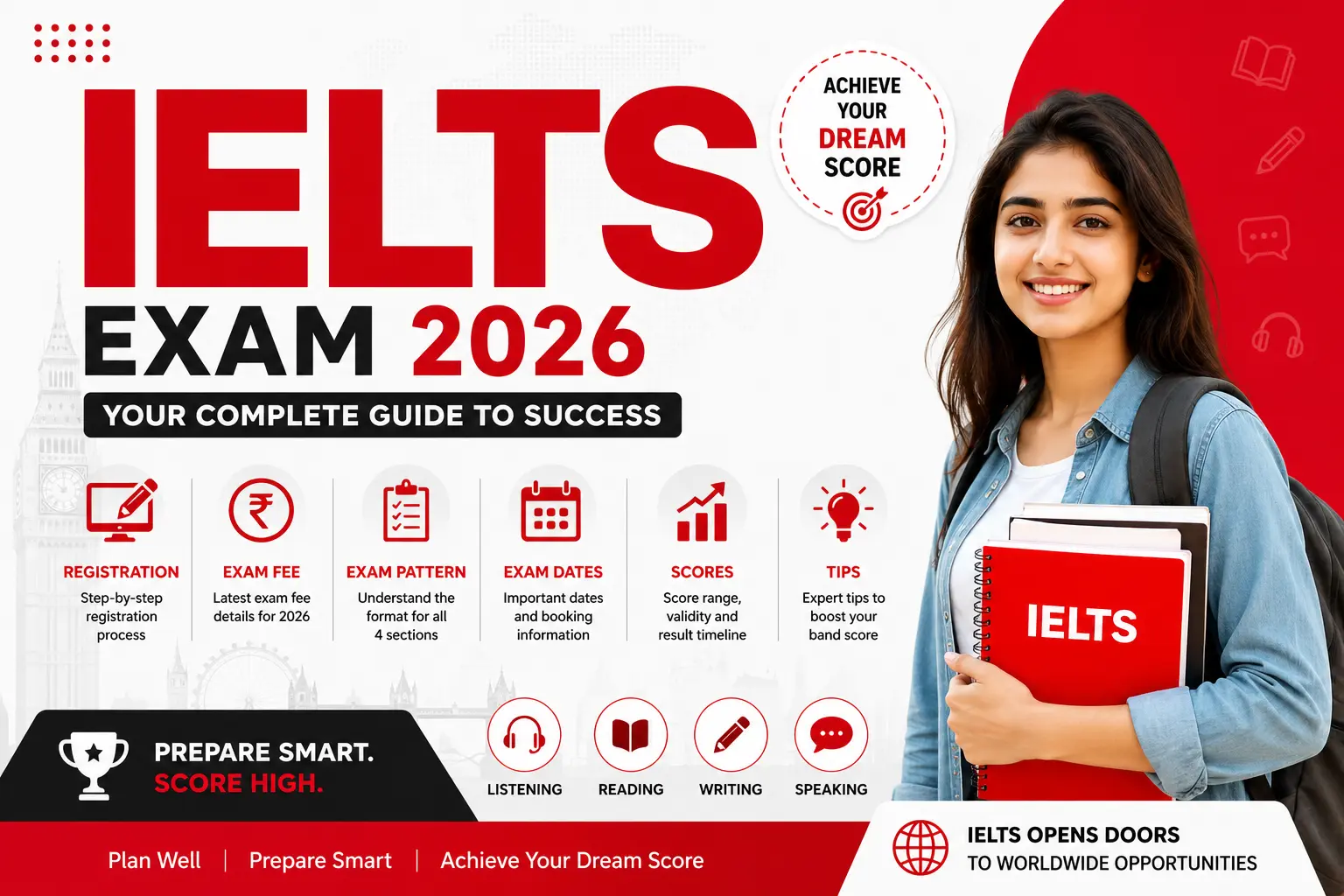
IELTS exam 2026: Registration, Exam Fee, Exam Pattern, Exam Dates, Scores and Tips
An essential first step for anyone looking to study, work, or relocate to an English-speaking nation is taking the IELTS exam. Moreover, being aware of the necessary details on the registration procedure, test dates, costs, syllabus, and helpful preparation advice to support you in your IELTS journey.
In India, the typical cost of the IELTS exam is INR 19,000.00. However, this cost applies to both the Academic and General Training versions of the IELTS exam. Therefore, to finish the test registration process, you must pay the IELTS exam fees 2026 in India if you intend to take the test to study, work, or migrate to English-speaking countries.
However, there is no formal announcement confirming any changes to the IELTS registration fee in India for 2026. Therefore, whether you opt to take the IELTS on paper or on a computer, the exam price for 2026 will stay at INR 19,000. IELTS costs for overseas students will differ depending on the local currency of each country. IELTS costs are the same in all Indian states, cities, and exam centers. From the first registration to the last stages of preparation, you must comprehend every aspect of the IELTS exam fees in 2026 to guarantee a successful and seamless testing experience.
We have included information about IELTS 2026 exam fees, cancellation fees, rescheduling fees, rechecking fees, and all other IELTS exam-related expenses in this post. For more information about the duration, refund policies, and mode of payment, read the entire article.
What about the IELTS Exam 2026?
The International English Language Testing System (IELTS) is a standardized exam used to evaluate applicants' English language skills in preparation for study or employment overseas. Your speaking, writing, listening, and reading abilities are evaluated in the IELTS exam. It is the most well-liked test in the world and a crucial prerequisite for admission to many prestigious universities overseas. Admission to prestigious universities in the United States, United Kingdom, Canada, Australia, New Zealand, and more than 140 other countries requires the IELTS exam.
There are two variants of this IELTS exam: IELTS General Training for work visas and IELTS Academic for study abroad. Both paper and computer versions of the IELTS Academic or General Training test are available. Before booking the test, candidates should review the IELTS exam pattern and syllabus to understand the four sections and prepare accordingly. Additionally, based on where they live, applicants can take the IELTS online sitting from home.
What is the full form of the IELTS Exam India?
The IELTS exam full form is the International English Language Testing System, accepted worldwide for study, work, and migration.
The IELTS test's highlights
This is a brief overview of the IELTS test.
- Academic and general training variants of the test
- The IELTS exam's mode: Both computer-based and paper-based IELTS
- Four sections make up the exam pattern: speaking, writing, listening, and reading.
- 16 is the minimum age restriction.
- There are an unlimited number of attempts.
- The IELTS score range is as follows: From 1 (lowest) to 9 (highest) on a scale.
- The following nations accept IELTS scores: Australia, New Zealand, Canada, Ireland, the United States, and the United Kingdom.
- Dates of the IELTS exam: adaptable. Within a year, you can reserve the exam date of your choice from 48 fixed dates.
IELTS helps secure admission to top universities across these destinations.
- Study in UK: IELTS is accepted by leading institutions like Oxford, Cambridge, and Imperial College London. A strong band score ensures eligibility for scholarships and post‑study work opportunities.
- Study in USA: Universities such as Harvard, MIT, and Stanford require IELTS scores for international admissions. Achieving a high band opens doors to research programs, internships, and career growth.
IELTS Exam Date 2026
Month | Paper‑Based IELTS Dates | Computer‑Delivered IELTS |
January | 10, 24, 31 | Available daily, multiple slots |
February | 7, 14, 21, 28 | Available daily, multiple slots |
March | 7, 14, 21 | Available daily, multiple slots |
April | 4, 11, 25 | Available daily, multiple slots |
May | 2, 7, 16, 23 | Available daily, multiple slots |
June | 6, 13, 20, 27 | Available daily, multiple slots |
July–Dec | Paper‑based discontinued | Computer‑delivered only, daily |
Key Updates for IELTS Exam Date 2026
- Paper‑based IELTS ends globally after June 27, 2026.
- From July 2026 onwards, only computer‑delivered IELTS will be available in India.
- Computer‑delivered IELTS offers faster results (3–5 days) and flexible scheduling.
- After selecting a suitable test date, candidates can follow these IELTS preparation tips to organize their study schedule and practise each section.
How much does it cost for the IELTS exam 2026?
An important aspect of any aspirant's study abroad experience is knowing how much the IELTS exam costs in India. To learn about the IELTS exam fees and other relevant information, many students visit the official website. However, test-takers may become confused by the intricate cost schedule for several exam kinds. For a thorough understanding of IELTS costs in 2026 in India according to test types, see the chart below.
Test Type | Fee (INR) | Notes |
IELTS Academic (Computer/Paper) | ₹19,000 | For higher education & professional registration |
IELTS General Training | ₹19,000 | For work, migration, vocational training |
IELTS for UKVI (Academic/General) | ₹20,000 | Approved for UK visa & immigration |
IELTS Life Skills (A1 & B1) | ₹15,350 | For UK family visas & citizenship |
IELTS Rescheduling | ₹3,500 approx | Must be requested at least 5 weeks before the test |
IELTS Cancellation (Refund) | Partial refund | Refund only if canceled 5+ weeks before test date |
Along with checking the exam fee, candidates should understand the IELTS exam registration process before selecting their test date and completing the booking.
IELTS Exam Fees 2026 by City
In India, the fee of the IELTS exam is the same regardless of the city. The IELTS exam cost in India is shown in the table below, regardless of the city of choice:
City Keyword | Academic / General Training | IELTS for UKVI | IELTS Life Skills (A1/B1) |
IELTS exam fee Jaipur | ₹19,000 | ₹20,000 | ₹15,350 |
IELTS exam fee Delhi | ₹19,000 | ₹20,000 | ₹15,350 |
IELTS exam fee Mumbai | ₹19,000 | ₹20,000 | ₹15,350 |
IELTS exam fee Bengaluru | ₹19,000 | ₹20,000 | ₹15,350 |
IELTS exam fee Hyderabad | ₹19,000 | ₹20,000 | ₹15,350 |
IELTS exam fee Chennai | ₹19,000 | ₹20,000 | ₹15,350 |
IELTS exam fee Kolkata | ₹19,000 | ₹20,000 | ₹15,350 |
IELTS exam fee Ahmedabad | ₹19,000 | ₹20,000 | ₹15,350 |
IELTS exam fee Pune | ₹19,000 | ₹20,000 | ₹15,350 |
IELTS exam fee Lucknow | ₹19,000 | ₹20,000 | ₹15,350 |
IELTS exam fee Chandigarh | ₹19,000 | ₹20,000 | ₹15,350 |
IELTS exam fee Indore | ₹19,000 | ₹20,000 | ₹15,350 |
IELTS exam fee Surat | ₹19,000 | ₹20,000 | ₹15,350 |
IELTS exam fee Nagpur | ₹19,000 | ₹20,000 | ₹15,350 |
IELTS exam fee Patna | ₹19,000 | ₹20,000 | ₹15,350 |
IELTS exam fee Bhopal | ₹19,000 | ₹20,000 | ₹15,350 |
IELTS exam fee Coimbatore | ₹19,000 | ₹20,000 | ₹15,350 |
IELTS exam fee Kochi | ₹19,000 | ₹20,000 | ₹15,350 |
IELTS exam fee Guwahati | ₹19,000 | ₹20,000 | ₹15,350 |
IELTS exam fee Mysuru | ₹19,000 | ₹20,000 | ₹15,350 |
Students planning to pursue higher education overseas can also explore our study abroad guides to compare destinations and understand their study options.
IELTS Exam Fees Payment Mode 2026-
Candidates have a variety of options regarding how to pay and register for the IELTS. Both online and offline registration are available to candidates. Additionally, the method you choose to register for the IELTS determines the payment method for the test fee. IDP India offers the following payment options for IELTS test registration.
- Online payment- When enrolling for the IELTS online, applicants who choose to pay the exam cost online can do so using a credit or debit card, net banking, or both.
- Bank deposit- Those who decide to take the IELTS offline can use bank deposits to cover the exam costs. The bank deposit slip can be downloaded by the candidate on the official IELTS IDP India website. They can also pick up this slip from the IDP India branch office that is closest to them. Applicants must deposit the IELTS exam fee (in cash) at any ICICI or HDFC branch after receiving the slip. When completing their IELTS registration at the IDP branch office, candidates must provide a copy of their slip.
- Demand draft: Candidates may also register for the IELTS and make their payment to IDP EDUCATION INDIA PRIVATE LIMITED, Payable in New Delhi via a demand draft. Applicants must only pay the demand draft from banks that the IDP has authorized. The list of authorized banks is available on the official website of IDP Education India.
Cancellation fees for IELTS-
Some requirements must be met to be eligible for a refund whenever you need to cancel your IELTS session for any reason. However, to cancel the IELTS test, you will have to pay cancellation charges.
- Candidates who cancel their IELTS reservation more than five weeks before the exam date will receive their money back, less a 25% administrative fee.
- There will be no reimbursement for candidates who cancel their IELTS test less than five weeks prior to the test date.
- An applicant will not be refunded if he does not show up for the IELTS exam. This is regarded as a cancellation as well.
After subtracting the local administration fee, those who can provide a medical certificate within five days of the test date will be refunded.
IELTS Rescheduling Fees 2026-
Fees for IELTS Rescheduling:
You must request rescheduling if you wish to alter the date of your IELTS exam. In India, postponing an IELTS exam costs INR 4,250.
- The administrative cost will be subtracted from the fee for those who reschedule their IELTS exam at least five weeks before the scheduled test date.
- Candidates will be paid the entire cost unless they have a valid medical reason if they cancel or reschedule their IELTS exam within five weeks of the test date.
- A refund less the local administration fee is available to applicants who submit a medical certificate within five days of the test date.
- If you are unable to take the IELTS test on the second attempt, you will not be eligible for a refund or a rescheduling opportunity.
Action | Fee (INR) | Conditions |
Rescheduling (Date Change) | ₹3,500 approx | Must be requested at least 5 weeks before the test date |
Cancellation (Refund) | Partial refund | Refund only if canceled 5+ weeks before the test date |
Late Rescheduling | No refund | If requested within 5 weeks of the test date, fee is forfeited |
IELTS Rechecking Fees:
Individuals who are dissatisfied with their IELTS results have the option to retest their scores. To use this service, they must, however, pay the IELTS rechecking charge. In India, rechecking an IELTS score costs INR 12,750. To file a remarking request, test takers must submit the "Enquiry on Results Form" (EOR Form). Examinees might choose to mark one or more sections of the IELTS exam for evaluation. If the test taker's result is altered to a higher band score, he will be given a complete refund. The following are the IELTS Rechecking Fees for EOR applications in India-
- IELTS: 12,750 Indian rupees
- Delivered by computer IELTS: 12,750 Indian rupees
- IELTS for Immigration and UK Visas: 12,750 Indian rupees
- IELTS Life Skills (A1 and B1)- 12,000 Indian rupees
IELTS retake fee:
There is no cap on the number of IELTS retakes you can take, but each time you take the test, you must pay the full fee (₹19,000). The registration and retaking fees for the academic and general training versions are the same.
IELTS Test Fee for Additional TRF:
Test-takers who register for IELTS get five electronic TRFs (Test Report Forms) for free. However, individuals must pay an additional TRF price for the IELTS exam if they choose to submit their results to more foreign universities. Up to five colleges may receive applications from candidates for electronic reporting in a single day. You must log in the next day if you would like to submit your score to more universities. Three methods are available for sending the extra TRF-
- Courier- For each address, candidates must pay an extra Rs 1500. Courier sends IELTS results in approximately four days, and candidates are given a tracking number.
- Airmail- Candidates must pay a cost of Rs 250 for each address when using airmail. Your scores may not be received for up to two weeks, though. When sending extra TRF via airmail, no tracking number is given.
- Electronic- Applicants must pay Rs 250 to each university to which they submit their scores. However, only universities that have chosen to download IELTS scores electronically are eligible to get this.
Scholarships for the IELTS
- One of the biggest obstacles to studying abroad is the expense of tuition. Moreover, numerous highly regarded colleges worldwide provide a variety of scholarships depending on students' IELTS results to support and motivate their quest. They can use this great tool to be ready for the IELTS and ace the exam to win special scholarships. The British Council and IDP Education India have given out the following awards:
- India's Great Scholarship.
- Scholarships from the Charles Wallace India Trust.
- The British Council IELTS award for the Commonwealth Scholarship and Fellowship Program.
Students planning to study abroad can also explore our study abroad counselling services for guidance on university options and application requirements.
What's the eligibility for the IELTS exam?
Age restrictions, educational prerequisites, or prior language study experience are not applicable. The IELTS is available to everyone who wants to show that they can speak English well. Still, it is best if pupils who are older than 16 take the test.
IELTS exam structure/Format:
You have the option of taking the IELTS Academic or General Training exam at an official testing facility on a computer or paper. Furthermore, the availability of online IELTS testing may vary based on your place of residence. IELTS evaluates four primary competencies:
Listening: Your ability to comprehend concepts, identify viewpoints, and track the progression of an argument is evaluated in this part.
Reading: This component evaluates your comprehension of the author's viewpoints and inferences as well as your ability to read for general sense, key ideas, and specifics.
Writing: Your ability to employ a variety of vocabulary and grammar structures, as well as how well and precisely you order your thoughts and compose a response, are all assessed in this area.
Speaking: Your ability to convey ideas and facts about commonplace subjects and experiences, as well as the way you articulate and support your beliefs, are evaluated in this part. Regular practice can help candidates become more familiar with the IELTS exam format and improve their confidence across all four test sections.
Why should you select the IELTS exam?
IELTS emphasizes practical communication skills and provides several significant advantages.
Discover new opportunities: You can study abroad at the universities of your choice because IELTS is recognized by 12,000 organizations in more than 140 countries.
Career opportunities for prospective employers that you can communicate in English by providing safe and precise results.
Work internationally: The Speaking element of the IELTS assesses the English spoken by individuals from various countries, while the Listening section features a variety of accents.
Moving to an English-speaking nation can help you prove to immigration officials that your English proficiency satisfies the requirements.
Select the test that is most appropriate for you- Take the exam from the convenience of your home using paper, a computer, or the internet. IELTS testing dates are accessible all across the world so that it can accommodate most schedules.
Having faith in your accomplishments is an accurate and fair test. Examiners are skilled experts in the English language who concentrate on language proficiency and practical communication abilities.
Who creates and administers the IELTS?
Among the most reputable companies in English education that administer IELTS are:
- The British Council is the international body offering educational opportunities in the United Kingdom.
- IDP IELTS is a well-known educational company with Australian origins.
- Cambridge English is a division of the University of Cambridge dedicated to testing students' English language skills.
Master the IELTS with Real Practice TestsAdaptive, timed, and exam‑style questions to help you score higher.
|
FAQs for IELTS exam 2026
Q.1 What is the cost of the IELTS test in India?
Ans- According to the official exam board, the cost of the IELTS exam in India is ₹19,000. Chennai, Bangalore, Kerala, Mumbai, Delhi, Jaipur, Pune, and other test locations all charge the same price for the IELTS exam in India.
Q.2 Can I pay for the IELTS exam in India with cash or a cheque?
Ans- No, the only ways to pay for the IELTS exam in India are via net banking or a credit or debit card. The IELTS exam fees cannot be paid with cash or checks.
Q.3 Can you take IELTS for free?
Ans- Yes. No, the IELTS cannot be taken for free. No candidate can negotiate the IELTS registration price, which is set at INR 19,000 in advance.
Q.4 Will the cost of the IELTS exam in India in 2026 change?
Ans- The British Council and IDP updated the IELTS registration fee. In India, the 2026 IELTS application fee is INR 19,000.00.
Q.5 Why is the cost of the IELTS exam so high?
Ans- The IELTS exam is expensive since it is a widely used language assessment examination that renowned institutions like Cambridge, IDP, and the British Council administer. Qualified examiners also conduct individual examinations of the answer sheets.
Q.6 How can you apply for an IELTS scholarship?
Ans- If you apply using the form on the British Council website, you can get a scholarship based on your IELTS score. All of your information, including your IELTS score, most recent photo, contact information, etc., will be provided in the application.
Q.7 Is it possible to lower your IELTS cost in India?
Ans- In India, you are unable to lower your IELTS application fee. The cost of the IELTS exam in India is still 17,000 rupees, regardless of the circumstances.
Q.8 Is the cost of the IELTS exam refundable?
Ans- No, there is no refund for the IELTS exam price. However, if you meet the requirements, you might receive a refund if you want to postpone or cancel your IELTS test.
Q.9 How can you apply for a reassessment of my IELTS score?
Ans- Applying for the EOR form with your official login will allow you to have your IELTS exam reviewed once more. The full test or just one or two portions can be reviewed. After the TRF is released, the revaluation form must be turned in within six weeks.
Q.10 Is the cost of the IELTS exam the same in every country?
Ans- The cost of the IELTS test may differ based on the nation you select. The cost of the IELTS exam, for instance, is 265 euros in Europe, 295 USD in America, and $330 AUS in Australia.

Study Abroad Consultants in Mumbai
Nowadays students dream of pursuing further education overseas in the linked world of today. Navigating this road might be daunting due to the abundance of alternatives for workshops, universities, and vacations. So, study abroad consultants in Mumbai can help you by acting as your go-to people to make the process easier and more efficient. These consultants are vital tools for students in Mumbai, the vibrant center of opportunity, to assist them in meeting their aspirations for global education.
Why pick the best study abroad consultants in Mumbai?
Choosing the best program and university, collecting application materials, passing language competence exams, and obtaining visas are just a few of the many procedures involved in studying abroad. Here's why hiring the best study abroad consultants in Mumbai can have a profound impact-
- Expert Advice: Consultants are knowledgeable about the prerequisites and admissions procedures of colleges around the world. They offer customized guidance according to your educational background, desired job path, and financial constraints.
- Streamlined Process: Consultants take care of the details so you may concentrate on your education, from shortlisting universities to creating your Statement of Purpose (SOP) and obtaining a student visa.
- Resource Access: A lot of consultants have partnerships with foreign colleges that give students access to special opportunities, financial aid, and insider knowledge.
- Help with Test Preparation: It might be intimidating to take proficiency exams like the GRE, GMAT, TOEFL, or IELTS. To improve your scores, a lot of experts provide test-prep classes.
Important Services Provided by Consultants for Study Abroad
Study abroad consultants in Mumbai Andherioften provide a wide range of services, such as
- Career counselling: Knowing your objectives to suggest colleges and courses that best suit them.
- Application support: Help with completing applications, creating SOPs, and obtaining letters of recommendation.
- Visa support: Help with paperwork, interview preparation, and visa applications.
- Pre-departure orientation: Assisting students with financial planning, cultural standards, and overseas housing possibilities.
- Scholarship advice: Locating and submitting applications for financial aid and scholarships.
Top Study Abroad Consultants in Mumbai
Mumbai is home to some trustworthy Abroad Education consultants in Mumbai, each with special advantages. Here are a few key points considered by Gateway Abroad Consultants
- Consultants become popular for offering application assistance and counseling. Gateway Abroad has assisted thousands of students in realizing their aspirations to study overseas.
- With a focus on countries like Australia, Canada, the UK, and the US, study abroad consultants offer comprehensive advice, including help with visas and university placements.
- It also helps with school finance, test preparation, and individualized counseling.
- Overseas education consultant offers free counseling sessions, application assistance, and professional advice with the goal of streamlining the study abroad process.
Tips for Selecting the Abroad Education Consultants in Mumbai
To guarantee a seamless voyage, choosing the appropriate expert is essential. The following advice will assist you in making an informed choice of Overseas education consultants in Mumbai.
- Reputation and reviews: Seek out advisors who have received great feedback and endorsements from previous pupils.
- Experience: Pick a consultant who has worked in your desired location or course for many years and has a solid track record.
- Transparency: Verify that the consultant gives precise details regarding their costs, offerings, and schedule.
- System of support: Choose advisors who provide all-encompassing assistance, including post-admission services and test preparation.
- Tailored attention: Steer clear of generic strategies and choose a consultant who will customize their recommendations to meet your unique requirements.
Top USA study abroad consultants in Mumbai.
For many students who want to receive a top-notch education, the USA continues to be their ideal destination. However, navigating the application procedure can be daunting. This is where knowledgeable Mumbai study-abroad advisers come in handy. The following are a few of the USA study abroad consultants in Mumbai that focus on admissions to the USA-
- Study abroad consultant provides individualized counseling for US colleges and are well-known for their emphasis on English-speaking nations. They streamline the process by helping with everything from shortlisting universities to getting ready for the visa interview.
- Gateway Abroad has a solid reputation for assisting students in getting accepted into prestigious US universities. They offer pre-departure orientation, financial planning, and application help.
- It also offers focused consulting to students seeking admission to Ivy League schools or other prominent universities. They place a strong emphasis on interview preparation, essay writing, and profile building.
- Test preparation, scholarships, and visa counseling for US study programs are the areas of expertise for Gateway Abroad which takes a comprehensive approach. Students receive comprehensive support from their skilled counselors.
- To determine the greatest fit, Quora users advise in-person meetings with consultants and an analysis of their success rates. Your ambition of studying abroad in the USA can become a reality with the help of the proper counselor
Germany study abroad consultants in Mumbai
For Indian students looking for a top-notch education, studying abroad in Germany is an exciting prospect, and Mumbai is home to several advisors with expertise in this area. Germany is a well-liked location for higher education because of its excellent educational system, inexpensive or free tuition, and varied cultural experiences. Study abroad advisors in Mumbai provide professional advice to ensure a smooth experience, assisting students with everything from choosing an institution to applying for a visa to making lodging arrangements.
These advisors can help students select the best course and institution for them depending on their academic background, professional objectives, and financial condition because they are knowledgeable about the subtleties of the German educational system. Additionally, they offer helpful guidance on learning German, which is a prerequisite for landing an internship or part-time employment in Germany.
With a track record of successfully assisting students in gaining admission to German colleges, Gateway Abroad is one of the leading study abroad advisors in Mumbai. These advisors make sure that students fulfill all prerequisites and provide a seamless application procedure. Having a reliable adviser at their side can greatly increase a student's chances of being admitted and succeeding academically in Germany.
Finland study abroad consultants in Mumbai
Finland is growing in popularity as a study-abroad destination because of its top-notch educational system. Selecting the proper adviser might make the process easier for Mumbai students who want to study in Finland. The following are key points for Finland study abroad consultants in Mumbai.
- It is popular in Mumbai and provides individualized guidance to students traveling to Finland. They offer advice on how to choose a university, apply, and obtain a visa.
- It provides end-to-end services. The services include help with applications, scholarships, and visa paperwork, and know Finland's educational system.
- Gateway Abroad consultants, who specialize in Nordic nations, provide specialized assistance to students with everything from post-arrival to university applications.
- The consultants a wide range of services and are highly recommended for students who want to study in Finland.
Best study abroad consultants in Mumbai Quora
Studying abroad can be both exciting and difficult, so it is important to have the right advice. As a center for prospective students, Mumbai is home to many studies abroad advisors. Insights shared on Quora highlight some of the best consultants who have consistently helped students achieve their dreams.
- It is highly regarded for its all-inclusive service, helping students with financial advice, university choices, applications, and visa procedures. The USA, UK, Canada, and Australia are just a few of the many places they serve.
- With a significant presence in Mumbai, Gateway Abroad is famous worldwide. With a significant presence in Mumbai, these consultants are famous worldwide.
- Study abroad consultants provide comprehensive services, such as post-admission support, scholarship aid, and career counseling. Students frequently enjoy their customized approach.
To ensure the consultant fits your needs, Quora users advise doing extensive research, reading reviews, and speaking with the consultant in person before choosing one. Selecting the proper companion can make the path to your ideal university easier.
Gateway study abroad consultants in Mumbai
Numerous reputable studies abroad advisors who assist students in fulfilling their aspirations for an international education can be found in Mumbai. Based on student feedback, services, and competence, the following is a list of the Top 10 study-abroad consultants in Mumbai.
- One reputable company providing end-to-end services for several nations. It includes the USA, UK, Canada, and Australia.
- Study abroad consultants for its extensive network of universities and proficiency with visa and scholarship procedures.
- It offers comprehensive profile assessment and advice for world-class colleges.
- Study abroad consultant offers admissions counseling and exam preparation services.
- Gateway Abroad offers a wide range of services, such as financial and application support.
- Test preparation, visa counseling, and documentation for international education are the areas of expertise for study abroad consultants.
- This platform focuses on AI-powered university shortlisting and individualized counseling
- Gateway Abroad is reputable due to its open and honest services and solid university relationships.
- Study abroad consultant provides customized guidance for students traveling to the United States, United Kingdom, and Australia.
It is crucial to look at a consultant's experience, success rate, and client testimonials before hiring them. A smooth path to Finland's best colleges can be guaranteed with the correct advice. Starting a study abroad program can be both thrilling and difficult. With the correct direction from Mumbai study abroad advisors, students may confidently handle the challenges. These experts offer the assistance you need to realize your goals. Even, they involve picking the ideal course, taking tests, or adjusting to a new culture. So, if you are preparing to take the leap toward a worldwide educational experience, start by exploring and engaging with a reliable study abroad adviser in Mumbai.
Top countries to study Abroad without IELTS
It is a frequently asked question by students thinking about pursuing further education overseas, or even, "Which country does not require IELTS for students to study in? For non-native English speakers, these exams, which evaluate a student's proficiency in reading, writing, and speaking the language, can be challenging. Although IELTS and TOEFL scores are essential admission requirements, specific colleges around the world admit students without them. Gateway Abroad Education is a study abroad consultant that will assist you in finding universities that offer study without language exams. Students comparing destinations can also explore our guide to study in USA to review general information about studying at American universities and planning their applications.
Moreover, you can pursue your ambition of studying abroad without having to worry about passing a language competency exam by using this blog of eight countries to study in without the IELTS or TOEFL in 2026.
Which are the nations and universities that offer study abroad without IELTS?
The IELTS criterion has been removed because several nations have acknowledged the high level of English proficiency that many Indian students possess. However, thanks to this modification, students can now study abroad more efficiently and successfully without taking the IELTS, even though it is a carefully curated list of nations in 2026 where you can pursue your studies abroad without any English proficiency.
Moreover, there are no official conditions of eligibility for the test. Anyone of any age, nationality, profession, or educational background can register for it.
USA
The United States is the most popular destination for studying abroad. Although admission often requires fluency in English, there are certain exceptions. For example, people who are native English speakers or who have attended a US university full-time for at least a year are exempt from taking the IELTS exam.
Applicants who have taken English-language secondary or graduate courses are also not eligible. But if you are committed, have the proper assistance, and prepare well for the IELTS exam, you can fulfil your aspirations of studying abroad and embarking on a life-altering educational journey.
List of Universities:

UK
The top universities in the UK are listed in the QS World University Rankings. Students from other countries who meet other qualifying criteria can study in the UK without taking the IELTS. However, this involves taking a pre-sessional language program or finishing an undergraduate degree conducted in English.
Moreover, without taking the IELTS, admittance requires a high school GPA of 70% or higher. To get admission to these colleges, learners might also have to participate in online interviews.
Students who are also comparing other English-speaking destinations can review our guide to study in the UK before deciding which country and university best match their academic goals.
List of Universities

Canada
One of the most incredible places to study without taking the IELTS is Canada. A large number of non-native English speakers decide to pursue higher education at Canadian universities. Other ways that students can demonstrate their English competence include CAEL, CanTest, CAE, ELP, and AEPUCE. Students planning to study in Canada should check the English-language requirements of each university and programme, as accepted alternatives and exemption rules can differ between institutions. Additionally, as English is their first language, people who have spent the last four years living in English-speaking nations are exempt from taking the IELTS exam. This language competency test is not required for admission to many of the nation's institutions and colleges.
List of Universities
Brock University
McGill University
Carleton University
Cambrian College
Concordia University
Okanagan College
University of Winnipeg
University of Regina
Memorial University
The University of Saskatchewan
Germany
Germany's top-notch universities and wide range of courses make it a popular choice for overseas students. Numerous universities provide courses that don't require the TOEFL or IELTS. It may be possible to study in Germany without IELTS at some universities, depending on the programme, the language of instruction and the institution's accepted proof of English proficiency. An IELTS score is sufficient for a seamless admissions process, however, as students do not require any English language certification.
In some instances, a letter from a previous school might prove English ability, allowing pupils to study in Germany without taking the IELTS. Because of this flexibility, students from a wide range of linguistic backgrounds come to Germany's esteemed universities to obtain bachelor's, doctoral, and diploma degrees.
List of universities:
University of Siegen
Free University of Berlin
University of Kaiserslautern
University of Giessen
University of Koblenz and Landau
Braunschweig University of Technology (TU Braunschweig)
Esslingen University of Applied Sciences (Hochschule Esslingen)
Australia
Students planning to study in Australia should check the English-language requirements of their chosen university, as some institutions may accept alternative evidence of proficiency instead of IELTS. However, other criteria are used by these universities to determine admissions. Moreover, one of them is that foreign applicants ought to have earned a degree from an institution where English was the primary language of education. Some universities accept alternative English-language tests, such as PTE Academic, depending on their admission policies. Students considering this option can explore PTE preparation and confirm which tests their chosen university accepts.
List of universities:
University of Queensland
University of Adelaide
Macquarie University
University of Southern Queensland
Swinburne University of Technology
Bond University
University of New South Wales
Ireland
Students planning to study in Ireland should check each university's English-language requirements, as some institutions may accept alternative tests or other evidence of English proficiency instead of IELTS. This country has universities and other institutions where the IELTS test score is not required for entrance, just as the other IELTS-no-studying nations stated above. Instead, they provide alternative language competency assessments to assess students’ writing, reading, and communication skills in English.
List of Universities
National University of Ireland
Royal College of Surgeons in Ireland
Maynooth University
University of Limerick
Many students find passing the qualifying IELTS exam a significant barrier to studying abroad. Fortunately, though, not every university in the world follows these standards. Other choices, such as alternate language proficiency examinations, are permitted. In addition to the nations listed above that do not require the IELTS, students can pursue their desired degrees in Singapore, Japan, Romania, Malaysia, China, and other places. Students considering destinations where English is not the main language of everyday life can also read our guide to studying abroad in non-English-speaking countries to understand some of the factors involved in choosing a suitable destination and programme.
FAQs-
Q.1: Which tests are substitutes for the IELTS?
Ans: Depending on the university and programme, students may be able to use alternative English-language tests instead of IELTS. These may include TOEFL preparation, PTE preparation and Duolingo English Test (DET) preparation. Students should confirm which tests their chosen institution accepts before applying.
Q.2: Is an IELTS score required to obtain a visa?
Ans: An IELTS score is not a universal requirement for every student visa. Requirements depend on the destination country, visa category and individual circumstances. Students should check the official immigration rules and the university's admission requirements. For further guidance, read our student visa application guide before preparing the necessary documents.

Common IELTS Writing Task 2 topics
Writing Task 2 of the International English Language Testing System (IELTS) exam is becoming increasingly popular to evaluate a candidate's capacity for concept expression, argumentation, and effective written communication. Moreover, you are presenting with a wide range of topics, themes, and prompts as you begin your IELTS journey. To be successful in IELTS task 2 topics 2026, you can get assistance from Gateway Abroad Jaipur. Even in these study abroad consultants, IELTS Task 2 topics courses are available for study abroad applicants. All of these tests test your ability to communicate in English and think critically. Let's examine the typical subjects that appear frequently in your essays for the IELTS Writing test.
Which are the Common IELTS Writing Task 2 topics?
Even though you can never predict what your Task 2 writing question on the IELTS exam will be about. However, there are frequently some subjects that show up time and time again when you practice examples of questions. A compilation of typical writing Task 2 subjects, along with some tips for getting acquainted with them, may be found here. Here, we will explore IELTS writing task 2 topics problems, and solutions that will help applicants understand IELTS question writing task 2.
IELTS task 2 topics agree and disagree-
You must explicitly declare whether you disagree or agree with this assertion to answer the agree or disagree option. However, this question requires you to express very distinct views, as opposed to one that asks how much you agree or disagree. Once you have made up your mind, come up with two or three arguments in favor of it.
Sample question-
- Taxes that fund public educational institutions should not have to be paid by parents whose children attend private schools. How much do you think this statement is true or false?
IELTS task 2 topics on education-
A prominent theme in IELTS Writing Task 2 is education, a topic that most IELTS students can connect to. Aspects ranging from learning environments to curriculum. Moreover, organization can be covered by the breadth of issues in this topic.
Sample question-
- Many believe that by 2050, the traditional classroom setting of professors and students will be superseded. Do you share this opinion? Share your thoughts
IELTS task 2 topics on crime-
- Crime and education: Is punishment the primary factor preventing criminal activity, or is education the most effective means of lowering crime rates?
- Crime punishment: If each sort of crime should have a set sentence or if the specifics of the offense should determine the punishment.
- Crime and technology: If technological advancements increase the likelihood of crime or make it simpler to detect.
- Crime and the media: Whether exposure to violent media causes violent behavior.
- Curfews: Are they a successful strategy for lowering crime?
- Crime and parents: Whether parents ought to face consequences for their children's offenses.
- Crime and teenagers: Should juvenile offenders receive the same penalties as adults?
Sample question-
- When juveniles commit crimes, the police should treat them the same as adults. How much do you agree or disagree with this?
- Because of technological advancements, the crime rate is declining in comparison to earlier times. How much do you agree or disagree with this?
Health Topic
IELTS Writing Task 2 frequently addresses the issue of health, which reflects the evolving complexity of the medical system and a rising interest in health and well-being in a variety of countries. The variety of viewpoints and methods about personal health and well-being highlights this significance.
Sample question-
- Doctors recommend regular exercise for elderly adults. But a lot of them don't exercise enough.
For what reasons?
How can we get them to work out more?
- Some governments are struggling to balance their medical budgets as a result of rising healthcare expenditures. Should everyone be eligible for free healthcare from the government, or should citizens be in charge of their health and purchase private health insurance? Talk about your thoughts on this matter.
IELTS task 2 topics speaking-
You will get a signal from the examiner when to begin speaking. For as long as you can, keep talking. However, the majority of the themes are personal narratives or events from your life. However, typical subjects include an item, a person, a location, an occasion, an event, or an action.
Sample question-
Describe a house or apartment you would like to live in.
You should say:
- where it is / Where it would be
- what you would (like to) do there
- who you would (like to) live in addition to that
And explain why you would like to live in this place.
IELTS writing task 2 topic on Government spending-
Every resident of a country is impacted by government funding; thus, there are a lot of passionate discussions and strong viewpoints. Government spending is a common topic in Writing Task 2 questions, which covers a wide range of test subjects.
Sample question-
- Budgets for the arts should be cut by governments to increase funding for education. Do you share this opinion?
- Public transit, including buses, trains, and subways, should be improved, according to some, while others think governments should invest more in repairing roads and highways. Talk about all sides and share your thoughts.
Topics task 2 IELTS writing Environment concerns-
The negative consequences of human activity on the environment are known as environmental concerns. Environmental challenges impact everyone on the planet, so they frequently appear as subjects in Writing Task 2. Some examples are pollution, population growth, waste management, climate change, global warming, and the greenhouse effect.
Sample question-
- Some claim that the extinction of certain plant and animal species is the primary environmental issue of our day. There are more significant environmental issues, according to some.
Talk about these two points of view and share your own.
- Although some people think that the most urgent environmental issue facing our planet right now is global warming, others believe that deforestation has a more catastrophic effect. Talk about all perspectives and share your thoughts.
Topic on Sociology-
The IELTS exam's writing portion frequently covers sociology. Inquiries often center on how people act in various contexts. In many problems, the study of people and how they behave in different contexts usually takes the front stage. Examples of sociology-related subjects included in IELTS writing assignment 2 include the following:
Sample question-
- A lot of parents pressure their kids to be successful. How much do you agree with this?
- Laws and regulations form the foundation of most communities. Society could not operate if people were allowed to behave as they pleased. How much do you agree or disagree with this?
Moreover, Art, business and money, family, communication and personality, politics, and more are some of the typical and difficult topics for IELTS Writing Task 2.
FAQs on writing task 2
Que-1 Which IELTS writing subjects are the most prevalent and challenging, and how can students get ready to do well on them?
Ans- Education, technology, the environment, society, health, and politics are some of the most frequently asked difficult IELTS writing subjects. To succeed in these areas, students need to become knowledgeable about the subjects, write essays on them, and examine the ideas and structure of other writings. They should also learn efficient organizing and brainstorming strategies to maintain their attention and concentrate throughout the test.
Que-2: Which IELTS task is the most challenging?
Ans- The reading portion of the IELTS might be challenging due to the substantial amount of reading that needs to be done in the allocated time. Candidates with strong reading skills will find this section easier.
Que-3 Which IELTS module is the most challenging?
Ans- According to IELTS module surveys, the writing portion of the test is thought to be the most difficult.
Que-4 What format should students use for their IELTS essays to express their thoughts and opinions clearly?
Ans- Students' IELTS essays should be organized with an introduction outlining the subject and stating their stance, followed by body paragraphs that provide examples and evidence to back up their stance. The essay should end with a summary of the key ideas and a restatement of the thesis. To keep the reader interested and guarantee a well-structured essay, utilize clear and succinct language, a variety of sentence forms, and appropriate transition words.