
Study Abroad Blogs
Abroad Insights: News and Tips for Students

Practice Spoken English with Friends
English is one of the most widely spoken languages in the world, and improving your spoken English can open doors to countless opportunities. Practicing with friends is one of the most effective and enjoyable ways to enhance your skills. In this blog, we’ll explore creative, fun, and simple daily exercises you can do with your friends to boost your spoken English skills.
What are the advantages of speaking with friends to practice English?
Practicing spoken English with friends offers numerous advantages that make learning both effective and enjoyable. Here’s why:
- Comfortable environment- Friends provide a judgment-free space where you can practice without fear of making mistakes. The informal setting helps reduce anxiety and builds confidence.
- Mutual motivation- Friends can encourage and hold each other accountable for regular practice. Shared goals and friendly competition make learning more engaging.
- Constructive feedback can point out mistakes in pronunciation, grammar, or vocabulary in a supportive manner. Collaborative problem-solving helps everyone improve together.
- Fun and interactive learning- Practicing with friends is enjoyable, thanks to games, role-playing, and casual conversations. Activities like storytelling, debates, or describing pictures keep the process exciting.
- Consistency- Regular meetups or daily conversations ensure consistent practice, which is essential for improvement. Speaking frequently builds fluency and reduces hesitation over time.
- Real-life scenarios- Friends can simulate everyday situations like ordering food, booking tickets, or casual chatting. This prepares you for real-world conversations in English.
- Cost-free learning classes or tutoring, practicing with friends is free and accessible.
- Shared progress- Celebrating milestones and achievements together keeps everyone motivated. The collective journey fosters a sense of accomplishment and teamwork.
How can you practice speaking English with Friends through games and discussing general topics?
1. Have a daily conversation only in English-
Every day, set aside 15 to 30 minutes to speak with your friend exclusively in English. Commit to speaking exclusively English throughout this period.
- Pick subjects that you both enjoy, such as travel, movies, or pastimes.
- Start with basic sentences and work your way up to more complex grammar and vocabulary.
- If you run into trouble, express your ideas using gestures or synonyms rather than your mother tongue.
2. Role-playing exercises-
It is an effective technique to rehearse talks in real life. Choose situations where you might utilize English, such as placing an order at a restaurant.
- Making a hotel reservation.
- Going to an interview for a job.
- In an unfamiliar city, asking for directions.
How to do it?
- To do this, have one person pretend to be the one conducting the interview or client while another person pretends to be the employer, server, or secretary.
- Change roles to experience various viewpoints.
- To improve your fluency and pronunciation, record your sessions.
3. Play word games-
They keep you interested and make studying enjoyable. To increase your understanding of words and proficiency, try these games-
Twenty inquiries
· To figure out what a thing, person, or location is, a single individual thinks of it, and the other person asks up to 20 yes/no questions.
Association of Words
· Say words associated with the previous one in turn. As an illustration, "Sun" → "Light" → "Warmth" → "Beach."
Taboo
· Don't use any particular "taboo" words while describing a word. If the word is "Apple," for instance, stay away from terms like "fruit" or "red."
4. Watch and talk about English-language media-
English-language films, TV series, and YouTube videos are excellent resources for learning pronunciation, phrases, and genuine expressions. Talk about what you saw to make it interactive.
Practice tips-
- Watch together and take a moment to go over important details.
- Act out scenes or recreate conversations.
- Write your summary of the story.
- Discuss your favorite statements or quotations from the text.
5. Practice telling stories-
Storytelling enhances coherence, vocabulary, and fluency. Take turns telling English-language stories.
Story ideas-
- First-hand accounts, such as "The funniest thing that happened to me last week."
- Retelling a story from a book or movie.
- Working together to construct imaginary stories, one sentence at a time.
6. Utilize flashcards to expand your vocabulary
Use flashcards to increase your vocabulary. On one side, write a new term, and on the other, its definition, pronunciation, or application.
How to work out together?
- Test one another by giving a definition or utilizing the term in a phrase.
- For targeted practice, group words into topics such as emotions, cuisine, or travel.
- By timing who can correctly determine the majority of phrases, you can make the exercise a game.
7. Discussion-friendly subjects-
Debating is a great opportunity to hone your speaking abilities and practice quick thinking. Select straightforward, humorous subjects like-
- "Which is a better pet, cats or dogs?"
- "Is summer preferable to winter?"
- "Should uniforms be required in schools?"
How to lead a discussion?
- Assign responsibilities to arguments that are "For" and "Against."
- After each share their point of view, there is a response.
- Pay attention to politely and clearly voicing your opinions.
8. Construct and resolve puzzles in English-
Create word searches, riddles, or crossword puzzles for one another. Learning new terms and their definitions can be enjoyable in this way.
For instance-
- Make a crossword puzzle using definitions, synonyms, or antonyms as clues.
9. Document and examine discussions-
One of the most effective tools for improving yourself is to record your interactions. It enables you to
- Determine where your grammar and pronunciation need work.
- Monitor your development over time.
- Gain confidence by recognizing your progress.
How to complete it?
- Make use of any recording equipment, such as a smartphone.
- Decide on a subject, record your discussion, and listen to it as a group.
- Give another person honest critiques.
10. Practice tongue twisters-
These are a great way to get better at diction and pronunciation. Here are a few examples-
instances such as-
- "She sells seashells by the seashore."
- "Peter Piper picked a peck of pickled peppers.
How should you practice?
- Alternately, say the tongue twister slowly at first, then more quickly.
- Attempt to say it correctly three times in a row by challenging one another.
11. Combine smartphone apps-
A variety of language-learning applications are available to make English practice enjoyable and engaging.
How can buddies utilize applications together?
- To keep yourself motivated, compete in-app challenges.
- Explain new words or grammatical concepts you have acquired.
- Engage in group speaking activities.
12. Work together to establish a vocabulary journal-
Keep a collective journal in which you record new terms, expressions, and phrases.
How to apply it?
- Every day, write a word and use it to form a phrase.
- To encourage learning, go over the notebook once a week.
- Make it a contest: Who can converse using the most journal words?
13. Practice explaining images-
Choose arbitrary images from books, periodicals, or the internet to describe. Each person takes turns using English to describe the setting, the individuals involved, and the activities.
The reason it works-
- Develops descriptive vocabulary and observational abilities.
- Promotes original thought and well-constructed sentences.
14. Speak English on social media-
Talk with your friends about the postings made by English-language accounts you follow on social media.
Concepts-
- Leave an English-language comment on posts and express your opinions.
- Talk about popular subjects or memes in English.
- Produce and distribute English-language material, such as brief films or captions.
15. Consider your errors together-
Making mistakes is a normal aspect of learning. As a group, discuss and gain knowledge from them.
How to handle errors?
- Jot down any mistakes you see in interactions.
- Examine the cause of the error and potential solutions.
- To keep each other inspired, acknowledge each other's accomplishments.
Conclusion
Spoken English practice with friends may be fun and productive if done creatively and consistently. You will strengthen your relationship with your friends as well as your ability to communicate by implementing these enjoyable and easy everyday activities.
FAQs
Q1. How can I start practicing spoken English with my friends?
Ans- Begin by setting a regular time to practice and agree to speak only in English during that session. Start with simple topics and gradually increase the complexity as you grow more confident.
Q2. What are some fun ways to improve English pronunciation with friends?
Ans-You can practice tongue twisters, do shadowing exercises by mimicking native speakers, or sing English songs together during a karaoke session.
Q3. How do I avoid feeling shy or nervous when speaking English?
Ans- Create a judgment-free zone with your friends. Remember, everyone is learning, and making mistakes is part of the process. Start with casual conversations to build confidence.
Q4. What games can we play to make English practice more enjoyable?
Ans-Try games like 20 Questions, Word Association, Taboo, or even creating riddles and puzzles for each other. These activities make learning interactive and fun.
Q5. Can watching movies or TV shows in English help?
Ans- Absolutely! Watching English media improves your listening skills, vocabulary, and understanding of natural expressions. Discussing what you watch with friends enhances the learning experience.
Modal Verbs: Definations, Type, Uses, and Examples of modal verbs
Modal verbs are auxiliary verbs that convey possibility, intent, ability, or necessity in phrases. They are used in conjunction with the main verb to convey capability, capacity, and possibility. In this blog, we will learn about modal verbs and how to utilize them in sentences.
What are Modals?
Modals (or modal verbs) are auxiliary verbs that express necessity, possibility, ability, permission, or obligation. They help modify the main verb in a sentence, but do not change the form based on the subject.
Common Modal Verbs
- Can, Could
- May, Might
- Shall, Should
- Will, Would
- Must
- Ought to
- Need, Dare
Table of Modals-
|
Modal |
Use |
Example |
|
Can |
Ability, permission, possibility |
She can swim well. |
|
Could |
Past ability, polite request, possibility |
Could you help me? |
|
May |
Permission, possibility |
You may leave now. |
|
Might |
Weak possibility |
It might snow tonight. |
|
Must |
Strong obligation, logical certainty |
You must wear a uniform. |
|
Shall |
Formal promise, suggestion, future action |
We shall meet soon. |
|
Should |
Advice, mild obligation |
You should drink more water. |
|
Will |
Future certainty, willingness |
I will help you. |
|
Would |
Past habit, polite request |
When I was a kid, I would play outside. |
|
Ought to |
Moral obligation, duty |
We ought to respect teachers. |
|
Need to |
Necessity |
You need to submit the form. |
|
Dare |
Challenge, courage |
How dare you speak like that! |
What are the types of Modals and their uses?
Modals of Ability-
Used to express ability or capability.
- Can – Present or future ability.
- Could – Past ability or polite request.
Examples:
- She can speak five languages. (Present ability)
- When I was younger, I could run fast. (Past ability)
- Could you help me with my homework? (Polite request)
Modals of Permission and Request-
Used to express asking for or giving permission.
- Can, Could, May, Might
Examples:
- Can I use your pen? (Informal permission)
- May I leave early today? (Formal permission)
- Might I ask a question? (Very polite request)
Modals of Necessity and Obligation-
Used to show necessity, duty, or strong recommendation.
- Must, Have to, Ought to, Should
Examples:
- You must wear a seatbelt while driving. (Strong obligation)
- We ought to respect our elders. (Moral duty)
- You should exercise regularly. (Advice)
Modals of Possibility and Probability-
Used to express possibility, certainty, or speculation.
- May, Might, Could, Must, Can’t
Examples:
- She may be at home now. (Possibility)
- It might rain tomorrow. (Weak possibility)
- He must be tired after the long journey. (Strong certainty)
- This can't be true! (Strong negative certainty)
Modals of Prohibition-
Used to express prohibition (not allowed to do something).
- Can’t, Mustn’t, May not
Examples:
- You must not smoke in the hospital. (Strong prohibition)
- Students may not leave the classroom before the bell rings.
Modals of Advice and Suggestion-
Used to give advice or make suggestions.
- Should, Ought to, Had better.
Examples:
- You should apologize for your mistake.
- We ought to leave early to avoid traffic.
- You had better study for the exam.
Modals of Deduction (Logical Conclusion)-
Used to make a logical assumption based on evidence.
- Must, Can’t, Could
Examples:
- He must be the new manager; everyone is greeting him.
- This can’t be real gold; it looks too cheap.
Modals of Future Intention and Prediction-
Used to indicate future certainty, plans, or expectations.
- Shall, Will, Would
Examples:
- I will call you tomorrow. (Future action)
- She shall be rewarded for her efforts. (Formal promise)
- He would always help me with my work. (Past habit)
Why is it Important to learn Modal Verbs?
Modal verbs provide your communication with more nuance and accuracy; therefore, learning them is crucial. They enable you to convey attitudes, levels of civility, and degrees of certainty in addition to acts. You can handle a variety of social and professional situations more skillfully if you are aware of modal verbs.
- Improving communication skills: Modal verbs allow you to convey possibilities in a nuanced way, ask for assistance, offer advice, and make requests. "Can you help me?" is a more direct question than "Could you help me?" which is a gentler and more courteous one.
- Managing social interactions: Making appropriate use of modal verbs enables you to engage with people in ways that are acceptable in society. In formal contexts, for instance, asking "may" to provide permission ("May I come in?") demonstrates deference and civility.
- Clarifying intentions: Modal verbs can be used to indicate a future action ("I will call you"), to emphasize need ("You must stop smoking"), or to offer advice ("You should try this").
Conclusion-
A key element of English grammar, modal verbs offer vital instruments for conveying a variety of meanings. You can communicate more effectively and express yourself more precisely if you know what modal verbs are and how to utilize them. Gaining proficiency with modal verbs will improve your capacity to communicate in English, whether you're requesting something, conveying a responsibility, or requesting authorization.
FAQs on Modals: Types, Uses, Examples
Q.1 What are modal verbs?
Ans- Modal verbs are auxiliary verbs that express ability, possibility, necessity, permission, or obligation (e.g., can, may, must).
Q.2 How many types of models are there?
Ans- There are eight main types: ability, permission, obligation, prohibition, possibility, necessity, deduction, and advice.
Q.3 What are examples of modals of ability?
Ans-
- Can – "She can swim well."
- Could – "He could play the piano as a child."
Q.4 How do modals express permission?
Ans-
- Can (informal) – "You can go now."
- May (formal) – "May I leave early?"
Q.5 What are the modals of necessity and obligation?
Ans-
- Must – "You must wear a seatbelt."
- Should – "You should eat healthy food."
Q.6 How do modals indicate possibility?
Ans-
- May – "She may be at home."
- Might – "It might rain later."
Q.7 What is the difference between ‘must’ and ‘should’?
Ans-
- Must show strong necessity: "You must submit the form."
- Should give advice: "You should sleep early."
Q.8 How do modals show prohibition?
Ans-
- Must not (mustn’t) – "You must not park here."
- Cannot (can’t) – "You can’t use your phone in class."
Q.9 Can modals be used in the past tense?
Ans-Yes, some models have past forms:
- Can → Could ("She could read at age 5.")
- May → Might ("He might have left early.")
Q.10 What are some common mistakes with modals?
Ans- Incorrect- He must went.
Correct- He must go.
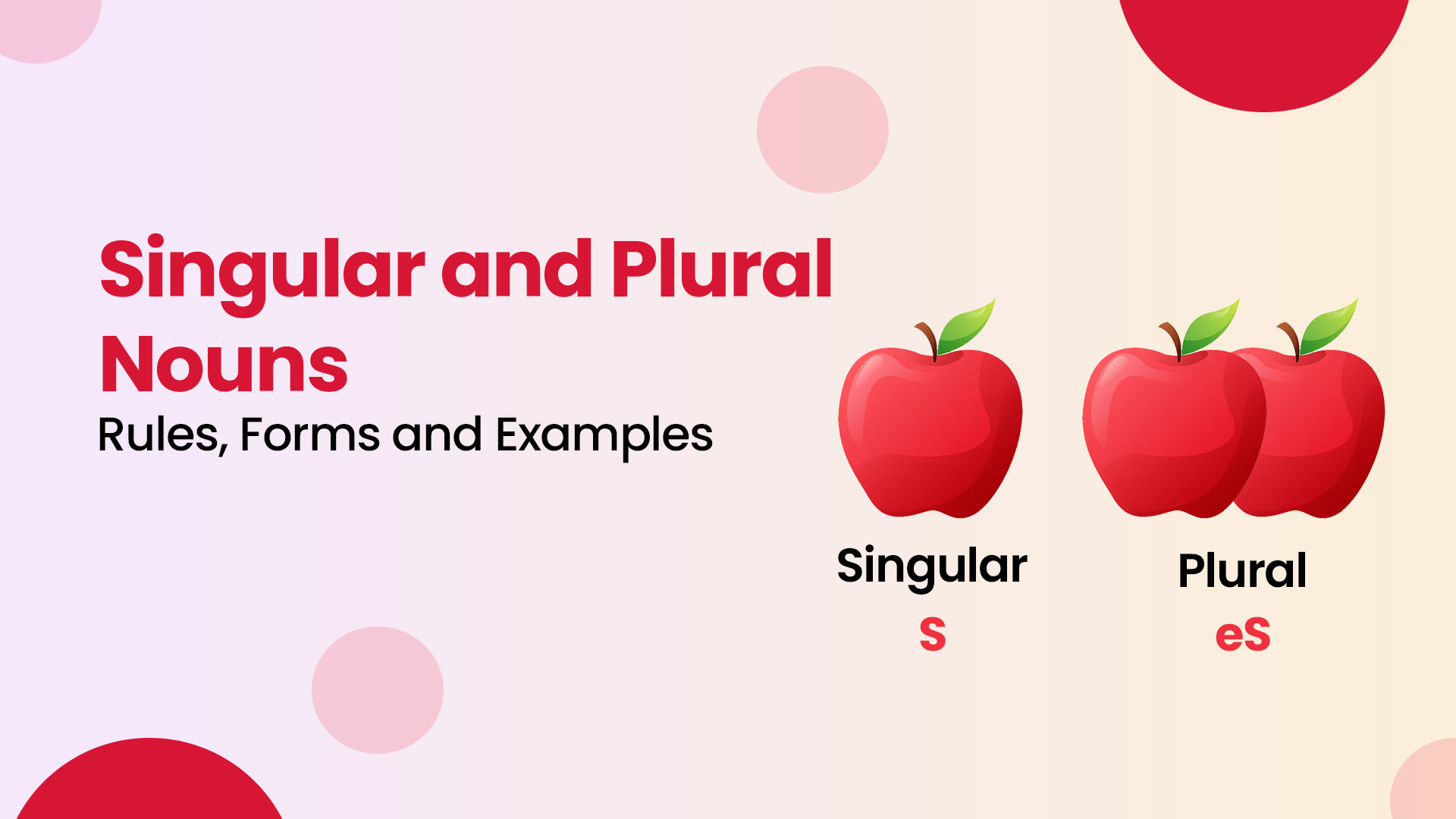
Singular and Plural Words- Rules, Forms and Examples
Understanding the difference between singular and plural nouns is one of the most fundamental aspects of mastering English grammar. Whether you are writing essays, speaking fluently, or preparing for competitive exams, a firm grasp of this concept will improve your overall communication skills.
What are Singular and Plural Nouns?
Singular nouns-
A singular noun refers to one person, place, thing, or idea. It represents a single unit or item. Understanding singular and plural nouns is essential in mastering English grammar. These terms relate to the number a noun refers to, whether it's one item or more than one.
- Examples:
§ A boy is playing.
§ She has a book.
§ That is a table.
§ He found an apple.
§ The sun is bright.
Plural nouns-
A plural noun refers to more than one person, place, thing, animal, or idea. Most plural nouns in English are formed by adding -s or -es to the singular form.
- Examples-
§ The boys are playing.
§ She has many books.
§ These are tables.
§ He found two apples.
§ The stars are shining.
What are the key differences between singular and plural nouns?
Understanding the difference between singular and plural nouns is crucial for correct grammar, especially in subject-verb agreement and sentence structure. Below is a clear breakdown of the main differences-
Definition-
- Singular Nouns- Refer to one person, place, animal, thing, or idea.
- Plural Nouns- Refer to more than one person, place, animal, thing, or idea.
Quantity-
- Singular: Indicates a single unit.
- Plural: Indicates two or more units.
Word Formation-
- Singular: Basic or root form of the word (e.g., book, apple, car).
- Plural: Usually formed by:
- Adding -s (e.g., books)
- Adding -es (e.g., boxes)
- Changing spelling in irregular forms (e.g., man → men, child → children)
Article Usage-
- Singular Nouns:
- Often used with “a” or “an” (e.g., a dog, an egg).
- Plural Nouns:
- Do not use “a” or “an” (e.g., dogs, eggs).
- You can use words like some, many, few, and several.
Verb Agreement-
- Singular Nouns:
- Take a singular verb form (e.g., The cat is sleeping.)
- Plural Nouns:
- Take a plural verb form (e.g., The cats are sleeping.)
Example Words-
- Singular Examples:
- pen, tree, girl, foot, mouse
- Plural Examples:
- pens, trees, girls, feet, mice
Use in Sentences-
- Singular Sentence: A boy is running in the park.
- Plural Sentence: Boys are running in the park.
Pronoun Compatibility-
- Singular Nouns:
- Match with he, she, it, this, that
- Plural Nouns:
- Match with they, these, those
Context and Usage-
- Singular- Used when focusing on individuality or a single entity.
- Plural- Used to indicate groups, collections, or multiple entities.
Compare with singular and plural nouns examples-
|
Aspect |
Singular Nouns |
Plural Nouns |
|
Definition |
Refers to one person, place, thing, or idea |
Refers to more than one person, place, thing, or idea |
|
Quantity |
One (1) |
More than one (2 or more) |
|
Form |
Basic/root form (often unchanged) |
Usually formed by adding -s, -es, or using irregular forms |
|
Examples |
Dog, car, house, child |
Dogs, cars, houses, children |
|
Article Usage |
Can use “a” or “an” |
Do not use “a” or “an” |
|
Verb Agreement |
Takes a singular verb |
Takes a plural verb |
|
Sentence Example |
The boy runs fast. |
The boys run fast. |
|
Usage Context |
When talking about a single unit |
When referring to multiple items |
|
Singular Sentence |
Plural Sentence |
|
A cat is on the sofa. |
Three cats are on the sofa. |
|
She bought an apple. |
She bought some apples. |
|
The child is playing. |
The children are playing. |
|
There is a book on the table. |
There are books on the table. |
Why is it important to know the differences between singular and plural nouns?
Understanding singular and plural forms is essential for
- Maintains grammatical accuracy- It helps form grammatically correct sentences. It even ensures the proper usage of noun-verb combinations.
- Supports subject-verb agreement- Aids in choosing the correct verb form based on the noun. Moreover, it prevents mismatched sentence structures.
- Enhances communication clarity- Clearly conveys whether one or multiple items are being discussed. Reduces ambiguity in both writing and speech.
- Improves exam and academic performance- Essential for scoring well in grammar-related questions. Demonstrates language proficiency in assessments.
- Expands vocabulary knowledge- Encourages learning of word patterns and variations. Develops understanding of regular and irregular noun forms.
- Guides proper use of articles and quantifiers- Assists in selecting the right articles and quantity words. Promotes accurate expression of numbers and amounts.
- Strengthens sentence structure- Helps maintain consistency across sentence elements. Supports logical sentence construction.
- Minimizes common errors- Reduces frequent mistakes made by English learners. Builds confidence in speaking and writing.
- Enhances professional communication- Ensures precision in emails, reports, and formal documents. Reflects a strong command of English grammar.
- Aids reading and listening comprehension- Facilitates better understanding of the number being referred to. It also helps to interpret texts and conversations more accurately.
What are the general rules for forming plural nouns?
Rule 1: Add –s to Most Nouns
This is the simplest and most common way to form the plural.
Examples:
- Book → Books
- Chair → Chairs
- Pen → Pens
Rule 2: Nouns Ending in –s, –ss, –sh, –ch, –x, or –z – Add –es
To make these nouns plural, add –es.
Examples:
- Bus → Buses
- Glass → Glasses
- Dish → Dishes
- Church → Churches
- Box → Boxes
- Quiz → Quizzes (double the z)
Rule 3: Nouns Ending in a Consonant + y – Change y to I and add –es
When a noun ends in a consonant followed by y, change y to i and add –es.
Examples:
- Baby → Babies
- City → Cities
- Lady → Ladies
Note: If there is a vowel before the y, simply add –s:
- Boy → Boys
- Key → Keys
Rule 4: Nouns Ending in –f or –fe – Change to –ves
Many nouns ending in –f or –fe change the f to v and add –es.
Examples:
- Knife → Knives
- Leaf → Leaves
- Life → Lives
- Wolf → Wolves
Exceptions: Some nouns just add –s.
- Roof → Roofs
- Chief → Chiefs
- Belief → Beliefs
Rule 5: Nouns Ending in –o – Add –es or –s
Some nouns ending in –o add –es, others just add –s.
Add –es:
- Potato → Potatoes
- Tomato → Tomatoes
- Hero → Heroes
Add –s (usually for foreign words or musical terms):
- Piano → Pianos
- Photo → Photos
- Zero → Zeros (sometimes Zeros/Zeroes both accepted)
Summary table of plural rules-
|
Rule Type |
Examples |
|
Add –s |
Book → Books, Pen → Pens |
|
Add –es |
Bus → Buses, Box → Boxes |
|
–y to –ies |
Baby → Babies |
|
–f/–fe to –ves |
Life → Lives, Knife → Knives |
What are the types of singular and plural nouns?
Here is a clear explanation of the types of singular and plural nouns, organized respectively to help you understand each category in detail-
Types of Singular Nouns
Singular nouns refer to one person, place, thing, animal, or idea. They can be classified into several types-
1. Common Nouns-
- Refer to general names of people, places, or things.
- It is not capitalized unless it is at the beginning of a sentence.
Examples- girl, city, table
2. Proper Nouns-
- Refer to specific names of people, places, or organizations.
- Always capitalized.
Examples- India, John, Amazon
3. Concrete Nouns-
- Refer to things that can be seen, touched, heard, smelled, or tasted.
Examples- flowers, music, apple
4. Abstract Nouns-
- Refer to ideas, qualities, or feelings that cannot be touched or seen.
Examples- honesty, love, freedom
5. Collective Nouns-
- Refer to a group of people or things but are treated as singular in form.
Examples- team, family, committee
6. Countable Nouns (Singular Form)-
- Refer to things that can be counted.
- Have both singular and plural forms.
Examples- chair, book, egg
7. Uncountable Nouns (Singular Form Only)-
- Refer to things that cannot be counted.
- They do not have a plural form and are used only in the singular.
Examples- information, furniture, water
Types of Plural Nouns-
Plural nouns refer to more than one person, place, thing, or idea. Like singular nouns, they can also be grouped into various types-
1. Regular Plural Nouns
- Formed by adding –s or –es to the singular noun.
Examples- pens, buses
2. Irregular Plural Nouns-
- Do not follow standard pluralization rules.
- It often involves changes in spelling or completely different words.
Examples- children, mice, feet
3. Foreign-Origin Plural Nouns-
- Words borrowed from other languages (like Latin or Greek) that retain original plural forms.
Examples- criteria (plural of criterion), bacteria (plural of bacterium)
4. Compound Plural Nouns-
- Made of two or more words, the most meaningful word takes the plural form.
Examples- mothers-in-law, commanders-in-chief
5. Collective Nouns (Plural Use)-
- It can be treated as plural when referring to the group members as individuals.
Examples- the team are wearing their uniforms (British English)
6. Unchanging Plural Nouns-
- The plural and singular forms are identical.
Examples- sheep, deer, aircraft
7. Plurals of Letters, Numbers, and Symbols-
- Often made by adding –'s to avoid confusion.
Examples: mind your p's and q's, find all the 7's
Summary table-
|
Singular Nouns |
Plural Nouns |
|
Refer to one item |
Refer to more than one item |
|
Include common, proper, abstract, etc. |
Include regular, irregular, foreign-origin, etc. |
|
Used with "a" or "an" |
Often used with numbers or quantifiers |
|
Verb: singular form |
Verb: plural form |
Plural-Only Nouns
Some nouns exist only in plural form and are treated as plural.
Examples:
- Scissors
- Pants
- Trousers
- Glasses
- Binoculars
- Clothes
- Earnings
- Annals
- Cattle
- Police
Usage:
- My pants are torn.
- The scissors are on the table.
Singular-Only Nouns
These nouns have no plural form and are always singular.
Examples:
- Information
- Advice
- Luggage
- Furniture
- Bread
- Knowledge
- Progress
- News
Spelling rules and exceptions in singular and plural nouns-
1. Add –s to Most Nouns-
For most nouns, simply add –s to the singular form.
- Book → Books
- Girl → Girls
- Computer → Computers
2. Nouns Ending in –s, –ss, –sh, –ch, –x, or –z: Add –es-
If a noun ends in a sibilant sound, add –es to make it plural.
- Bus → Buses
- Brush → Brushes
- Box → Boxes
- Buzz → Buzzes
3. Nouns Ending in a Consonant + y: Change “y” to “i” and add –es-
If a noun ends in a consonant + y, change the “y” to “i” and add –es.
- Baby → Babies
- City → Cities
- Puppy → Puppies
4. Nouns Ending in a Vowel + y: Add –s-
If a noun ends in a vowel + y, simply add –s.
- Key → Keys
- Toy → Toys
- Boy → Boys
5. Nouns Ending in –f or –fe: Change to –ves-
Many nouns ending in –f or –fe form the plural by changing –f/–fe to –ves.
- Knife → Knives
- Leaf → Leaves
- Life → Lives
6. Some –f or –fe Nouns Just Add –s (Exception)-
Not all nouns ending in –f/–fe follow the “–ves” rule. Some just add –s.
- Roof → Roofs
- Chief → Chiefs
- Belief → Beliefs
7. Nouns Ending in –o: Add –es or –s-
Some nouns ending in –o take –es, others take –s.
Add –es:
- Tomato → Tomatoes
- Potato → Potatoes
- Hero → Heroes
Add –s:
- Photo → Photos
- Piano → Pianos
- Memo → Memos
8. Change Vowels in Irregular Nouns-
Some irregular nouns change the vowel in the word to form the plural.
- Man → Men
- Woman → Women
- Foot → Feet
- Tooth → Teeth
9. Change Entire Words in Irregular Nouns-
Some nouns change entirely from the plural.
- Child → Children
- Person → People
- Mouse → Mice
- Goose → Geese
10. Nouns with No Change in Spelling
Some singular and plural nouns stay the same.
- Sheep → Sheep
- Deer → Deer
- Series → Series
- Species → Species
What are the common mistakes in avoiding using these nouns?
Using Plural Verbs with Singular Nouns (Subject-Verb Disagreement)
- Error: Using a plural verb with a singular noun.
- Avoid it by ensuring that singular nouns take singular verbs.
Using Singular Verbs with Plural Nouns
- Mistake: Matching a plural noun with a singular verb.
- Solve it by remembering that plural nouns require plural verbs.
Adding “s” to Uncountable Nouns
- Mistake: Trying to make uncountable nouns plural by adding “s” (e.g., informations, advices).
- Avoid it by using quantifiers like some, a piece of, or a bit of with uncountable nouns.
Incorrect Use of Irregular Plurals
- Error: Using incorrect plural forms for irregular nouns (e.g., childs, mouses).
- Solve it by memorizing and practicing irregular plural forms.
Using Plural-Only Nouns as Singular
- Mistake: Treating nouns like scissors, trousers, and binoculars as singular.
- Avoid it by always using them with plural verbs and treating them as plural nouns.
Forgetting to Change “y” to “i” in Some Plurals
- Error: Writing babies instead of babies.
- Solve it by applying the correct spelling rule: change y to i and add –es when preceded by a consonant.
Misapplying “–ves” Rule
- Mistake: Using rooves or chives instead of roofs or chiefs.
- Avoid it by knowing which –f/–fe nouns take –ves and which take –s.
Treating Collective Nouns Incorrectly
- Mistake: Using plural verbs with singular collective nouns (e.g., The team is playing in American English).
- Avoid it by checking whether the context or regional style (British/American) affects verb agreement.
Not Pluralizing Compound Nouns Correctly
- Error: Writing mothers-in-law instead of mothers-in-law.
- Solve it by pluralizing the main noun in the compound structure.
Confusing Words with Similar Singular and Plural Forms
- Mistake: Misinterpreting words like deer, sheep, and species, which remain the same in the plural.
- Avoid it by checking the context to determine whether they are singular or plural.
Using “a” or “an” with Plural Nouns
- Error: Writing a dogs or an apples.
- Solve it by remembering that “a” or “an” is only used with singular, countable nouns.
Using Plural Nouns Without Appropriate Determiners
- Mistake: Saying I have books without context.
- Avoid it by adding quantifiers or numbers when needed for clarity (e.g., some books, many books).
Overgeneralizing Rules
- Mistake: Applying the same rule to all nouns (e.g., assuming all nouns ending in –o take –es).
- Avoid it by learning exceptions and irregularities through practice and examples.
Practice Examples-
Change the following from singular to plural:
- Tomato → Tomatoes
- Woman → Women
- Hero → Heroes
- Leaf → Leaves
- Baby → Babies
- Ox → Oxen
- Tooth → Teeth
- Photo → Photos
- Thesis → Theses
- Sheep → Sheep
Learning strategy for getting mastery in nouns-
- Practice with real sentences- Use nouns in complete sentences to understand context and subject-verb agreement.
- Acquire irregular forms- Make a chart or flashcards including irregular plural forms, then go over them frequently.
- Read widely- As you read more, you'll notice more instances of proper usage of single and plural nouns.
- Focus on exceptions- Make a special list of exception words and review them separately.
Conclusion-
Understanding singular and plural nouns is essential for building correct English grammar. Knowing the rules and forms helps ensure proper subject-verb agreement, enhances clarity in writing, and improves communication skills. From regular and irregular plurals to exceptions and spelling rules, mastering these concepts strengthens both written and spoken English. With consistent practice and attention to common mistakes, learners can confidently use singular and plural nouns in everyday language, academic writing, and professional communication.
FAQs on Singular and Plural nouns-
Q.1 Can all nouns be pluralized?
Ans- No. Traditional pluralization is impossible for words that are uncountable or plural-only.
Q.2 How are the majority of English nouns formed in the plural?
Ans- Most nouns become plural by simply adding -s (e.g., book → books).
Q.3 When do we add –es instead of –s to form plurals?
Ans- Add -es when the noun ends in -s, -sh, -ch, -x, or -z (e.g., box → boxes).
Q.4 What are irregular plural nouns?
Ans- The conventional norms of pluralization (e.g., man → men, kid → children) are not followed by irregular plural nouns.
Q.5 How do we pluralize nouns ending in “-y”?
Ans- If a noun ends in a consonant + y, change y to i and add –es (e.g., city → cities). If it ends in a vowel + y, just add –s (e.g., toy → toys).
Q.6 Which nouns possess the identical pattern in the singular and plural cases?
Ans- Some nouns remain unchanged in the plural form, such as sheep, deer, and series.
Q.7 Are specific nouns limited to the plural form?
Ans- Yes, some nouns like scissors, trousers, and glasses are always plural and have no singular form.
Q.8 What are uncountable nouns, and can they be pluralized?
Ans- Uncountable nouns (e.g., information, furniture) cannot be counted individually and do not have plural forms.
Q.9 How do you pluralize compound nouns like “mother-in-law”?
Ans- Make the main noun plural: mother-in-law → mothers-in-law.
Q.10 Why is it essential to know singular and plural noun rules?
Ans- It helps maintain grammatical accuracy, proper subject-verb agreement, and clear communication in both speech and writing.
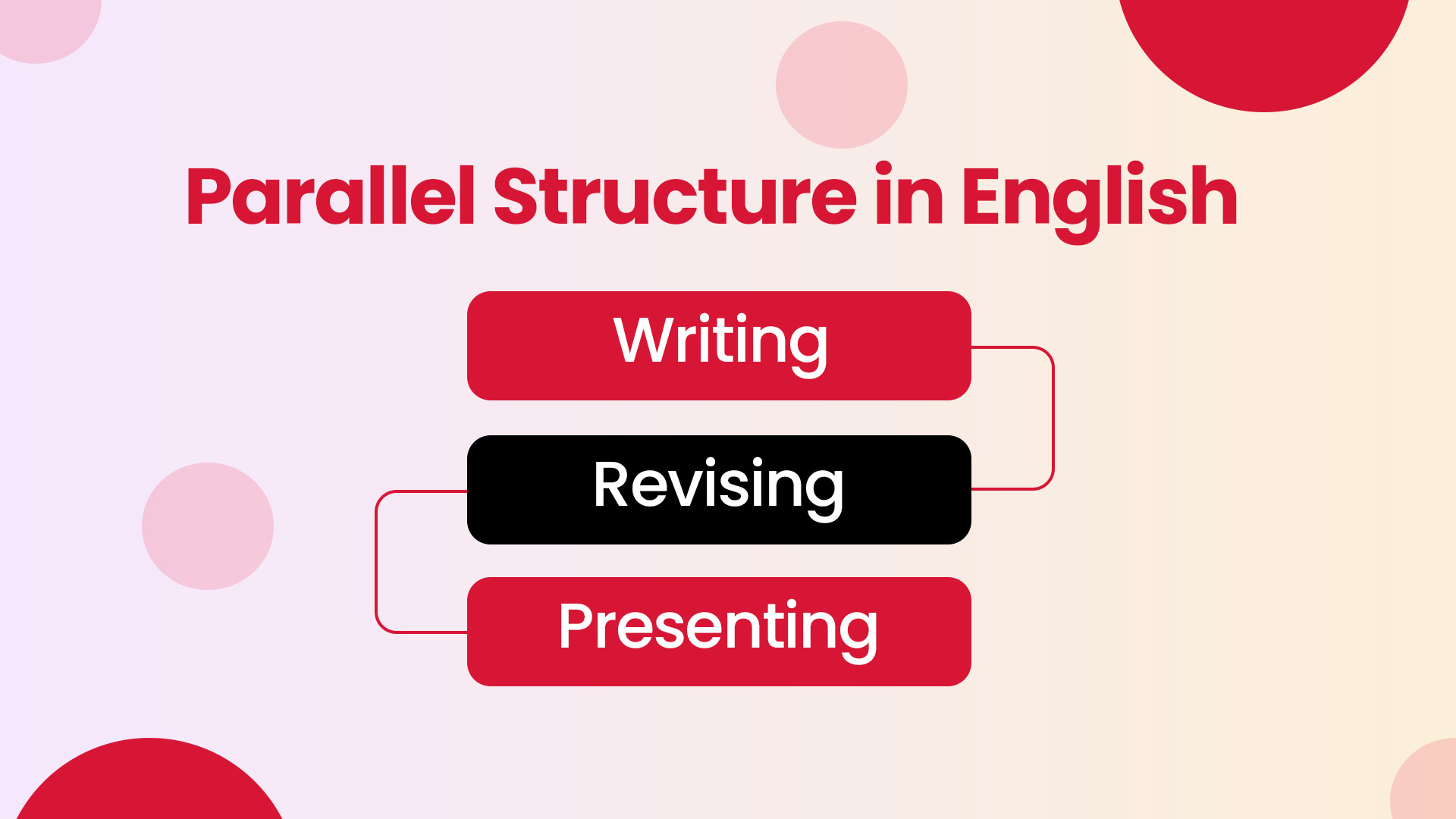
Parallel Structure in English: Polishing Grammar for Professional Growth
Teach balancing phrases (e.g., "to learn, to grow, to succeed") for resumes and interviews.
What is Parallel Structure?
The grammatical importance of things needs to be similar for them to be considered parallel in writing. Parallel structure is when the same grammatical structures are repeated inside a phrase to give it comparable grammatical worth. Examples of grammatical structures in sentences are parts of speech, clauses, and words. When two or more concepts are equally important, a parallel structure uses the same patterns and elements of speech to achieve balance in the phrase.
The parallel structure provides clarity and balance and draws attention to or emphasizes particular aspects. To establish parallel structure in writing, authors must ensure that every thought in a sentence adheres to the same grammatical form and pattern. This makes writing sound official and sophisticated while assisting authors in properly communicating thoughts.
Examples of Parallel Structure-
Sentences with an unbalanced grammatical structure can be hard to comprehend and make it hard to grasp what the author is trying to say. The imbalance between the sentence's components is often obvious and makes it hard to understand, making it easy to see when there is a lack of adequate parallel construction. This may be fixed by stating each notion using the same grammatical structures and forms.
- False- I like bicycling, swim, and jog.
- Right- I like swimming, biking, and jogging.
Parallelism creates a clean and unified appearance in professional contexts, particularly in applications and interviews. It conveys linguistic maturity, excellent communication abilities, and attention to detail.
Why parallel structure is crucial for professional growth?
Parallel structure, or parallelism, is crucial for professional growth because it enhances clarity, consistency, and impact in written and spoken communication. Here’s why it matters in a professional context-
- Improves clarity- A parallel framework ensures that concepts are communicated fairly and systematically, facilitating comprehension. For instance:
§ Incorrect: My objectives are to grow, learn, and achieve.
§ Correct: My goals are to learn, grow, and succeed.
When your communication is clear, your professionalism and competence are immediately more apparent to colleagues, clients, and employers.
- Improves persuasiveness—Parallel structure creates rhythm and emphasis, making arguments and presentations more convincing. Whether writing a resume, giving a speech, or crafting an email, parallelism can help reinforce key points.
- Demonstrates attention to detail- Professionals who use parallel structure show they care about precision and accuracy. This small grammatical skill reflects a larger ability to be thorough and attentive, which is highly valued in any industry.
- Strengthens professional documents- Resumes, cover letters, reports, and presentations all become stronger with parallel structure. Example:
§ Weak: Responsible for managing projects, customer relations, and leading teams.
§ Strong: Responsible for managing projects, building customer relations, and leading teams.
A well-structured resume or proposal makes a better impression on employers and clients.
- Builds professional credibility- Effective communication is key to leadership and career advancement. Mastering parallel structure allows you to speak and write in a way that commands respect and trust, positioning you as a competent professional.
- Boosts impact in interviews- When answering questions or describing your achievements in interviews, parallel structure helps you sound polished and organized:
§ Example: I developed marketing strategies, led cross-functional teams, and achieved a 20% growth in revenue.
This creates a strong, memorable impact.
- Promotes logical thinking- Practicing parallelism encourages you to organize thoughts logically. This habit is useful in problem-solving, decision-making, and team collaboration skills that directly influence career growth.
- Facilitates global communication—Clarity is essential in international workplaces. Parallel structure reduces the chance of miscommunication, helping you collaborate efficiently with diverse teams.
What are the core principles of parallel structure?
The core principles of parallel structure (or parallelism) revolve around balancing similar grammatical forms within or across related sentences. As a result, communication becomes clear, rhythmic, and consistent. The following are the main ideas you should be aware of-
· Employ the same grammatical form for related elements- Every item in a list or comparison of concepts should follow the same syntactic pattern.
Example-
§ Incorrect- She likes dancing, to swim, and biking.
§ Correct: She likes dancing, swimming, and biking.
If you start with a gerund (-ing form), continue with gerunds. If you begin with infinitives (to + verb), continue with infinitives.
- Maintain balance in paired ideas- When using correlative conjunctions (both/and, either/or, neither/nor, not only/but also), ensure the structure following each part is the same.
Example-
§ Incorrect: She is not only intelligent but also works hard.
§ Correct: She is not only intelligent but also hardworking.
Both sides of the correlative pair must match in form.
- Keep Lists Consistent- When you have lists in sentences (especially bullet points in resumes, presentations, or reports), each item should follow the same grammatical structure.
- Example-
§ Incorrect:
o Managed teams
o Customer service
o To increase sales
§ Correct:
o Managed teams
o Provided customer service
o Increased sales
Ensure all list items are either noun phrases, verb phrases, or consistent grammatical forms.
- Maintain parallel structure in comparisons—When comparisons using than or as, the elements compared should be grammatically similar.
Example-
§ Incorrect: Working from home is better than to commute to the office.
§ Correct: Working from home is better than commuting to the office.
Keep the form consistent on both sides of the comparison.
- Match verb tenses and forms- If the sentence structure repeats a verb, ensure the verbs remain in the same tense and form.
Example-
§ Incorrect: He planned the project carefully, executes it well, and was delivering results.
§ Correct: He planned the project carefully, executed it well, and delivered results.
Uniform tense helps maintain logical flow.
- Use consistent voice and tone—In formal writing, maintaining parallel structure includes maintaining the same voice (active/passive) and tone throughout lists and related sentences.
Example-
§ Incorrect: The report was written, she presented it, and approval was granted.
§ Correct: The report was written, it was presented, and approval was granted.
Avoid switching between active and passive voice unnecessarily.
- Check prepositions and articles- When using prepositions or articles before items in a list, repeat them consistently or use them only once before all items.
Example-
§ Incorrect: The workshop focused on time management, leadership skills, and effective communication.
§ Correct: The workshop focused on time management, leadership skills, and effective communication.
§ Correct: The workshop focused on time management, leadership skills, and effective communication.
Both methods are correct, but consistency is key.
Summary Table: Core principles of parallel structure-
|
Principle |
Key Focus |
Example (Correct Form) |
|
Same Grammatical Form |
Keep all elements in the same structure |
Dancing, swimming, biking |
|
Balanced Paired Ideas |
Match both sides of conjunctions |
Not only intelligent but also hardworking |
|
Consistent Lists |
All items share the same structure |
Managed teams, provided service, increased sales |
|
Parallel Comparisons |
Grammatical balance on both sides of comparison |
Better than commuting |
|
Uniform Verb Tense |
Same tense across actions |
Planned, executed, delivered |
|
Consistent Voice |
Same active/passive voice |
Was written, was presented, was approved |
|
Preposition/Article Consistency |
Repeat or correctly distribute prepositions |
On time management, on leadership, on communication |
What do you understand by parallel structure in resumes?
- Bullet points- Each point should start with a strong, consistent verb form:
§ Managed budgets, supervised cross-functional teams, and delivered quarterly reports.
§ Managing budgets, to supervise teams, and reported quarterly.
Consistent verb tenses present for current roles and past for previous ones create cohesion.
- Headings and sections- Ensure uniformity across resume sections:
§ Experience | Education | Skills
§ Experience | Your Education | And Skills
· Branding and summary lines- Maintain consistency in tone and structure:
§ Strategizing marketing campaigns, analyzing consumer data, and driving brand growth.
§ Strategy development, analysis of consumer patterns, and Brand growth.
What about parallel structure in interviews?
- Crafting balanced responses- Use balanced lists to present achievements-
§ “I aim to learn new tools, to grow in leadership, and to deliver measurable results.”
This consistent phrasing reinforces patterns of learning–growth–and achievement.
- Storytelling and impact- When sharing projects reflect structure-
§ “I conducted research, drafted proposals, and implemented solutions.”
Then connect with results-
§ “As a result, team efficiency increased, client satisfaction rose, and we met all deadlines.”
- Answering competency questions- Response format-"When I faced X, I did A, B, and C"-
§ “When we hit a budget shortfall, I analyzed expenses, renegotiated vendor contracts, and realigned project scope.”
Uniform phrasing helps the interviewer follow your logic and confidently evaluate your capabilities.
How do we learn and teach parallel structure?
Learn Parallel Structure-
- Watch an introductory video: "What Is Parallelism?” by Oregon State’s Liz Delf. It clearly explains parallel structure with real-life writing examples, including resumes and professional documents.
- Study clear rules and examples- Purdue OWL covers parallelism at the word, phrase, clause, and list levels, complete with examples and proofreading strategies. CGU’s Grammar Quickies PDF lists variations (e.g., infinitives vs. gerunds) and provides a handy revision checklist.
- Explore helpful blogs- Wordvice outlines three corrective strategies: align mismatches, rewrite or split sentences. Using famous literature quotations, Grammar Girl explores how parallelism enhances flow and curiosity among readers.
Teach Parallel Structure-
- Use mentor sentences and transformation- Start with a weak sentence and transform it. Blog posts like “How to Tackle Boring Sentences” guide you in modelling and analysis before asking students to rewrite. Present powerfully crafted mentor sentences (e.g., MLK Jr.’s “to work together, to pray together…”), ask students how and why they're effective.
- Hands‑on classroom activities- Sadlier’s “Parallel Structure Practice” suggests drawing parallel lines, listing “-ing” verbs, and having students supply matching words across the lines. Interactive ideas like Index Card Swap: exchange verb cards, then write parallel sentences in different tenses.
- Writing and editing practice- Have students free-write, then revise sentences to enforce parallelism, either by rewriting or splitting into multiple sentences. Use structured worksheets such as those from Towson University or CGU PDF to identify and correct errors.
- Embed in real writing tasks- Ensure bullet points align in tense and voice when drafting resumes. Use consistent structures like “Managed X, Designed Y, Improved Z”. During daily writing, prompt students to “read lists aloud” and adjust for rhythm and pattern.
Step-by-step learning and teaching plan-
|
Stage |
Student Action |
Teaching Focus |
|
Observe |
Watch Liz Delf’s video |
Define parallel structure; notice examples |
|
Practice |
Do Khan Academy drills & Chomp Chomp exercise |
Build confidence in identifying correct forms |
|
Analyze |
Review mentor sentences |
Discuss why this work; explore rhetorical impact |
|
Create |
Write own sentences from prompts |
Ensure matching forms (verbs, gerunds, infinitives) |
|
Edit |
Swap drafts & revise each other’s writing |
Teach methods: match nonconformers, rewrite sentence structure |
|
Apply |
Build resume/bullet list with consistency |
Reinforce real-world relevance and clarity |
Advanced applications of parallel structure in English-
· Rhetorical figures built on Parallelism- These devices use parallel grammar to amplify impact, clarity, and elegance-
§ Anaphora – repetition at the beginning of clauses
“I have a dream… I have a dream…”
§ Epistrophe – repetition at the end
“Speak no evil. Say no evil. Do no evil.”
§ Symploce – both anaphora and epistrophe combined
“If you sing…I will smile; if you laugh…I will smile.”
§ Asyndeton – omission of conjunctions for punch
“I came, I saw, I conquered.”
§ Polysyndeton – overuse of conjunctions for rhythm
“and work and wedge…and tradition, and delusion…”
· Contrasts and mirroring- Parallelism becomes even more powerful when used for contrast or inversion-
§ Antithesis – juxtaposes opposite ideas in parallel form
“It was the best of times; it was the worst of times.”
§ Chiasmus – AB–BA structure without word repetition
“He who laughs last, laughs loudest.”
§ Antimetabole – chiasmus with exact word repetition
“Ask not what your country can do for you; ask what you can do for your country.”
· Rhythmic grouping- Grouping items equally create a satisfying, strong rhythm-
§ Tricolon – three parallel elements
“Veni, vidi, vici.”
§ Isocolon – parallel elements of equal length (words or syllables)
· Linked reflection-
§ Anadiplosis – repeats the last word of a clause at the start of the next
“Fear leads to anger. Anger leads to hate…”
· Intentional ‘Incorrectness’ for Effect
§ Enallage – deliberate shift in tense or person to maintain parallelism or tone
Shakespeare uses shifts like “Is there not wars? Is there not employment?”
What are the common challenges in learning parallel structure in English?
- Mixing verb forms- Learners often combine gerunds, infinitives, and past participles, e.g. “He enjoys hiking, to swim, and biking.” Switching forms breaks rhythm and clarity.
- Inconsistent tenses- Sentences may shift tense unexpectedly: “She walked, eats, and will run.” Maintaining uniform tense across parallel elements is essential.
- Unequal phrase structures- Combining different grammatical types (noun, verb, clause), e.g. “singing, to dance, and art.” Parallelism requires matching parts of speech.
- A preposition and article misuse- uneven use of function words: “skilled at playing, and in singing.” All items should consistently include or drop prepositions/articles.
- Correlative conjunction errors- Pairs like “either/or” and “not only/but also” are often misaligned in structure. Each clause must mirror the other after these conjunctions.
- Subtle structural mismatches- Complex sentences with mixed clauses or varying lengths can hide non‑parallelism. These require close analysis and often reading aloud.
- Lack of awareness of rules- Many learners aren’t taught parallelism explicitly and find it “random.” Without clear guidelines, it's hard to diagnose and correct errors.
Table of common drawbacks and solution-
|
Issue |
Faulty Example |
Fix |
|
Mixed gerunds + infinitives |
I enjoy cooking, to jog, and watching movies. |
I enjoy cooking, jogging, and watching movies. |
|
Tense inconsistency |
Led team, manage budget, created report. |
Led team, managed budget, created report. |
|
Clause structure mismatch |
She not only leads the team but also team morale.’ |
She not only leads the team but also boosts morale. |
|
Headings inconsistency |
Professional Summary / Your Work Experience |
Professional Summary / Work Experience |
Step-by-Step Guide to Mastering Parallel Structure-
- Recognize Parallel Elements- Identify lists, comparisons, and coordinated clauses where similar ideas appear.
- Analyze Grammatical Form- Determine if elements share the same part of speech, verb tense, and structure.
- Align Structures- Adjust items so they all follow a consistent grammatical pattern.
- Use Conjunction Awareness- Ensure both sides of coordinating (“and”, “but”) and correlative (“either…or”, “not only…but also”) conjunctions mirror each other.
- Read Aloud for Rhythm- Vocalizing your sentences helps detect imbalances and awkward flow.
- Peer or Self‑Review- Seek feedback or revisit drafts to catch subtle mismatches.
- Practice Through Revision- Convert non‑parallel sentences into parallel forms; rewrite and refine repeatedly.
- Integrate into Writing Routine- Regularly check parallelism in drafts, especially in headings, lists, and thesis statements.
- Progress to Complex Sentences- Apply parallel structure to multi‑clause constructions for advanced coherence.
- Short‑list Golden Rules- Create reference reminders: match forms, maintain consistent elements, and ensure clarity
Conclusion-
Parallel structure is more than a simple grammar rule. It is a clear sign of clarity, professionalism, and polished communication. Using balanced phrasing like “to learn, to grow, to succeed” helps you present your ambitions and qualifications effectively. It makes your message persuasive and easy to understand. Parallel structure improves readability. It helps sentences flow smoothly. It allows your audience to grasp your ideas quickly and without effort. When you use parallelism carefully, you show great attention to detail. It also strengthens your credibility.
It highlights your professional writing skills, especially in resumes, emails, and presentations. Embracing parallel structure makes your writing stronger. It sharpens your message. It increases engagement. It shows your competence and focus. Learning the rules, practicing regularly, using helpful tools, and speaking with balance can all improve your professional image. Start with small steps, such as writing bullet points or preparing interview answers. Over time, parallel structure will become a natural habit.
FAQs on Parallel Structure in English-
Q.1 What is parallel structure?
Ans- Parallel structure (or parallelism) means using the same grammatical form for elements in a list, series, or coordinated clauses.
Q.2 Why is parallel structure important in professional writing?
Ans- It enhances clarity and readability and highlights balanced phrasing, conveying goals and skills effectively.
Q.3 How does parallel structure benefit resumes and interviews?
Ans- It underscores ambitions and credentials, increases readability, and projects linguistic precision, boosting persuasive power.
Q.4 Where should you apply it in a resume?
Ans- Focus on bullet points, skills lists, summary statements, and headings, ensuring each element uses a consistent grammatical form.
Q.5 What common errors should you avoid?
Ans- Watch for mixing verb forms or tenses, inconsistent use of prepositions/articles, and uneven phrase structures.
Q.6 How do you teach balanced phrasing like “to learn, grow, succeed”?
Ans- Emphasize matching infinitive forms, reinforce consistency in lists, and practice creating similarly structured sequences.
Q.7 What role do action verbs play in parallel structure?
Ans- Action verbs anchor bullet points and summaries, ensuring all entries are dynamic, consistent, and resume-ready.
Q.8 Should you use gerunds or infinitives?
Ans- Either form works; consistency throughout matters; choose one and stick with it across parallel elements.
Q.9 How can you self-check for parallelism?
Ans- Read your phrases aloud, look for grammatical alignment, and ensure lists or clauses follow the same structure.
Q.10 How do you practice advanced parallelism?
Ans- Rewrite sentences to align structures, use peer review, and consistently apply parallel phrasing in cover letters, interview answers, and resumes.
Subject and Object Pronouns: A Complete Guide
Pronouns are essential building blocks of the English language, enabling us to avoid repetition and communicate more effectively. Among the various types of pronouns, subject pronouns and object pronouns are fundamental to constructing clear and grammatically correct sentences. This guide explores what these pronouns are, how they differ, and how to use them correctly, with numerous examples and practice tips.
What are pronouns?
Pronouns are words that replace nouns in a sentence. They help avoid repetition and make sentences clearer and less awkward. Instead of repeating the same noun over and over, pronouns let us refer to people, places, things, or ideas without naming them every time.
Examples-
Without pronouns-
- Ravi is a student. Ravi goes to school every day. Ravi studies hard.
With pronouns-
- Ravi is a student. He goes to school every day. He studies hard.
In these examples, "he" is a pronoun replacing the noun "Ravi”.
What are the types of pronouns?
Pronouns are words that replace nouns to avoid repetition and simplify sentences. There are several types of pronouns, each serving a specific grammatical function. Below is a complete guide to the main types of pronouns-
- Subject Pronouns- These pronouns replace the subject of a sentence, such as the person or thing acting.
List of subject pronouns-
§ I, you, he, she, it, we, they
· Usage- Subject pronouns come before the verb and indicate who is doing the action.
Examples-
§ I am going to school.
§ You look happy today.
§ He plays football.
§ She is reading a book.
§ It is raining outside.
§ We are best friends.
§ They are dancing at the party.
- Object Pronouns- These kinds of pronouns replace the object of a sentence, the person or thing that receives the action of the verb.
List of object pronouns-
§ Me, you, him, her, it, us, them
- Usage- Object pronouns come after the verb or after a preposition.
Examples-
§ She called me.
§ I love you.
§ We met him yesterday.
§ I saw her at the station.
§ He dropped it.
§ Can you help us?
§ The teacher praised them.
Subject vs. Object Pronouns: What's the Difference?
Subject pronouns and object pronouns are both used to replace nouns, but they have different roles in a sentence.
· Subject Pronouns Examples-
§ She is reading a book.
§ They play football every Sunday.
§ We went to the market.
Here, the pronoun is acting.
· Object Pronouns Examples-
§ The teacher called me.
§ I saw him at the mall.
§ Can you help us?
Here, the pronoun is receiving the action.
Comparison table of subject and object pronouns-
|
Role |
Subject Pronoun |
Object Pronoun |
Example |
|
First Person |
I |
me |
I love books. / She called me. |
|
Second Person |
you |
you |
You are kind. / I saw you. |
|
Third Person |
he, she, it |
him, her, it |
He runs fast. / I like him. |
|
Plural |
we, they |
us, them |
We are here. / Join us. |
What are the common mistakes when using subject and object pronouns, and how can we avoid them?
Many English learners (and even native speakers) confuse subject and object pronouns, especially in casual speech or writing. Below are the most common mistakes, along with tips to avoid them and examples for better understanding.
1. Using object pronouns as subjects- People often use “me” or “him” instead of “I” or “he” because it sounds informal or casual in speech.
- Incorrect-
§ Me went to the store.
§ Him and me are friends.
- Correct-
§ I went to the store.
§ He and I are friends.
Solution-
- Remove the other subject and check-
- Would you say “Me am going”? No. So it must be “I am going.”
2. Using subject pronouns as objects- Mix-up between subject and object forms of pronouns.
- Incorrect-
§ The teacher called she.
§ Give the book to they.
- Correct-
§ The teacher called her.
§ Give the book to them.
How to avoid it?
- Ask yourself: Who is receiving the action? Use object pronouns (me, her, them) after verbs or prepositions.
3. Mixing up pronouns in compound subjects or objects-
- Incorrect-
§ Me and Rina are going to the party.
§ The teacher gave he and I a task.
- Correct-
§ Rina and I are going to the party.
§ The teacher gave him and me a task.
4. Using "Myself" Instead of "Me" or "I"- “Myself” is often misused to sound formal.
- Incorrect:
§ Please contact myself if you have questions.
§ Myself and John will attend.
- Correct:
§ Please contact me if you have questions.
§ John and I will attend.
Solution-
- Use “myself” only for reflexive or emphatic use-
§ I hurt myself.
§ I will do it myself.
5. Inconsistency between subject and object in a sentence-
- Incorrect-
§ Me love when they help I.
- Correct:
§ I love when they help me.
How to avoid it?
- Identify who is doing the action (use subject pronoun) and who is receiving the action (use object pronoun).
Summary Table: Mistake vs Correction-
|
Wrong |
Correct |
Reason |
|
Me went home. |
I went home. |
“I” is the subject. |
|
She gave I the book. |
She gave me the book. |
“Me” is the object. |
|
Him and me went there. |
He and I went there. |
Both are subjects. |
|
The gift is from she. |
The gift is from her. |
“Her” is the object of the preposition. |
|
Myself will do it. |
I will do it myself. |
“Myself” for emphasis, not as a subject. |
What is the other usage of pronouns in sentences?
Using pronouns with prepositions-
Object pronouns are always used after prepositions, such as to, for, with, about, at, in, etc.
Examples-
- This gift is for her.
- Can you come with me?
- The book is about them.
- Don’t be angry at him.
Pronouns in questions and answers-
When answering questions, it's essential to choose the correct pronoun form.
Examples:
Q: Who is going to the party?
A: He is. (He = subject)
Q: Whom did she invite?
A: She invited us. (Us = object)
Emphatic use of pronouns-
Sometimes, pronouns are used for emphasis, especially after comparison or with conjunctions.
- Nobody likes pizza more than me.
- She is taller than I am.
However, “than me” is more casual; “than I” is more formal and grammatically complete.
Subject and object pronouns in passive voice-
In passive sentences, the subject and object roles switch.
Active Voice:
- He painted the wall. (He = subject, the wall = object)
Passive Voice:
- The wall was painted by him. (The wall = subject, him = object)
Subject and object pronouns with Infinitives and Gerunds-
Subject pronouns follow infinitives and start gerunds:
- It is important for him to study.
- She enjoys swimming.
- The teacher expects us to be on time.
Cultural and formal usage tips-
- In formal writing, use subject pronouns properly (e.g., It is I instead of It’s me, though both are common in speech).
- In spoken English, object pronouns often follow verbs even when it's grammatically informal (e.g., It’s me!).
Summary table-
|
Role |
Pronoun Type |
Examples |
|
Subject |
I, you, he, she |
She is kind. |
|
|
it, we, they |
They are late. |
|
Object |
me, you, him, her |
Give him the book. |
|
|
it, us, them |
The gift is for us. |
Practice sentences-
Fill in the blanks with the correct pronoun:
- ___ am going to the store. (I/me)
- She likes ___. (he/him)
- Can you help ___? (we/us)
- ___ are my best friends. (they/them)
- He gave the book to Sarah and ___. (I/me)
Answers:
- I
- him
- us
- they
- me
Real-life conversation examples-
Example 1:
A: Who’s at the door?
B: It is the delivery man. He gave me a package.
Example 2:
A: Are they coming to the wedding?
B: Yes, I invited them last week.
Exercises for practice-
Convert the sentence using the correct pronoun:
- John is tired. John went to bed early.
- → ___ went to bed early.
- I met Rina and Maya. I gave Rina and Maya the books.
- → I gave ___ the books.
- This is for you and me. This is for you and I.
- → Which is correct?
- Rohan and I played cricket. Rohan and me played cricket.
- → Which is correct?
Answers:
- He went to bed early.
- I gave them the books.
- You and me (after “for”)
- Rohan and I (subject)
Conclusion-
Understanding the difference between subject and object pronouns is key to mastering English grammar and improving communication skills. Pronouns that refer to the action's doer are called subject pronouns, while those that refer to the action's recipient are called object pronouns. Misusing certain pronouns might result in confusion or grammatical mistakes.
Whether you're writing formally, having a casual conversation, or preparing for an exam like IELTS, TOEFL, or other proficiency tests, a solid grasp of pronoun usage ensures you speak and write English more fluently.
FAQs on Subject and Object Pronouns-
Q.1 What are subject pronouns?
Ans- Subject pronouns are used as the doers of the action in a sentence. I, you, he, she, it, us, and they are examples of common subject pronouns.
Q.2 What are object pronouns?
Ans- Object pronouns receive the action of the verb or follow a preposition. Examples are me, you, him, her, it, us, them.
Q.3 How do subject and object pronouns vary from one another?
Ans- Subject pronouns act (e.g., I eat), while object pronouns receive the action (e.g., She saw me).
Q.4 Is it possible to employ object pronouns as the sentence's subject?
Ans- No. This is a common mistake.
Q.5 How can subject and object pronouns appear together in a sentence?
Answer-
- He (subject) saw her (object).
- They invited us to the party.
Q.6 Is "you" a subject pronoun as well as an object pronoun?
Ans- Yes. “You” works as both.
- Subject: You are kind.
- Object: I will help you.
Q.7 How do you know which pronoun to use in a sentence?
Ans- Identify the role of the pronoun:
- If it is doing the action, use a subject pronoun.
- If it is receiving the action or follows a preposition, use an object pronoun.
Q.8 Why is “Me and my friend went…” incorrect?
Ans-
- “Me” is an object pronoun and cannot be used as a subject.
- Correct- My friend and I went to the party.
Q.9 Can pronouns be used with prepositions?
Ans- Yes, but always use object pronouns after prepositions.
- The gift is for him.
- She sat next to me.
Q.10 What are common mistakes to avoid with subject and object pronouns?
Ans-
- Using “me” instead of “I” as a subject.
- Using “I” instead of “me” after prepositions.
- Using reflexive pronouns (like “myself”) incorrectly.
- Forgetting to match the pronoun to its role in the sentence.

How to write a letter of explanation for a visa extension?
Some situations may force you to remain longer than your visa initially permits while you are working, learning, or traveling overseas. In some circumstances, writing a Letter of Explanation (LoE) for a visa extension becomes essential. Your request for an extension may be granted or denied based on the quality of your letter. This thorough tutorial will explain when to write a letter of explanation, how to format it, and crucial pointers to help you make your application compelling.
What is a Letter of Explanation for a Visa Extension?
A Letter of Explanation (LoE) for a visa extension is a formal document submitted to the immigration authorities to explain why you need to extend your stay in the host country beyond the original visa period. It is your opportunity to present your situation, provide supporting evidence, and demonstrate your genuine intentions.
The letter must be honest, polite, concise, and supported by valid reasons and documentation. Immigration officers use this letter to assess whether your extension request is reasonable and whether you meet the eligibility criteria for an extended stay.
What are common reasons for requesting a visa extension?
Your reason for extension should always be valid, truthful, and well-supported. Common reasons include:
- Medical Treatment: Illness or injury requiring extended treatment.
- Educational Purposes: Additional time needed to complete studies, exams, or research.
- Family Emergencies: Death, illness, or marriage of a family member.
- Unexpected Delays: Travel disruptions, cancellations, or visa processing delays.
- Professional Commitments: Business tasks, conferences, or projects requiring additional time.
- Tourism Extension: I want to explore the country further, provided I have financial and legal compliance.
When should you submit the letter?
- You should submit the letter of explanation before your current visa expires.
- Most countries recommend submitting the extension application at least 30 days in advance to avoid overstaying penalties.
- Late submissions may not be considered unless you justify the delay with valid evidence (e.g., hospitalization).
What are the key components of a letter of explanation for a visa extension?
Your letter should include the following sections:
1. Header
- Your full name (as in your passport)
- Passport number
- Visa number
- Contact details (email, phone, address in the host country)
- Date of Writing
2. Recipient Details
- Name of the visa officer or relevant authority (if known)
- Name of the immigration office or visa department
- Full address
3. Subject Line
Example-
- Subject: Request for Visa Extension – Visitor Visa – [Your Full Name]
4. Salutation
Example-
Dear Sir/Madam,
or
To the Visa Officer,
5. Introduction
- Briefly state your purpose: applying for a visa extension.
- Mention your current visa type and its expiration date.
6. Body of the Letter
Divide this into clear paragraphs:
- Reason for Extension: Provide a detailed explanation with dates, events, or circumstances.
- Supporting Evidence: Mention attached documents such as medical certificates, flight cancellations, academic letters, or proof of funds.
- Assurance of Compliance: Confirm that you will leave the country once your extension period is over.
- Financial Assurance: Demonstrate sufficient funds to support yourself during the extended stay.
7. Conclusion
- Politely request that the immigration authority consider your application.
- Thank them for their thoughtfulness and time.
8. Signature
- Closing statement: "Yours sincerely" or "Kind regards."
- Full name
- Signature (if submitting a printed copy)
Detailed Sample Letter of Explanation for Visa Extension-
Here’s a practical example to guide you:
[Your Full Name]
Passport No: [XXXXXX]
Visa No: [XXXXXX]
Email: [Your Email Address]
Phone: [Your Contact Number]
Address: [Your Current Address in Host Country]
Date: [DD/MM/YYYY]
To:
The Visa Officer
[Immigration Office Name]
[Office Address]
Subject: Request for Visitor Visa Extension – [Your Full Name]
Dear Sir/Madam,
I am writing to formally request an extension of my current visitor visa for [Country], which is due to expire on [Visa Expiry Date]. I arrived in [Country] on [Arrival Date] and have thoroughly enjoyed my stay, fully complying with all visa conditions.
The reason for this extension request is [clearly state your reason, e.g., "my mother, who resides here, has fallen seriously ill and requires my assistance for her daily care and medical visits"]. I have attached her medical reports and a letter from her attending physician to substantiate my claim.
I humbly ask for an extension of [number of days/weeks/months] so that I may keep making ends meet without putting too much strain on the government. My attached bank statements show that I have enough money.
I plan to return to my own country when this extended time ends. Subject to permission, I have tentatively scheduled a return flight for [New Proposed Departure Date] since I recognize the importance of following immigration requirements.
Please consider my application. I appreciate your time and focus.
Yours sincerely,
[Your Full Name]
[Signature if required]
Which strategy should you remember for writing an effective letter?
- Be honest—never provide false information. Immigration officials can verify your assertions, and lying might result in your visa being denied or in future prohibitions.
- Be specific- Avoid vague statements. Provide dates, names, and supporting details.
- Speak professionally- Keep your tone serious and courteous. Avoid slang or casual expressions.
- Attach supporting documents- Back up your request with solid evidence, like-
- Medical reports
- Flight itineraries
- Bank statements
- Letters from employers, universities, or family members
· Keep it concise- Though you must be detailed, avoid unnecessary information. Aim for clarity and relevance.
· Follow the country’s format- Each country may have specific guidelines or templates for visa extension letters. Always check the official immigration website.
· Proofread carefully- Grammar or spelling errors can make your letter look careless. Have it proofread or reviewed by another person.
Which common mistakes should be avoided while writing a letter of explanation for a visa extension?
Here are the common mistakes to avoid while writing a Letter of Explanation (LoE) for a visa extension-
- Missing Key Details: Failing to mention the visa number, passport number, or intended extension duration.
- Submitting Late: Always apply before your visa expires.
- Lack of Supporting Evidence: Unsubstantiated requests are often denied.
- Vague Explanations: General reasons like "I want to travel more" without details may not convince the officer.
- Unprofessional Language: This can reduce the seriousness of your application.
- Incomplete Documentation: Omitting key forms or missing fees can delay processing.
Conclusion-
A Letter of Explanation for a visa extension is your chance to communicate your need to stay longer in a foreign country. Writing it with honesty, precision, and proper documentation can significantly increase your chances of approval. Always research your host country’s specific requirements, ensure you apply within the timeline, and remember that professionalism and transparency are your best allies in the visa extension process.
Following the structured format, using clear language, and providing strong evidence, you can write a compelling letter that satisfies immigration authorities and helps you achieve your visa goals. If unsure, consider consulting with an immigration advisor or lawyer to improve your application’s success rate.
Frequently Asked Questions (FAQs)
Q.1 When should you submit a visa extension application?
Ans- You should apply at least 30 days before your visa expires. Some countries accept shorter notice, but early application is recommended.
Q.2 Can you stay in the country while my visa extension is processed?
Ans—If you apply before your visa expires, you are permitted to remain lawfully in many countries while an assessment is being made. Check the specific rules for your host country.
Q.3 Do all visa types allow for extensions?
Ans- No, not all visa types are eligible for extensions. Tourist visas, in particular, may have stricter limitations.
Q.4 What happens if my extension is denied?
Ans—You may be required to leave the country immediately or within a specified grace period. A longer stay may result in penalties or future visa restrictions.
Q.5 What fees are involved?
Ans- Visa extension applications usually involve a processing fee, which varies by country.
Q.6 Can you extend my visa multiple times?
Ans- Some countries allow multiple extensions, but there is usually a maximum allowable stay. Check the immigration laws of the host country.
Q.7 Is a Letter of Explanation mandatory?
Ans- In most cases, yes. It’s your primary way of communicating the reasons for your extension request.
Q.8 Can you write the letter in my native language?
Ans- Typically, the letter must be written in the official language of the immigration authority, usually English.
Q.9 How long does it take to process a visa extension?
Ans—Processing times vary, but they generally take 2 to 8 weeks, depending on the country and case complexity.
Q.10 Does a visa extension guarantee approval?
Ans- No. Approval depends on your reasons, supporting documents, immigration history, and compliance with visa rules.
Application Writing: Type, Format, Example, Tips, How to write and more
Application writing is a formal means of communication used in educational institutions, businesses, government offices, and professional environments. Whether you are applying for leave, a job, admission, or requesting services, understanding the correct application writing format is crucial for ensuring clarity, professionalism, and effectiveness.
This guide provides a detailed breakdown of the standard format, types of applications, writing tips, and practical examples to help you master application writing for various purposes.
What is an application?
An application is a formal written request addressed to an authority, organization, or individual seeking permission, information, or a specific service. It follows a structured format and is written in polite, concise, and respectful language.
Applications are typically written for:
- Leave requests (casual, medical, emergency)
- Job applications
- Admission to educational programs
- Issue of official documents (passport, certificates)
- Service requests (banking, electricity, water connection)
- Visa applications
Why is application writing important?
Application writing holds significant importance in academic, professional, and official settings. It is much more than just drafting a request. It is a formal communication tool that can influence decisions and outcomes. Here are the key reasons why application writing is essential-
- Facilitates formal communication—Applications are standardized and recognized communication methods with authorities, institutions, or organizations. They convey requests, permissions, or concerns in a structured, respectful, and professional way.
- Ensures clarity and precision- Application writing helps the sender express their purpose and specific needs without ambiguity. It allows the recipient to understand the request and take appropriate action quickly.
- Maintains professionalism- Proper application writing demonstrates seriousness, responsibility, and respect for the process and authority. It reflects your ability to follow formal communication etiquette, which is essential in academic and workplace environments.
- Serves as a record of request- Written applications become official records for both the sender and the receiver. They can be referred to later in disputes, verifications, or follow-ups.
- Improves decision-making- Well-written applications help decision-makers quickly assess the request, verify the provided details, and make informed decisions. Clear and properly formatted applications speed up processing.
- Showcases writing and communication skills—Effective application writing highlights your ability to communicate logically and respectfully. This skill is valuable in academics, job applications, and daily administrative processes.
- Increases the chances of approval- A clear, polite, and correctly formatted application is more likely to be accepted and processed quickly. Poorly written or incomplete applications often face delays or rejection.
- Writing an application demonstrates responsibility and seriousness. It shows that you are aware of proper procedures and willing to follow them. It indicates that you value the recipient’s time and the formal processes.
- Encourages organized thinking- Writing an application requires you to organize your thoughts and present your request logically. This promotes clarity of purpose and effective communication.
Standard application writing principle
The most widely accepted format for formal applications includes the following parts:
1. Sender's Details
Include your:
Full name
Address
Contact information
Date of Writing
· Example-
Ravi Sharma
123, Green Park, Delhi – 110016
Phone: ******
Date: 24 June 2026
2. Receiver’s Details
Include the name, designation, and address of the recipient.
· Example-
The Principal
ABC Public School
New Delhi – 110019
3. Subject Line
Write a short, direct summary of the purpose of your application.
· Example-
Subject: Application for Sick Leave for Two Days
4. Salutation
Use a respectful greeting.
· Examples:
§ Dear Sir/Madam,
§ Respected Principal,
§ To the Branch Manager,
5. Body of the Application
The body is typically divided into three key paragraphs:
a) Introduction
· Clearly state the purpose of your application.
b) Detailed Explanation
· Explain your request in detail. Include relevant dates, reasons, and any supporting information.
c) Conclusion
· Politely request action and express gratitude.
6. Complimentary Closing
Use formal closing phrases.
· Examples:
Yours sincerely,
Yours faithfully,
Yours truly,
7. Signature
Include your full name and sometimes your designation or roll number if applicable.
Detailed Structure Example-
Here’s how the full format would look-
[Sender’s Address]
[City, Postal Code]
[Contact Number]
[Date]
[Receiver’s Designation]
[Organization Name]
[Address]
Subject: [Write the Subject Clearly]
Respected Sir/Madam,
[Paragraph 1: Introduction]
[Paragraph 2: Detailed Explanation]
[Paragraph 3: Conclusion]
Thank you.
Yours sincerely,
[Full Name]
[Roll No./Employee ID if applicable]
Types of applications and examples-
1. Application writing to Principal for leave
Example: Sick Leave
Subject: Application for Sick Leave for Three Days
Respected Sir,
I am writing to ask for three days of sick leave from June 25 to June 27, 2026, as I have a bad case of the flu, and my doctor has told me to take it easy. For your information, I've included the medical certificate.
I promise that when I return, I will finish any unfinished business.
Thank you.
Yours sincerely,
Ravi Sharma
Class 10, Roll No. 45
2. Job Application
Example: Application for the Post of Accountant
Subject: Application for the Post of Accountant
Dear Sir/Madam,
As stated on your website, I am writing to express my interest in the accountant position at your prestigious company. I have three years of experience in the accounting industry and a Bachelor of Commerce degree.
I've included my certifications and résumé for your review. I would value the chance to discuss how my abilities can benefit your business.
Thank you for your time.
Yours sincerely,
Ravi Sharma
3. Admission Application
Example: Admission to a Degree Program
Subject: Application for Admission to B. Com Program
Respected Sir,
I am writing to express my interest in enrolling in your college's Bachelor of Commerce program for the 2026–2026 academic year. With an 85% grade in my 12th grade, I would like to continue my education at your esteemed university.
All necessary paperwork, including my grade report and identification evidence, is enclosed.
Kindly consider my application favorably.
Thank you.
Yours faithfully,
Ravi Sharma
4. Service Request Application
Example: Application for the Issue of a Bank Passbook
Subject: Application for Issuance of New Passbook
To
The Branch Manager
XYZ Bank, Delhi
Respected Sir,
I am writing to request a new passbook for my savings account (Account No: XXXXXXXX), as my current passbook has been misplaced. Kindly issue me a duplicate passbook at the earliest.
I have attached a copy of my ID and bank details.
Thank you.
Yours truly,
Ravi Sharma
5. Visa Extension Application
Example: Application for Visa Extension
Subject: Application for Visa Extension Due to Medical Emergency
Dear Sir/Madam,
I am writing to request an extension of my current tourist visa, which expires on June 30th, 2026. Due to a medical emergency, I require additional time in the country for treatment and recovery.
I have attached supporting medical documents. Kindly grant me an extension of 30 days to complete the necessary medical care.
I appreciate your consideration.
Yours sincerely,
Ravi Sharma
Key Tips for Writing an Effective Application
1. Be Clear and Concise
- Write directly to the point.
- Avoid unnecessary explanations or lengthy descriptions.
2. Use Formal Language
- Maintain professionalism throughout the application.
- Avoid slang, contractions, or casual language.
3. Stick to the Format
- Proper structure makes your application easy to read and process.
4. Be Polite and Respectful
- Always address the recipient appropriately.
- Use words like “kindly,” “please,” and “thank you.”
5. Proofread Your Application
- Verify for punctuation, grammatical, and spelling mistakes.
- A mistake-free application looks more professional.
6. Attach Necessary Documents
- Supporting evidence like medical reports, certificates, or identification should be included.
7. State Exact Dates and Duration
- Always include precise dates when requesting a leave of absence or an extension.
8. Follow Instructions
- Some organizations have specific formats or additional forms that must be completed. Always comply with these.
Common mistakes to avoid while writing an application-
- Incomplete details—Not mentioning essential information like name, address, date, or subject can make your application unclear and unprofessional.
- Unclear purpose- Not stating the request confuses the reader and may lead to rejection or delay.
- Informal language- Using casual words, slang, or abbreviations is inappropriate in formal applications.
- Spelling and grammar errors- Grammatical mistakes reduce the credibility of your application and may give a negative impression.
- Ignoring format —skipping proper structure, such as salutation, subject, and closing —shows carelessness.
- Lack of supporting documents- Forgetting to attach necessary evidence weakens your request.
- Being overly demanding- Writing in a demanding tone instead of a polite request is disrespectful and may harm your chances.
Differences between formal and informal Applications-
|
Feature |
Formal Application |
Informal Application |
|
Tone |
Respectful, professional |
Friendly, casual |
|
Language |
No slang, no contractions |
Can include casual phrases |
|
Structure |
Strict, follows a standard format |
Flexible, less structured |
|
Purpose |
Official requests (leave, job, service) |
Personal requests (to friends, relatives) |
|
Salutation & Closing |
Formal greetings and closings |
Informal greetings like "Hi" or "Bye" |
| Also Know About: Formal Letter Writing Format | Informal Letter Writing Format | Application Writing Format |
Application Writing in Digital Formats-
In the modern world, many applications are submitted via email or online forms. While the basic structure remains the same, some key adjustments are:
Email Applications:
- Use a clear subject line.
- Include contact details in the email signature.
- Attach required documents in appropriate formats (PDF, JPEG).
Online Forms:
- Follow field instructions carefully.
- Type responses clearly and avoid short forms.
- Upload documents within the specified file size and format.
Conclusion-
Application writing is essential for students, employees, professionals, and travelers. Whether you are requesting leave, applying for a job, or requesting a service, writing a well-structured, polite, and professional application ensures your request is taken seriously. A correctly written application can influence decisions and showcase your sense of responsibility and respect for formal procedures.
To write a practical application, it is essential to use the correct format, be clear and to the point, maintain a formal tone, and attach all necessary supporting documents. These elements make your application more convincing, help the reader process your request efficiently, and reduce the chances of delay or rejection.
Mastering application writing helps you in school or work settings and significantly improves your overall communication abilities, allowing you to handle formal correspondence confidently in various life situations.
FAQs
Q.1 What is the application writing format?
Ans- The application writing format refers to the structured layout of formal applications. It includes essential parts such as the sender’s details, recipient’s details, subject, salutation, body, closing, and signature.
Q.2 Why is the application writing format important?
Ans- Using the correct format ensures clarity, professionalism, and ease of reading. It helps the recipient quickly understand your request and shows that you respect formal communication protocols.
Q.3 What are the key components of an application writing format?
Ans-
The main parts include:
- Sender’s Address and Date
- Receiver’s Details
- Subject Line
- Salutation
- Body (Introduction, Explanation, Conclusion)
- Complimentary Closing
- Signature
Q.4 What type of language should be used in an application?
Ans- An application should always use formal, respectful, and polite language. Informal words, slang, and abbreviations should be avoided.
Q.5 When is application writing commonly used?
Ans- Application writing is commonly used for leave requests, job applications, admissions, service requests, visa processes, and official permissions in schools, offices, and government organizations.
Q.6 What happens if you don’t follow the correct application format?
Ans- Failure to follow the correct format can make your application appear unprofessional, confusing, or incomplete, which may lead to rejection or delayed processing.
Q.7 Is the application writing format similar to emails and printed letters?
Ans- The basic structure remains the same, but email applications may skip the sender’s address and use an email signature, while printed applications require the complete address at the top.
Q.8 How can you improve my application writing skills?
Ans- You can improve by practicing different types of applications, studying sample formats, proofreading carefully, and seeking feedback from teachers or mentors to correct mistakes.
New Words in English: Definition, Meaning, and Uses
English is not the only language that is changing all the time. With globalization, technological advancement, and cultural shifts, new words emerge in English regularly. These neologisms reflect our changing society, addressing new phenomena, trends, and inventions. This blog explores the concept of new words in English, their definitions, meanings, uses, and examples.
What are new words in English?
Neologisms, often known as new words in English, are phrases or terminologies that are freshly created and utilized in daily speech but might not be included in official dictionaries. They arise from technological innovation, social media trends, popular culture, and the blending of global languages.
Types of new words in English-
New words in English, also called neologisms, can be formed in various creative ways. Here are the main types of new word formation in English with examples-
Blending-
Definition: Combining parts of two words to create a new one.
Examples:
- Brunch = breakfast + lunch
- Motel = motor + hotel
- Smog = smoke + fog
- Hangry = hungry + angry
Compounding-
Definition: Joining two complete words to create a new one.
Examples:
- Toothpaste = tooth + paste
- Laptop = lap + top
- Facebook = face + book
- Babysitter = baby + sitter
Clipping-
Definition: Shortening a longer word.
Examples:
- Gym (from gymnasium)
- Flu (from influenza)
- App (from application)
- Photo (from photograph)
Acronyms and Initialisms-
Definition: Forming new words using the initial letters of a phrase.
- Acronym (pronounced as a word):
- NASA – National Aeronautics and Space Administration
- YOLO – You Only Live Once
- Initialism (each letter pronounced):
- FBI – Federal Bureau of Investigation
- ATM – Automated Teller Machine
Borrowing (Loanwords)-
Definition: Adopting words from other languages into English.
Examples:
- Tsunami (Japanese)
- Café (French)
- Piano (Italian)
- Guru (Sanskrit/Hindi)
Backformation-
Definition: Creating a new word by removing an affix (usually a suffix) from an existing word.
Examples:
- Edit (from editor)
- Burgle (from burglar)
- Laze (from lazy)
- Enthuse (from enthusiasm)
Conversion (Zero Derivation)-
Definition: Changing the grammatical function of a word without changing its form.
Examples:
- Google (noun → verb): “I’ll Google it.”
- Text (noun → verb): “He texted me.”
- Impact (noun → verb): “The policy impacted everyone.”
Coinage (Invention)-
Definition: Completely new, invented words, often brand names or slang.
Examples:
- Kleenex (brand name)
- Xerox (used as a verb for photocopying)
- Blog (short for weblog)
Reduplication-
Definition: Repetition of similar sounds for effect, often in informal usage.
Examples:
- Hocus-pocus
- Super-duper
- Wishy-washy
- Bling-bling
Onomatopoeia-
Definition: Words that imitate natural sounds.
Examples:
- Buzz
- Splash
- Click
- Bang
Why do new words emerge?
New words emerge in English because language evolves to reflect the ever-changing world. As society, culture, and technology develop, people create new vocabulary to describe new ideas, tools, experiences, and phenomena. Here are the key reasons why new words are created-
Technological innovation- Advances in technology introduce new gadgets, platforms, and concepts that need names. As new tools and digital habits arise, the language grows to match them.
- Examples- Smartphone, Wi-Fi, podcast, blockchain, AI, selfie
Social media and pop culture- The internet, memes, and celebrity culture rapidly spread slang and catchphrases, leading to new words. Platforms like TikTok, Instagram, and YouTube are powerful engines for new vocabulary.
- Examples- Binge-watch, ghosting, DM (Direct Message), meme, influencer, stan.
Cultural and social movements—Evolving social values and political issues create new words to describe identities, ideologies, and behaviors. Language changes to reflect action and changing ideologies.
- Examples include gender-fluid, climate strike, woke, cancel culture and eco-anxiety.
- Globalization and borrowing- English frequently borrows words from other languages as people, foods, and cultures mix. International interaction adds a variety of words to English.
Examples- Tsunami (Japanese), pasta (Italian), guru (Hindi), sushi (Japanese), yoga (Sanskrit)
Creativity and wordplay- Writers, speakers, marketers, and internet users invent catchy or funny new words for style or branding. Creativity leads to memorable and expressive new terms.
- Examples- Adulting, hangry, mansplaining, clickbait, cringe
- Need for precision or novelty—People create new words when existing words can’t capture a new concept or experience. Language responds to specific modern challenges or experiences.
Examples- Zoom fatigue (from overuse of video calls)
Quiet quitting (working as little as possible)
- Convenience and language economy: To communicate more quickly, people frequently condense or simplify words. Clipping or abbreviating everyday speech is more efficient.
Examples- App (application), flu (influenza), gym (gymnasium)
What are the Examples of New Words in English in 2026?
Here are some notable new English words and phrases recognized in 2026, reflecting evolving trends in technology, culture, environment, and lifestyle-
Environment and sustainability-
- Climavore (noun): An individual who selects their diet based on its environmental impact.
- Example- "As a climavore, she opts for foods that support ecological balance."
- Eco-minimalism (noun): A lifestyle emphasizing minimal consumption to reduce environmental harm.
- Example- "He embraced eco-minimalism by decluttering and avoiding unnecessary purchases.
- Slow fashion (noun): A movement promoting ethical and sustainable apparel development and consumption.
Example- "She supports slow fashion by buying locally-made garments."
Wellbeing and lifestyle-
- Biohacking (noun): Optimizing one's body and mind through lifestyle changes and technology.
- Example- "He's into biohacking, tracking his sleep and diet meticulously."
- Quiet luxury (phrase): A trend favoring understated, high-quality products over flashy brands.
- Example- "She prefers quiet luxury, choosing timeless pieces over trendy items."
- Life admin (noun): Routine tasks necessary for managing one's personal life.
- Example: "Sunday afternoons are reserved for life admin like paying bills."
Slang and pop culture-
Rizz (noun): Charisma or charm, especially when attracting others.
- Example- "He's got serious rizz; everyone enjoys his company."
Mid (adjective): Describes something as average or unremarkable.
- Example- "The movie was mid; it didn't live up to the hype."
- Unhinged (adjective): Acting in a wild or irrational manner.
- Example- "Her unhinged behavior at the party surprised everyone."
Global influences-
- Gigil (noun): A Tagalog term describing the overwhelming urge to squeeze something extremely cute.
- Example: "Seeing the puppy gave me gigil; it was too adorable."
- Alamak (interjection): An expression of surprise or dismay common in Singapore and Malaysia.
- Example- "Alamak! I forgot my keys at home."
- Komorebi (noun): A Japanese word for sunlight filtering through trees.
- Example- "The komorebi created a serene atmosphere in the forest."
Fashion and consumer trends-
- Shacket (noun): A hybrid garment combining shirt and jacket features.
- Example: "The shacket is perfect for layering during transitional weather."
- Frankenshoe (noun): A shoe design merging elements from different styles.
- Example: "She wore a pair of frankenshoes that combined sneakers and heels."
- Snoafer (noun): A footwear blend of a sneaker and a loafer.
- Example- "His snoafers offered both comfort and style."
Technology and innovation-
- Dwellness (noun): A term describing wellness-focused smart home technologies.
- Example- "The dwellness features in her home monitor air quality and lighting."
- Plagger (noun): An author who uses AI tools to generate initial drafts of their work.
- Example- "As a plagger, he relies on AI to kickstart his writing process."
- Czechnology (noun): High-quality technology products originating from the Czech Republic.
- Example- "Czechnology has become a significant player in the tech industry."
Food and culture-
- Girl dinner (noun): A casual meal with assorted snacks, often requiring minimal preparation.
- Example- "After a long day, she opted for a girl's dinner of cheese and crackers."
- Spice bag (noun): A popular Irish takeaway dish featuring fried chicken, chips, and spices.
- Example- "He craved a spice bag from his favorite Dublin eatery."
- Blaa (noun): A soft white bread roll from Waterford, Ireland.
- Example- "She enjoyed a blaa filled with fresh butter for breakfast.
How are new words accepted into English?
New words often begin as slang or informal usage. If they gain widespread use and stay relevant, they may be added to the Oxford English Dictionary (OED) or Merriam-Webster.
Criteria for Inclusion:
- Frequency of usage
- Geographic spread
- Longevity
- Meaning consistency
"Selfie" was added to the OED in 2013 due to massive usage worldwide.
New words are gradually accepted into the English language, involving widespread use, social acceptance, and, eventually, dictionary inclusion. Here's a breakdown of how this happens:
- Creation- New words often emerge from-
- Technological innovation (e.g., selfie, smartphone)
- Cultural trends (e.g., binge-watch, hangry)
- Slang and social media (e.g., yeet, ghosting)
- Blends and abbreviations (e.g., brunch from breakfast + lunch, FOMO for fear of missing out)
- Widespread usage—A new word gains traction when it’s used frequently by the public. Influencers, celebrities, internet users, and the media often play a key role in spreading new words. Many people must use the word in a clear, consistent context.
- Endurance and stability- Not all trendy words survive. For a word to be accepted into English-
- It must remain in use over some time.
- It must appear in different types of communication: spoken, written, formal, and informal.
- Documentation by lexicographers- Lexicographers (dictionary editors) track word usage through:
- Newspapers, books, websites, academic papers, and even social media.
- They look for:
- Frequency of use
- Geographic spread
- Clear definition and purpose
- Dictionary inclusion- When lexicographers find sufficient evidence, the word is added to dictionaries like:
- Oxford English Dictionary (OED)
- Merriam-Webster
- Collins Dictionary
- The word gets an official definition and becomes part of the recorded language.
- Continuous evolution-
- Even after being accepted:
- A word’s meaning can evolve (e.g., cloud now also means internet storage).
- It can become obsolete if usage declines.
What is the role of social media in language change?
The role of social media in language change is both powerful and dynamic. It enables the rapid spread of new words, phrases, and expressions across global audiences within a short time. Platforms like Twitter, Instagram, TikTok, and Reddit allow users to experiment with language in informal and creative ways. This has resulted in the invention of new slang, abbreviations, acronyms, and even visual elements like emojis, which have become part of everyday communication.
Social media also promotes language mixing and code-switching, where users blend English with local languages, creating hybrid forms like Hinglish or Spanglish. Online communities and influencers often coin new terms or redefine existing ones, influencing how words are used and understood.
Moreover, social media encourages playful spelling, punctuation, and grammar, reflecting tone, emotion, or humor. As these expressions gain popularity, they often enter mainstream media, advertising, and even dictionaries. Ultimately, social media acts as a living lab for language evolution, shaping English to be more inclusive, flexible, and reflective of modern culture.
Example: Words like "influencer," "unbox," and "cancel culture" gained popularity through social media trends.
How significant is understanding new words in English?
Understanding new words in English is highly significant for several essential reasons. It enhances communication, comprehension, and cultural awareness in an ever-evolving language environment. Here's why it matters-
- Improving communication skills- Knowing new words helps you express yourself more accurately and confidently. It expands your vocabulary, allowing you to choose the right words for different situations: formal, informal, academic, or creative.
- Enhances reading and listening comprehension- Understanding modern vocabulary, slang, and technical terms allows you to follow news articles, social media content, entertainment, and academic materials more effectively. This is especially crucial for students, professionals, and English learners.
- It keeps you culturally updated- new words often reflect current trends, technologies, and social changes. Words like selfie, influencer, ghosting, or climate anxiety carry modern cultural meaning. Knowing them helps you stay connected to contemporary issues and conversations.
- Boosts academic and professional success- A strong and up-to-date vocabulary in scholarly writing and the workplace shows proficiency and professionalism. It helps you understand technical documents, reports, and discussions and improves your performance in IELTS, TOEFL, SAT, and GRE exams.
- New words strengthen creative and critical thinking and help develop a deeper understanding of ideas and concepts. They also improve writing, storytelling, and public speaking skills by offering more precise ways to describe emotions, actions, and abstract thoughts.
- Encourages lifelong learning- Language is constantly evolving. Staying updated with new words shows adaptability and curiosity, essential for personal and intellectual growth.
What strategies should you opt to learn and use new words?
To learn and effectively use new words in English, you can adopt a combination of active learning strategies and practical usage techniques. Here are the most effective strategies to help you grow your vocabulary and use it with confidence-
- Read widely and regularly- Read books, newspapers, blogs, and articles on different topics. Expose yourself to various writing styles—formal, informal, technical, and conversational. Highlight or note down unfamiliar words and look up their meanings.
- Use a vocabulary Journal- Maintain a notebook or digital file to record new words. Include the word, meaning, part of speech, an example sentence, and a translation (if needed). Review your journal regularly to reinforce memory.
- Learn in context- Don’t just memorize definitions—understand how words are used in real sentences. For example, Instead of learning that resilience means "able to recover," read how it's used in sentences like “She remained resilient despite the challenges.”
- Practice with flashcards—Use physical flashcards or apps like Quizlet, Anki, or Memrise. Create cards with the word on one side and the meaning, usage, and sample sentence on the other. Practice daily in short sessions to build long-term memory.
- Use new words in writing and speaking- Make a conscious effort to use new words in-
- Essays
- Social media posts
- Conversations
- Emails
The more you use a word, the more it becomes a natural part of your vocabulary.
- Play word games and quizzes- Engage with language through fun activities like-
- Crossword puzzles
- Word searches
- Vocabulary quizzes
- Games like Scrabble, Boggle, or Wordle
These enhance word recognition and retention.
- Learn word roots, prefixes, and suffixes- Understanding word parts helps you guess the meanings of unfamiliar words.
- Example: Auto- means “self” (autograph, autobiography)
- -logy means “study of” (biology, geology)
- Watch and listen in English- Watch English-language TV shows, YouTube videos, TED Talks, or podcasts. Turn on subtitles and note down new vocabulary as you listen. Pay attention to pronunciation, tone, and usage.
- Use language learning apps- Apps like Duolingo, BBC Learning English, Busuu, or HelloTalk provide interactive vocabulary training. These include audio support, daily reminders, and gamified lessons.
- Review regularly and revise- Schedule weekly reviews of your learned words. Practice with short writing tasks, quizzes, or group discussions. Repetition helps reinforce memory and long-term retention.
What are the challenges in learning new words in English?
Learning new words in English can be rewarding, but it also comes with several challenges. These obstacles can slow vocabulary development or make it harder to use new words accurately and confidently. Here are the main difficulties learners often face-
- Multiple meanings (Polysemy)—Many English words have more than one meaning, depending on context. For example, “Bank” can mean a financial institution or the side of a river. This can confuse learners when trying to understand or use the word correctly.
- Pronunciation difficulties- English pronunciation often doesn’t match spelling; for example, Though, through, tough, and thought look similar but sound different. New words may be difficult to pronounce or recognize in speech.
- Spelling inconsistencies—English spelling rules are irregular, such as Receive vs. Believe similar sounds but different spelling patterns. This can make remembering how to spell new words frustrating.
- Confusing synonyms and subtle differences—English has many near-synonyms with subtle distinctions. For example, Big, large, huge, and enormous are all similar but used in slightly different contexts. Learners may struggle to know which one is most appropriate.
- Lack of context—Without proper context, it’s hard to grasp how or when to use a word. Reading a word in isolation doesn't show tone, formality, or meaning.
- Forgetting new words- They are easily overlooked if new words aren’t used regularly. Passive recognition does not always lead to active use in speech or writing.
- Overuse of simple vocabulary: Learners often resort to basic words they are comfortable with. This prevents them from practicing or integrating more advanced vocabulary into everyday use.
- Fear of making mistakes- Some learners avoid using new words due to fear of mispronunciation, wrong usage, or being corrected. This reduces confidence and limits practice.
- Cultural and idiomatic differences- Some words or phrases carry cultural meanings that aren’t easily understood, for example- Break the ice, spill the tea, barking up the wrong tree. Idioms and slang can be confusing without cultural context.
- Too much information at once- Memorizing long vocabulary lists without structure or repetition can be overwhelming and ineffective. Cramming leads to short-term memory, not long-term retention.
- "Expanding your vocabulary is only the first step; read our guide on how to structurally contrast these concepts using proper degrees of comparison
What is the future of new words in English?
The future of new words in English is vibrant, fast-paced, and deeply influenced by technology, culture, global communication, and social media. As the world changes, so does language. Here’s what the future likely holds for the evolution of English vocabulary:
- Faster word creation- Digital communication has sped up how quickly new words are created and shared. Platforms like TikTok, Twitter/X, and Instagram are accelerating the birth and spread of slang and internet phrases. Words can go viral in hours, entering everyday use far quicker than ever before.
- Influence of technology and AI- Emerging technologies will introduce new terms, such as those related to:
- Artificial Intelligence (e.g., deepfake, prompt engineering)
- Virtual Reality/Metaverse (e.g., avatar, VR fatigue)
- Cybersecurity and data (e.g., phishing, data breach, quantum-proof)
- More blended and hybrid words- English will increasingly borrow from other languages, especially in multicultural societies and online spaces. Expect more code-mixed terms (like Hinglish and Spanglish) and hybrid constructions (e.g., workcation = work + vacation).
- Greater role of pop culture and memes—Movies, music, influencers, and online communities will continue to shape new words, such as stan (obsessive fan), rizz (charisma), and vibe check (emotional energy check). Memes and humor will continue to fuel playful word creation.
- Visual and symbolic language growth- Emojis, GIFs, stickers, and even abbreviations may evolve into a form of visual language. They often complement or replace written words in casual communication.
- Changing grammar and usage patterns- The definition of “correct English” may become more flexible and inclusive. Informal structures like lowercase writing, emojis in sentences, and slang will be more widely accepted in digital writing.
- Increased influence of Gen Z and Gen Alpha—These younger generations are creating new linguistic trends based on shared digital culture. Due to their influence, words like sus, slay, no cap, and mid is now mainstream.
- More environment and society-driven vocabulary- As global issues like climate change and mental health take center stage, new words will emerge- Eco-anxiety, greenwashing, climate justice, doom-scrolling
- AI-assisted lexicography—Future dictionaries may use AI to track, analyze, and include new words faster than ever. Usage data from social media, forums, and blogs will guide what is officially accepted.
- Global English as a shared language- As English continues to serve as a global lingua franca, non-native speakers will contribute to vocabulary evolution. Their usage, creativity, and cultural perspectives will introduce fresh expressions and influence mainstream English.
Conclusion-
New words in English are more than just slang or buzzwords. They reflect how society thinks, behaves, and evolves. Technological terms like "deepfake" and cultural expressions like "woke" shape how we communicate and understand the world. Staying updated with new vocabulary helps learners, professionals, and everyday users of English remain connected and relevant. So, the next time you hear a new term, don’t ignore it—explore its meaning, context, and usage. Language, after all, is a living, breathing entity.
FAQs on New Words in English: Definition, Meaning, and Uses-
Q.1 What are new words in English?
Ans- New words in English are recently created or adapted terms that reflect changes in culture, technology, or society.
Q.2 How are new words formed in English?
Ans- New words can be created through blending (e.g., brunch), abbreviations (FOMO), borrowing from other languages, or coining entirely new terms.
Q.3 Why do new words emerge?
Ans- They emerge to describe new inventions, trends, ideas, or behaviors that didn’t exist or weren’t previously named.
Q.4 Who decides if a new word is official?
Ans- Dictionaries like Oxford or Merriam-Webster include new words once they are widely used and consistently understood by the public.
Q.5 What role does social media play in new word creation?
Ans—Social-media accelerates the spread of new words by making them go viral and widely adopted quickly.
Q.6 Are all new words informal or slang?
Ans- No. While many new words begin informally, some become formal over time and are used in academic or professional settings.
Q.7 How can you learn and remember new English words?
Ans- Read regularly, keep a vocabulary journal, use flashcards, practice speaking, and engage with language learning apps.
Q.8 Do all new words stay in the language permanently?
Ans- No. Some words fade over time if tied to short-lived trends or become outdated.
Q.9 Can new words be added to English by non-native speakers?
Ans- Yes. English is a global language, and words from other cultures and communities often enter mainstream use.
Q.10 What are some examples of new English words in recent years?
Ans—Examples include selfies, ghosting, climate anxiety, doomscrolling, and rizz—each reflecting modern trends or social behavior.

Active and passive Voice: Rule, Example, Tricks, Practice Exercise
To write properly and clearly, one must be aware of the distinction between the active and passive voices. Both voices serve their purpose in communication, but each is best suited to different situations. Let’s explore what these voices are, how they’re used, and when to choose one over the other.
What do you understand from the voice in grammar?
Voice in grammar is the structure of a verb that indicates whether the action described in the statement is performed by or received by the person or thing being discussed.
- Active Voice: The subject acts.
- Passive Voice: The subject receives the action.
What is Active Voice?
The sentence's subject acts in the active voice. It is direct, clear, and typically preferred in most forms of writing, especially academic, business, and creative content.
Structure of Active Voice:
· Subject + Verb + Object
Examples of Active Voice:
- The chef cooked a delicious meal.
- → (Subject = the chef, Verb = cooked, Object = a delicious meal)
- She completed the assignment on time.
- The dog chased the cat.
Why use Active Voice?
- Clarity- Active voice clearly tells who is doing what. It avoids confusion by making the subject and action obvious.
- Conciseness- Active sentences are usually shorter and more straightforward, helping you communicate your message efficiently.
- Energy and engagement- Active voice makes writing feel more dynamic and livelier, which keeps readers interested.
- Stronger tone- In persuasive, academic, or business writing, active voice helps establish a confident and authoritative tone.
- Better for most writing styles- In general, active voice is preferred in
- Essays and reports
- Business communication
- Journalism
- Creative writing
- Speeches and presentations
What is Passive Voice?
When an expression is in the passive voice, the role of acting is given to the subject. Passive constructions are more indirect and are often used when the doer of the action is unknown, unimportant, or implied.
Structure of Passive Voice:
Object + Auxiliary Verb (be) + Past Participle + (by + Subject)
Examples of Passive Voice:
A delicious meal was cooked by the chef.
- → (Subject = a delicious meal, Verb = was cooked, Doer = by the chef)
- The assignment was completed on time.
- The cat was chased by the dog.
Why use Passive Voice?
- When the subject is unclear or irrelevant: When the individual acting is not well-known, pertinent, or worthy of being mentioned. Beneficial for official declarations, investigations, and news reports.
- To highlight the action or the recipient of the action: When you want to draw attention to what occurred or who was affected, rather than the attacker.
- For a formal or unbiased voice: Passive voice can produce a tone that is more disconnected and unbiased, which is frequently desired in educational, legal, or scientific articles.
- To avoid blame or responsibility, Passive voice can soften the impact of negative information or avoid pointing fingers.
- To maintain sentence flow or cohesion, sometimes passive voice helps maintain a smooth flow between sentences, especially when continuing a topic.
Active vs. Passive Voice Comparison Table-
|
Feature |
Active Voice |
Passive Voice |
|
Focus |
Subject (doer of the action) |
Object (receiver of the action) |
|
Sentence Structure |
Subject + Verb + Object |
Object + Be Verb + Past Participle (+ by Subject) |
|
Example |
The teacher praised the student. |
The student was praised by the teacher. |
|
Clarity |
More direct and concise |
More formal or indirect |
|
Usage |
Preferred in most writing |
Used for emphasis, formality, or when doer is unknown |
How do you change Active Voice to Passive Voice in Tenses?
Rearranging a sentence to ensure an action's object turns into the sentence's subject is known as shifting it from active to passive. Use these procedures to change an active sentence to a passive one-
- Identify the subject, verb, and object.
- Transfer the item to the position of the subject.
- Use the appropriate form of the verb “to be” + past participle.
- You can additionally use "by" to add the subject that was originally written.
Example:
Active: The manager approved the proposal.
Passive: The proposal was approved by the manager.
Tense changes in Passive Voice-
Tense-wise Passive Voice Conversion Rules-
|
Tense |
Passive Structure |
Example (Active → Passive) |
|
Simple Present |
Obj + is/am/are + past participle + (by S) |
She writes a letter → A letter is written by her |
|
Present Continuous |
Obj + is/am/are being + past participle + (by S) |
They are eating apples → Apples are being eaten by them |
|
Present Perfect |
Obj + has/have been + past participle + (by S) |
He has done the work → The work has been done by him |
|
Simple Past |
Obj + was/were + past participle + (by S) |
I wrote a report → A report was written by me |
|
Past Continuous |
Obj + was/were being + past participle + (by S) |
She was reading a book → A book was being read by her |
|
Past Perfect |
Obj + had been + past participle + (by S) |
They had finished the job → The job had been finished by them |
|
Simple Future |
Obj + will be + past participle + (by S) |
He will repair the car → The car will be repaired by him |
|
Future Perfect |
Obj + will have been + past participle + (by S) |
She will have written the note → The note will have been written by her |
|
Modal Auxiliaries |
Obj + modal + be + past participle + (by S) |
They can solve it → It can be solved by them |
|
Non‑Convertible Tenses |
— |
No passive for perfect continuous / future continuous |
The format of "to be" that is used determines the verb's tense. Here’s how active and passive sentences look across tenses-
Example table of conversion of sentence active to passive voice-
|
Tense |
Active Voice |
Passive Voice |
|
Present Simple |
She writes a letter. |
A letter is written by her. |
|
Past Simple |
He cleaned the room. |
The room was cleaned by him. |
|
Future Simple |
They will deliver the package. |
The package will be delivered by them. |
|
Present Perfect |
She has sent the invitation. |
The invitation has been sent by her. |
|
Past Perfect |
He had finished the work. |
The work had been finished by him. |
|
Future Perfect |
They will have built the house. |
The house will have been built by them. |
|
Modals |
You should read the instructions. |
The instructions should be read by you. |
When should someone avoid using Passive Voice?
- When it makes the sentence vague or confusing, Passive voice can hide who is doing the action, making your meaning unclear.
- When it creates wordy or awkward sentences, passive voice often uses extra words, which leads to clunky writing.
- When you want to emphasize the doer- If it is important to show who did something, active voice is the better choice.
- In persuasive or engaging writing, Passive voice can sound detached or lifeless, which weakens emotional appeal or reader interest.
- When writing instructions or commands, imperatives and directions should always be in the active voice for clarity.
What are the strategies you should follow to identify Passive Voice?
Passive voice can be tricky, but here are some easy and reliable tips to help you spot it quickly:
- Look for a form of the verb "To Be" + Past Participle- Passive sentences almost always include a form of the verb “to be” followed by a past participle (e.g., was written, is cleaned, has been eaten).
Examples:
- The letter was sent yesterday.
- The food is being prepared.
If you see something like “was opened,” “is made,” “has been stolen” — chances are it's passive voice.
- Ask: "Who is Doing the Action?"- In passive voice, the doer (subject) may be missing or comes after the verb, often introduced with "by."
Examples:
- The homework was completed by Sarah.
- The windows were broken. (We don't know who did it.)
If the person or thing doing the action isn't clearly stated, it may be passive.
- The subject receives the action- If the subject of the sentence is being acted upon, it’s passive voice.
Examples:
- The cake was eaten by the children.
- → The cake (subject) didn’t do anything—it got eaten.
- The building is being painted.
- → The building receives the action.
- Check for wordiness or formal tone- Passive voice often sounds longer, more formal, or impersonal.
Compare:
- Passive: The results were analyzed by the team.
- Active: The team analyzed the results.
- Look for “By + [Agent]”- In passive sentences, the doer is often introduced with “by.”
Examples:
- The novel was written by the author.
- The song was sung by her.
Not all passive sentences include “by,” but if you see it, check for passive structure.
Conclusion-
Writing effectively and clearly requires an understanding of the distinction between the active and passive voice. Your sentences are clear, powerful, and simple to understand when you use the active voice. It emphasizes the subject performing the action, which is perfect for the majority of writing scenarios, particularly in creative, business, and academic writing. On the other hand, the passive voice is useful when the action itself, rather than the person performing it, should be the primary focus, or when the individual acting is unidentified or meaningless.
The active voice is typically chosen for its clarity and conciseness, even though both voices have a place in the English language. Being able to recognize and modify each voice as well as know when to use it will greatly enhance the accuracy and caliber of your communications.
FAQs on Active and Passive Voice-
Q.1 What is active voice?
Ans- Active voice is when the subject acts as a sentence.
Q.2 What is passive voice?
Ans- Passive voice is when the subject receives the action.
Q.3 Which voice is more commonly used in writing?
Ans- Active voice is more common because it's clearer and more direct.
Q.4 When should you use passive voice?
Ans- Use passive voice when the doer is unknown, unimportant, or when you want to emphasize the action or object.
Q.5 How can you identify passive voice?
Ans- Look for a form of the verb “to be” + past participle, often followed by “by.”
Q.6 Is passive voice incorrect?
Ans- No, passive voice is grammatically correct. It’s just used less frequently in casual or direct writing.
Q.7 Can every active sentence be changed to passive?
Ans- Only transitive verbs (verbs with an object) can be converted to passive voice.
Q.8 Does passive voice affect sentence length?
Ans- Yes, passive sentences are usually longer and may seem more formal or wordy.
Q.9 Why is passive voice common in scientific writing?
Ans- It creates an objective tone by focusing on the action or result rather than the person performing it.
Q.10 How do you convert an active sentence to passive?
Ans- Move the object to the subject’s position, use the correct form of “to be”, and add the past participle of the verb.

Gig Economy 2.0: High-Demand Skills & Training Programs Abroad
The global workforce is experiencing a paradigm shift. Traditional nine-to-five roles are increasingly giving way to project-based, flexible, and freelance opportunities, collectively known as the gig economy. In 2026, the gig economy will be a career option and a thriving ecosystem supported by specialized education, international collaboration, and entrepreneurial innovation.
For students and professionals aiming to thrive in this fast-evolving landscape, studying entrepreneurship abroad has become a smart pathway to building the essential skills required for success in the gig economy. This guide explores the most relevant gig economy skills, key programs, and the top global hubs fostering entrepreneurial and freelance expertise.
What do you understand about the gig economy in 2026?
The gig economy currently accounts for a sizeable portion of the world's labour force. According to recent studies, platforms like Upwork, Fiverr, and Toptal have seen unprecedented growth, with millions of professionals opting for freelance, contract, or startup-based work instead of traditional employment.
In response to this shift, universities and global programs have begun focusing on gig economy and entrepreneurship skills, empowering learners to launch startups, succeed as freelancers, and thrive in digital marketplaces. The skills needed in 2026 now extend beyond technical expertise. They include adaptability, cross-cultural communication, digital marketing, and financial acumen.
What are the essential Gig Economy skills to develop in 2026?
Whether you are planning to build a startup, work independently, or grow within a decentralized organization, mastering the following gig economy skills is critical-
1. Digital Literacy and Remote Collaboration
- Proficiency with Google Workspace, Trello, Asana, Figma, and Slack programs.
- Effective virtual communication and project management.
- Proficiency in cloud platforms, cybersecurity basics, and remote workflow optimization.
2. Entrepreneurial Mindset
- Opportunity recognition and market validation.
- Lean startup methodology and agile project management.
- Business model generation and growth hacking.
3. Financial & Legal Fundamentals
- Pricing strategies for freelance and contract work.
- Understanding taxes, contracts, and intellectual property rights.
- Financial planning and investment readiness for startups.
4. Personal Branding and Networking
- Additionally, creating an individual web page, LinkedIn profile, and digital portfolio.
- Strategies for winning clients, pitching ideas, and building partnerships.
5. Soft Skills
- Adaptability, resilience, cross-cultural communication, and self-management.
- Negotiation and conflict resolution.
- Creative problem-solving and critical thinking.
6. Tech-Enhanced Expertise
- Leveraging AI tools for automation and scalability.
- Basic coding, SEO, digital marketing, and analytics for freelancers.
- Understanding blockchain, Web3, and decentralized platforms for future-proofing careers.
What about the top global hubs for studying entrepreneurship and Gig Economy skills?
1. Accra, Ghana – Meltwater Entrepreneurial School of Technology (MEST)
- Program Focus: Full-time entrepreneurial training in tech, business, and software development.
- Unique Feature: Offers seed funding and access to the pan-African startup network.
- Why It Matters: Ghana has become a fast-growing startup ecosystem, and MEST is central to Africa’s gig economy revolution.
2. Barcelona & Bangkok – Harbour.Space University
- Program Focus: Specializes in high-tech entrepreneurship, digital marketing, and product management.
- Unique Feature: Combines project-based learning with mentorship from international industry leaders.
- Why It Matters: Students gain hands-on experience in two of the world's most dynamic innovation hubs.
3. Paris, France – HEC Paris Innovation & Entrepreneurship Institute
- Program Focus: Offers a Master's in Innovation and Entrepreneurship and executive programs.
- Unique Feature: Direct access to Station F, the world’s largest startup campus.
- Why It Matters: Paris is a growing entrepreneurial hotspot with a strong focus on tech and sustainable innovation.
4. Berlin, Germany – Berlin School of Creative Leadership
- Program Focus: Creative entrepreneurship and leadership tailored to gig economy professionals and creative startups.
- Unique Feature: Designed for mid-career freelancers and executives aiming to pivot into entrepreneurial leadership roles.
- Why It Matters: Berlin is one of Europe's most affordable and vibrant gig economy hubs.
5. Munich, Germany – Technical University of Munich (TUM) Quantum Entrepreneurship Lab
- Program Focus: Entrepreneurship in quantum technologies and emerging deep tech fields.
- Unique Feature: Cross-disciplinary lab offering real commercialization pathways and collaboration with tech giants.
- Why It Matters: Positions students at the intersection of science and scalable entrepreneurship.
6. Warsaw, Poland – MIT Global Startup Workshop (2026 Edition)
- Program Focus: Global entrepreneurship conference offering workshops, competitions, and networking.
- Unique Feature: MIT-backed ecosystem supporting high-growth startups and gig economy solutions.
- Why It Matters: Warsaw is an emerging innovation hub with a cost-effective startup environment.
7. Singapore – National University of Singapore (NUS) Entrepreneurship Program
- Program Focus: Entrepreneurial studies focusing on Southeast Asia’s booming digital economy.
- Unique Feature: Access Asia's leading startup accelerators and venture capital networks.
- Why It Matters: Singapore is known for its pro-business policies and international startup connectivity.
Short-term and summer programs for Gig Economy skills-
Short-term and summer programs are excellent options for students and professionals aiming to develop gig economy and entrepreneurship skills quickly. These programs are typically intensive, hands-on, and highly practical, designed to equip participants with the essential tools needed to succeed in freelancing, remote work, and startup ventures.
Key features-
- Duration: 2 weeks to 3 months
- Focus: Practical freelancing, entrepreneurship, digital marketing, project management, remote work tools
- Delivery: In-person, online, or hybrid
- Locations: Global gig hubs like Berlin, San Francisco, Singapore, London, and Lisbon
Popular short and summer program types
- Freelancing Bootcamps
- Cover client acquisition, pricing strategies, portfolio building, and gig platform optimization.
- Often include live projects with international clients.
- Entrepreneurship Summer Schools
- Offer startup simulations, business model development, and investor pitching sessions.
- Provide access to startup accelerators and global mentors.
- Remote Work Skills Programs
- Teach digital tools like Slack, Trello, Zoom, and Asana.
- Focus on managing international teams and cross-cultural communication.
- Digital Marketing and E-commerce Courses
- Equip students with skills to build online businesses and freelance as social media managers, SEO experts, and digital marketers.
- Coding and Tech-for-Gig Programs
- Teach gig-friendly coding languages, app development, and AI for freelancers.
- Often include projects that can be monetized post-program.
Benefits of short-term and summer programs-
- Quick skill acquisition for gig-based careers
- International exposure and networking in a short time frame
- Flexible entry points for beginners and professionals
- Affordable compared to full-time degree programs
- Opportunities to freelance or work remotely immediately after completion
Top Destinations for Summer Programs in 2026:
- Berlin, Germany: Startup hubs, freelancing-friendly environment, visa flexibility
- San Francisco, USA: Leading innovation and gig economy programs
- Singapore: Fast-growing digital economy, access to Southeast Asian gig markets
- Lisbon, Portugal: Emerging digital nomad hotspot with summer freelancing boot camps
- London, UK: World-class business schools and vibrant startup culture
Emerging Hybrid and Online Initiatives (2026 Trends)
In 2026, hybrid and online learning will become the cornerstone of the gig economy and entrepreneurship education. As remote work becomes the global norm, educational institutions are rapidly adopting flexible, technology-driven models that align with the needs of freelancers, digital nomads, and aspiring entrepreneurs.
- Hybrid Programs with Global Collaboration- Many universities now offer blended courses where students split their time between online classes and short-term international residencies. Gig hotspots like Berlin, Singapore, and Lisbon provide physical networking training sessions, virtual collaborative endeavours, and virtual seminars. This format gives learners location flexibility while offering valuable global exposure.
- Remote Work Simulations and Virtual Gigs- 2026 programs incorporate remote work simulations to prepare students for cross-border freelancing. Students collaborate with international clients, manage virtual teams, and complete real gig assignments on platforms like Upwork and Fiverr as part of their coursework.
- On-Demand Micro-Credentials- There’s a growing demand for self-paced, skill-specific micro-credentials that can be earned quickly and stacked to build comprehensive gig economy qualifications. These certifications focus on in-demand skills like digital marketing, project management, remote leadership, AI applications, and blockchain-based payment systems.
- Global Startup Incubators Online- Startup incubation has gone digital. Many global incubators and accelerators now offer fully online entrepreneurship support, including mentorship, funding advice, pitch events, and international networking, making it easier for students worldwide to launch startups remotely.
- Gig Economy Platforms Integrated with Learning- Some educational providers partner directly with gig platforms to give students immediate access to freelance projects. This seamless integration allows students to apply their skills in live marketplaces during their studies.
- AI-Powered Learning Personalization- AI-driven platforms are now personalizing course content based on a student’s gig interests, skill gaps, and preferred work style. This makes learning more targeted and efficient, focusing on skills that provide faster access to real-world freelancing opportunities.
- Cross-Cultural Virtual Entrepreneurship Projects- To prepare for global gig work, programs launch cross-cultural virtual teams where students from different countries collaborate on startup ideas or digital projects, building essential remote work and international communication skills.
- Flexible Digital Nomad-Friendly Schedules- Courses are increasingly designed for time-zone flexibility, asynchronous learning, and modular structures, enabling students to travel and study simultaneously while building freelance careers.
Bootcamps for freelance success-
1. EmpServe Freelance Launch Bootcamp (Nairobi, Kenya)
- Offers intensive portfolio building, pricing, and client acquisition training for freelancers in emerging markets.
2. FoldEd’s Modular Bootcamps
- Focus on launching digital freelance careers with real-client assignments.
- Popular among creatives, marketers, and virtual assistants.
What are the advantages of studying Gig Economy skills abroad?
- Global industry exposure- Learn international freelance trends and practices. Get hands-on knowledge of major gig economy hotspots such as Australia, Singapore, Germany, and the United States.
- Access to specialized gig-focused courses- Study entrepreneurship, freelancing, and remote work programs not widely available in home countries. Get practical training on managing gig businesses, contracts, taxes, and digital platforms.
- Skill diversification and digital fluency- Integrating scientific, enterprise, and artistic talents for a flexible profession. Master digital tools, AI platforms, blockchain, e-commerce, and remote work technologies.
- Development of soft skills and cultural intelligence- Improve cross-cultural communication and global client management skills. Learn to collaborate remotely with clients from different countries and backgrounds.
- Global professional networking opportunities- Build connections with international freelancers, entrepreneurs, and mentors. Join startup communities, co-working hubs, and alum networks abroad.
- Practical internships and real-world projects- Work on live projects with global clients. Gain hands-on experience in startups, gig marketplaces, and freelancing platforms.
- Support from entrepreneurial ecosystems- Access startup visas, campus incubators, and business funding opportunities. Attend international workshops, hackathons, and pitch competitions.
- Increased independence and resiliency: While living overseas, develop time management, self-control, and financial responsibility. Develop life skills that directly support a successful freelance career.
- Exposure to emerging technologies- Work with cutting-edge gig platforms, fintech tools, and AI-driven gig solutions. Stay ahead in adopting new technologies shaping the freelance market.
- Higher earning potential- Command premium rates in international freelance markets. Create an appealing worldwide portfolio to draw in well-off customers.
- Possibility of developing a digital nomad lifestyle- Find places conducive to freelance employment and visa possibilities for digital nomads. Join global digital nomad communities while working from anywhere.
- Long-term career security and flexibility- Prepare for a gig-driven future with flexible, adaptable career options. Develop skills that are in high demand across industries and borders.
How do you choose the right program for studying Gig economy skills abroad in 2026?
- Identify your career goal- Decide if you want to be a freelancer, digital nomad, or startup founder.
- Choose a gig-friendly country- Select countries with strong gig economies, supportive visa options, and thriving startup hubs.
- Select the right city. I prefer innovation hubs like San Francisco, Berlin, Singapore, or Lisbon for better exposure.
- Decide on program type and duration—based on your timeline, Choose between short-term certifications, diplomas, or full-degree programs.
- Prioritize practical, project-based learning- Look for programs offering real client projects, freelancing opportunities, and startup incubation.
- Evaluate industry connections and mentorship- Choose programs with strong links to gig platforms, tech companies, and active startup communities.
- Consider financial investment- Assess tuition fees, cost of living, scholarships, and chances of earning through freelancing during the course.
- Assess the course's standing and the student's achievements. Confirm graduate results, student evaluations, and alums's prosperous gig employment.
- Verify visa and post-study work options- Ensure the country offers post-study work visas, freelance visas, or digital nomad visas.
- Look for income-generating opportunities during the study. Students will prefer programs that support part-time freelance gigs or remote internships while studying.
|
Factor |
Questions to Consider |
|
Program Type |
Are you seeking a degree, certificate, bootcamp, or short-term summer course? |
|
Global Hub |
Do you prefer to study in Europe, Africa, Asia, or North America? |
|
Budget |
Are there scholarships, stipends, or affordable living options? |
|
Specialization |
Do you want to focus on tech, creative industries, sustainability, or social entrepreneurship? |
|
Career Outcomes |
Will the program provide access to clients, startup funding, or internships? |
The Future of Gig Economy and Entrepreneurship Studies
The future of gig economy and entrepreneurship studies is rapidly evolving to meet the demands of a flexible, digital-first workforce. Academic programs are shifting from traditional classroom models to practical, project-based learning that integrates real freelance work and startup experiences. Micro-credentials and short-term certifications are becoming popular, offering targeted skills aligned with global gig market trends. Future programs will emphasize cross-disciplinary learning, blending entrepreneurship with technology, digital marketing, and finance to prepare students for diverse freelance opportunities. As remote work and globalization expand, courses will focus on international client management, cross-cultural collaboration, and digital nomadism. Emerging technologies like AI, blockchain, and gig platforms will shape curriculum content, ensuring graduates are prepared for future gig ecosystems. Social impact and sustainability will also become integral to entrepreneurship studies, encouraging students to build ethical, community-focused ventures. Ultimately, gig economy education will be flexible, tech-driven, and globally relevant, equipping students for long-term success.
Conclusion
The gig economy is more than a trend; it is a transformative global workforce model. Studying entrepreneurship abroad in 2026 offers aspiring freelancers, startup founders, and digital nomads a competitive edge. Whether through degree programs, summer schools, boot camps, or micro-credentials, there are ample opportunities worldwide to build the skills necessary to thrive in the gig economy and lead successful entrepreneurial ventures.
By selecting the right global hub and aligning your education with emerging market needs, you can future-proof your career and become part of a dynamic, borderless workforce.
FAQs on Gig Economy
Q.1 What are gig economy skills, and why should I study them abroad?
Ans- Gig economy skills include freelancing, remote work management, digital marketing, project-based work, and entrepreneurship. Studying abroad exposes you to global gig trends, innovative work cultures, and international networking opportunities.
Q.2 Which countries are best for studying gig economy and entrepreneurship in 2026?
Ans- Countries like the USA, Germany, Singapore, Portugal, and Australia are popular for gig economy studies due to their supportive ecosystems, freelancer visa options, and strong startup hubs.
Q.3 What types of programs teach gig economy skills abroad?
Ans—Options include short-term certifications, diplomas, undergraduate degrees, master's in entrepreneurship, and project-based boot camps focusing on freelancing, remote work, and digital business.
Q.4 What are the key benefits of studying gig economy skills abroad?
Ans- Benefits include practical learning, global freelancing exposure, networking with international clients, access to startup incubators, and opportunities to work remotely while studying.
Q.5 How can you choose the right gig economy program abroad?
Ans- Consider your career goals, country’s visa policies, program flexibility, cost, industry connections, hands-on projects, and post-study freelancing opportunities.
Q.6 Are there scholarships available for gig economy or entrepreneurship programs abroad?
Ans- Many universities offer entrepreneurship scholarships, innovation grants, and funding for startup-focused studies, especially for international students.
Q.7 Can you freelance while studying abroad?
Ans—Students can work part-time or freelance in many countries with proper visa permissions. Always check the specific work policies for international students in your destination country.
Q.8 Do gig economy programs include remote work preparation?
Ans- Most modern gig economy programs cover remote work tools, cross-border freelancing, virtual client management, and online presence strategies.
Q.9 What are the future career opportunities after studying gig economy skills abroad?
Ans- Graduates can become freelancers, remote consultants, digital marketers, startup founders, or build a location-independent business as a digital nomad.
Q.10 How will be studying abroad in 2026 help me succeed in the gig economy?
Ans- Studying abroad offers real-world exposure, enhances cultural adaptability, builds global networks, and provides practical experiences that prepare you for the fast-growing gig economy.
English Conversation Practice Topics for Students: A Complete Guide
Mastering English conversation is one of the most essential skills for students in today’s global environment. Whether participating in classroom discussions, preparing for competitive exams, studying abroad, or applying for jobs, strong spoken English can make a difference. One of the best ways to improve fluency is by practicing everyday conversation topics.
This blog will explore engaging English conversation practice topics for students, categorized by difficulty and purpose. These topics are perfect for individual practice, pair discussions, classroom role-plays, or speaking clubs.
Why practice English conversations?
Practicing English conversations is essential for improving fluency, confidence, and communication skills. The following are the main justifications for its significance-
- Builds Fluency – Regular practice helps you speak smoothly without hesitation or long pauses.
- Improves Vocabulary – Conversations expose you to new words and phrases used in real-life contexts.
- Boosts Confidence – The more you speak, the more confident you express your thoughts.
- Enhances Listening Skills – Conversations train your ears to understand different accents and sentence patterns.
- Develops Grammar in Context – Speaking naturally helps you apply grammar rules correctly.
- Prepares for Real Situations—Conversation practice prepares you for real-world communication, whether in school, interviews, or social settings.
- Reduces Fear of Mistakes – Practicing regularly helps overcome the fear of being judged or making errors.
- Encourages Thinking in English – As you practice more, you start forming thoughts directly in English without translating.
- Supports Academic and Career Growth – Strong spoken English is often required in education and professional life.
- Promotes Interactive Learning – It’s a fun, engaging way to learn that goes beyond textbooks.
What are the common topics for English conversation?
Beginner-Level Conversation Topics
These easy and familiar topics help build a strong foundation in English speaking.
1. Introduce Yourself
Practice talking about your name, age, school, class, hobbies, and family.
Example Questions:
- What’s your name, and where are you from?
- How many members are there in your family?
- What do you like to do in your free time?
2. Daily Routine
Talk about your activities throughout the day.
Example Questions:
- What time do you wake up?
- How do you spend your day at school?
- What do you do before sleeping?
3. My School
Discuss details about your school life.
Example Questions:
- What is the name of your school?
- What is your favorite subject and why?
- Describe your classroom or your best friend at school.
4. My Favorite Things
Share your likes and dislikes.
Example Questions:
- What is your favorite food/movie/sport?
- Who is your favorite teacher or friend?
- What is your favorite festival or holiday?
5. My Family
Describe your family members and their roles.
Example Questions:
- Who are the members of your family?
- What does your father/mother do?
- What do you do together as a family?
Intermediate-Level Conversation Topics-
These topics help students improve fluency, vocabulary, and sentence structure.
1. My Ambition / Future Goals
Discuss your dreams and career plans.
Example Questions:
- What do you want to become in the future?
- Why do you want to choose that career?
- What are you doing to achieve your goal?
2. Technology in Our Lives
Talk about gadgets and how they help or affect us.
Example Questions:
- How often do you use mobile phones or computers?
- What are the advantages of technology in education?
- Is social media good or bad for students?
3. Healthy Habits
Practice discussing health, fitness, and lifestyle.
Example Questions:
- What do you do to stay healthy?
- What are your eating habits?
- Should students play outdoor games?
4. Festivals and Traditions
Explore cultural practices and celebrations.
Example Questions:
- What is your favorite festival, and how do you celebrate it?
- Why are festivals important in our lives?
- Describe a traditional celebration in your region.
5. My Hobbies
Talk about free time and interests.
Example Questions:
- What are your hobbies, and why do you enjoy them?
- How often do you pursue your hobbies?
- Have your hobbies changed over time?
Advanced-Level Conversation Topics-
This is for students to polish their fluency, grammar, and critical thinking.
1. Importance of Education
Speak about the value and impact of learning.
Example Questions:
- Why is education important in our lives?
- What changes would you suggest in our education system?
- How does online learning compare to classroom learning?
2. Environmental Issues
Discuss nature, pollution, and sustainable living.
Example Questions:
- What can students do to save the environment?
- Do you think climate change is a serious problem?
- How can we reduce plastic usage in daily life?
3. Peer Pressure and Teen Challenges
Talk about common issues among students.
Example Questions:
- How do you deal with exam stress?
- What do you think about peer pressure?
- Is mental health awareness critical for students?
4. Study Abroad Dreams
Practice speaking about global education and goals.
Example Questions:
- Would you like to study in a foreign country?
- What country would you choose and why?
- What are the benefits of international education?
5. Technology vs. Tradition
Debate the balance between modern living and cultural roots.
Example Questions:
- Should we follow traditions or adapt to new changes?
- Is technology taking away human values?
- Can tradition and technology co-exist?
Fun and creative speaking topics-
To make learning enjoyable and interactive.
· If I Were the Principal for a Day
Let students imagine and share what changes they’d make.
· If I Could Travel Anywhere in the World
Describe your dream destination and what you'd do there.
· My Superpower Wish
If you could have one superpower, what would it be and why?
· Describe a Funny Incident
It helps students share personal stories and improve storytelling.
· Role Plays (Shopkeeper-Customer, Teacher-Student, Doctor-Patient)
Perfect for practicing real-life dialogues and responses.
What tactics should be used for effective conversation practice?
- Practice regularly- Consistency is key. Speak English every day, even if just for a few minutes. The more you use the language, the more fluent you'll become.
- Start with simple topics- Begin with familiar subjects like daily routine, hobbies, or family. Gradually move to more complex issues like current events or opinions.
- Speak slowly and clearly- Focus on pronunciation and clarity. Don’t rush; it’s better to speak slowly and correctly than fast and confused.
- Listen actively- good speaking starts with good listening. Watch English shows, listen to podcasts, or engage in conversations to improve understanding and response time.
- Use a mirror (Self-practice)- Practice speaking in front of a mirror to observe your facial expressions and body language. It builds confidence and self-awareness.
- Record and review yourself- Record your conversations or practice sessions, then listen to identify grammar, pronunciation, or sentence structure mistakes.
- Learn and use new words: a habit of learning 3–5 new words daily and try to use them in your conversations.
- Think in English- Try forming sentences in English in your mind throughout the day. This reduces the need to translate from your native language.
- Practice with a partner- Find a speaking partner – a friend, classmate, or online buddy. Honest conversations offer the best learning experience.
- Use conversation apps- Leverage tools like Duolingo, HelloTalk, or Cambly for structured speaking practice and feedback.
- Focus on grammar in context- Instead of memorizing rules, practice speaking with proper sentence structure in conversations.
- Ask and answer questions—Conversations are a two-way street. Practice both asking and answering questions to improve your interaction skills.
- Join speaking clubs or groups- Participate in school or online English clubs where you can talk, debate, and discuss in English regularly.
- Be patient and positive- Don't fear mistakes; they are part of learning. Stay motivated and celebrate minor improvements.
Helpful tools for practice-
- Apps: Duolingo, Hello English, Cake, BBC Learning English
- YouTube Channels: Speak English with Mr. Steve, Learn English Lab
- Online Platforms: ConversationExchange, Speaky, HelloTalk
Conclusion-
Conversation practice is one of the most potent methods for students to improve their spoken English. By discussing relevant and engaging topics, students develop fluency and vocabulary and gain the confidence to express themselves in different situations. Whether preparing for a class activity, exam, or daily communication, these topics will help you take your English-speaking skills to the next level.
FAQs on English conversation practice topics for students-
Q.1 What are English conversation practice topics?
Ans—They are everyday subjects’ students can talk about to improve their English-speaking skills, such as hobbies, school, or future goals.
Q.2 Why should students practice English conversation?
Ans- It builds fluency, boosts confidence, improves vocabulary, and prepares them for real-life communication.
Q.3 How can you choose the right topic to practice?
Ans- Start with simple, familiar topics and gradually move to more complex ones as your confidence grows.
Q.4 Can you practice speaking English alone?
Ans- Yes, by speaking in front of a mirror, recording yourself, or thinking in English.
Q.5 What are some good beginner-level topics?
Ans- "Myself," "My daily routine," "My school," and "My family" are great to start with.
Q.6 How often should you practice conversation?
Ans- Daily practice, even for 10–15 minutes, can lead to significant improvement.
Q.7 What tools can help with conversation practice?
Ans- Apps like Duolingo, Hello English, and YouTube channels with English dialogues are beneficial.
Q.8 Can you use role plays for practice?
Ans- Yes, role plays like teacher-student or shopkeeper-customer improve real-life speaking skills.
Q.9 Is it okay to make mistakes while speaking?
Ans- Absolutely. Mistakes are part of learning and help you improve over time.
Q.10 How can you overcome the fear of speaking English?
Ans- Practice regularly, start with easy topics, and speak with friends or partners in a supportive environment.
British vs. American vs. Australian English: Accents, Slang & Spelling Compared
English is a global language with impressive diversity. Beyond spelling, grammar, and vocabulary, the phonetics and accents vary significantly in British, American, and Australian English. Understanding these differences is not just academic; it is essential for confident communication when living, studying, or working abroad. This guide explores how these accents differ, why they evolved, and how learners can adapt through practical strategies.
A quick summary of origins and historical context to understand regional English variations-
British English
Rooted in Old and Middle English, the Norman Conquest further shaped it, which was later reinforced by print and Received Pronunciation (RP) in the 19th century. Students interested in the British education system can also explore opportunities to study in UK.
RP, also known as “the Queen’s English,” is non‑rhotic (no pronounced “r” at the word end), with precise enunciation and long vowels.
American English
Developed distinct features after colonization, embracing rhotic pronunciation (“r” pronounced in all positions). Students planning to pursue their education in the country can also explore opportunities to study in USA.
Regional dialects, such as General American, Southern, New York, etc., exhibit marked variations in vowel sounds, intonation, and tempo.
Australian English
Originates from 18th-century settlers but soon diverged, developing unique vowel shifts and non-rhotic patterns. Students interested in Australian education can also explore opportunities to study in Australia.
Sub‑dialects include Broad (e.g., Steve Irwin), General (Hugh Jackman), and Cultivated (Cate Blanchett), each with subtle differences.
How do you explain the pronunciation and accent features of regional English variations?
Here’s a clearer and more structured explanation of pronunciation and accent features in regional English variations focusing on British (RP and regional), American (General American), and Australian English to help your students grasp and adapt effectively-
Rhoticity: To “r” or not to “r”
American English is strongly rhotic: words like “car” [kɑːr] and “water” [ˈwɑtər] pronounce the final “r.”
British RP and most Australian English are non-rhotic: “car” becomes [kɑː], and “water” [ˈwɔːtə], with only linking “r” if the next word begins with a vowel.
Vowel Quality and Diphthongs
Australian English often features flattened vowels and extended diphthongs; e.g., “day” may sound like “die," while “night” has a nasal edge.
The trap–bath split: Words like “bath,” “laugh,” and “grass” shift from short [æ] to broader [ɑː] in British RP and Australian accents.
American English has clear, short vowels and often employs the “flap t” (e.g., “butter” becomes [ˈbʌɾər]).
Diphthongs and Vowel Shifts
Australian English has flatter, more nasal diphthongs-
Understanding a Diphthong can also help learners recognize how vowel sounds change within a single syllable across different English accents.
§ Day might sound closer to /daɪ/ (“die”)
§ No can be triphthongized: /nəʊ/ → /nəʊʊ/
American English features clear diphthongs-
Go (/goʊ/) and vowel raising before nasals: man, /meən/ vs British /mæn/Consonants and Intonation
British RP maintains precise, elongated vowels contrasted against flattened American diphthongs
Consonants and Intonation
Understanding Consonants and Vowels can also help explain why pronunciation varies across British, American, and Australian English.
T-glottalization (British non-rhotic dialects) sees “t” in “better” become a glottal stop [ʔ]: “beh-uh”
American employs a “hard T” or flap: “water” sounds like “wadder”
Australian English also shares some non‑rhotic and glottal characteristics, though typically clearer than Cockney.
Intonation Patterns
British RP: Generally flat or falling intonation—formal and measured.
American: Varied; clear downbeats, sometimes uptalk at phrase ends.
Australian: Characterized by “upspeak”—rising intonation at sentence ends, perceived as casual or friendly.
Resonance and Mouth Positioning
American: Resonance tends to sit in the middle of the mouth—clear, balanced.
Australian: More back-of-mouth resonance, sometimes nasal quality due to jaw posture; vowels are “slippery”.
British RP: Often taught with forward mouth focus tip and teeth for precision.
Summary Table
Feature | American (GenAm) | British (RP) | Australian English |
Rhoticity | Rhotic | Non-rhotic | Non-rhotic, intrusive r |
Trap–Bath | /æ/ | /ɑː/ | /ɑː/ |
T Pronunciation | Flap [ɾ] | Glottal stop [ʔ] | Flap + mild glottal = |
Vowel Shifts | Clear diphthongs | Precise monophthongs | Flat, nasal diphthongs |
Intonation | Varied, stress-rich | Falling melodic | Rising “upspeak” |
Resonance/Mouth | Middle, open | Tip-focused | Back, tight, flat |
Explain vocabulary and slang of Regional English Variations-
Core Differences
British vs. American: lift/elevator, lorry/truck, flat/apartment, biscuit/cookie.
Australian English shares overlap, yet has unique terms: footpath (US sidewalk, UK pavement), capsicum (bell pepper), doonah (comforter), servo (gas station), arvo (afternoon).
British English vocabulary and slang-
Cuppa – “cup of tea” (e.g., “Fancy a cuppa?”)
Bloke / Lad – roughly guy, dude (bloke used more broadly than lad)
Quid – pound sterling (“That cost me 20 quid.”)
Dodgy – suspicious or shoddy (“That deal sounds dodgy.”)
Bevvy – alcoholic drink (“Fancy a bevvy later?”)
Fiver / Tenner – £5 / £10 note
Innit – colloquial for “isn’t it?”, common in informal speech
Key things to note- Many traditional British terms are declining among Gen Z, who often prefer Americanisms.
American English vocabulary and slang
Awesome, cool – common informal affirmations (“That’s awesome!”)
Hang out – spend time casually (“Let’s hang out later.”)
Bail – leave abruptly (“He bailed on us.”)
Crash – fall asleep or stay over somewhere (“I crashed early.”)
Cookie – sweet baked snack (UK calls this “biscuit”)
Apartment – housing unit (UK: flat)
Truck – large vehicle (UK: lorry)
These expressions typically carry informal, casual tones across everyday conversations.
Australian English: A Fresh Slang World
Australia’s regional slang is colorful and deeply embedded in daily life. Two main patterns emerge:
Diminutives (Nicknames)-
Australians love abbreviations, often adding -o, -ie/-y, -s endings:
Barbie = barbecue
Arvo = afternoon
Brekky = breakfast
Sunnies = sunglasses
Bikkie = biscuit
Servo = service station (gas station)
Aussie = Australian; Ute = utility vehicle
Here is a quick comparison table of accent variations in regional English-
Item | British | American | Australian |
Elevator | Lift | Elevator | Lift |
Biscuit (snack) | Biscuit | Cookie | Biscuit/Bikkie |
Gas Station | Petrol Station | Gas Station | Servo |
Football | Football (soccer) | Soccer | Footy (AFL/Rugby) |
Shorts/Thong (flip-flops) | N/A | Thong (underwear) | Thongs (flip-flops) |
How do you understand slang and idioms in regional English variations?
What are slang and idioms?
Slang: Informal words or phrases specific to communities (e.g., bogan, awesome).
Idioms: Expressions whose meanings can’t be guessed literally (e.g., take a rain check).
Both reflect culture, humor, and regional identity.
Why do they vary regionally?
Slang and idioms evolve with regional culture, daily life, and values. Learning Slang and Idioms can make it easier to understand informal conversations and everyday expressions used by native speakers.
E.g., southern US’s pop vs northeaster n’s soda, Australian fair dinkum vs UK irony.
Examples by region-
British English-
- Irony and understatement are key: e.g., “Oh, brilliant” can mean the opposite.
Common slang-
- bungalow = detached house,
- bobby = police officer,
- regional pride shows in terms of Manchester or Scouse dialect
American English-
- Regional diversity-
- North: faucet; South: spigot.
- US-wide: awesome, hang out, cookie
- African-American Vernacular English (AAVE) adds terms like “dig,” “main squeeze,” and “chill out.”
Australian English-
- Diminutives: barbie (barbecue), arvo (afternoon), sunnies.
- True Aussie terms-
- fair dinkum (genuine), g’day, mosmie (mosquito), bogan
- Regional slang: WA’s verge (nature strip), home open (open house)
What about spelling variations in regional English variations?
1.“‑or” vs “‑our”-
American English drops the u, e.g., color, honor, labor.
British & Australian English retain it: colour, honour, labour
2. “‑re” vs “‑er” (French‑derived words)-
British/Australian: centre, theatre, metre
American: center, theater, meter
3. “‑ise” vs “‑ize” and “‑yse” vs “‑yze”-
American: organize, analyze
British/Australian: typically organise, analyse—though Oxford spelling allows “‑ize” based on etymology
Australian uses “‑yse” in words like analyse, not “‑yze”
4. Doubling final consonants: “‑l” vs “‑ll”-
Americans often use a single “l”: traveled, canceled, fueling.
British/Australian double the “l”: travelled, cancelled, fuelling.
5. “‑ce” vs “‑se” (noun vs verb distinction)-
British-
Noun: practice, licence, defence
Verb: practise, license, defend
American: same forms for noun and verb (practice, license, defense).
6. Vowel patterns: “‑ae/oe” vs “‑e”-
British: paediatrics, oestrogen, analogue
American: pediatrics, estrogen, analog
Australian: retains “‑ae/oe” but varies; for example, analogue is accepted, but analog is also listed.
Table of other frequent differences-
Pattern | British/Australian | American |
Jewellery | jewellery | jewelry |
Litre / Centre | litre, centre | liter, center |
Pyjamas | pyjamas | pajamas |
Grey | grey | gray |
Aluminium | aluminium | aluminum |
Dialogue vs. Dialog | dialogue | dialog |
What about grammar nuances regional English variations?
While core grammar remains consistent across dialects, a few subtle differences are noteworthy:
Past Tense Forms-
The use of Past Tense forms differs slightly across regions. US tends to use “gotten” (get–got–gotten), while UK/Australia prefer “got”.
UK/Australia often use “learnt,” whereas the US prefers “learned”.
Present Perfect vs Simple Past-
UK/Australia: “I have just eaten.”
US: “I just ate.”
Collective Nouns-
UK: "The team are playing well."
US/Australia: "The team is playing well."
Auxiliary Preferences-
UK: "Shall we have a cuppa?"
US: "Should we get a cup of coffee?"
These distinctions, though small, shape tone perception and grammatical correctness in different regions.
Explain mutual intelligibility in Regional English Variations-
Mutual intelligibility describes how well speakers of different English dialects, like British, American, and Australian English, can understand one another without special study. Key factors include pronunciation, familiarity, exposure, and context.
- Understanding mutual intelligibility- Mutual intelligibility is not an all-or-nothing concept but a spectrum of understanding. Variations in accent, vocabulary, and idiom can slow comprehension, but speakers generally understand one another with some effort.
- High mutual intelligibility among major varieties-
- British, American, and Australian English are highly mutually intelligible, remaining the same language despite regional differences.
- Comprehension scores between British and American speakers on familiar sentences are around 80–90%.
- Differences are mainly pronunciation, slang, and regional idioms rather than grammatical structure.
Why are some varieties harder to understand?
Pronunciation differences-
Accents—such as non-rhotic (UK/Aus) vs. rhotic (US), glottal stops, flapped T, and diphthongs—can make speech less transparent.
The Cockney or Northern Irish accent may be harder for unfamiliar listeners.
Vocabulary and idiom differences-
Words like boot (UK car trunk) vs boot (footwear) and idioms like fair dinkum (Aus) or raining cats and dogs (UK) may cause momentary confusion.
Cultural experience and exposure-
Regular exposure through media, travel, or interaction—enhances comprehension.
Americans, for instance, often understand British English better than vice versa due to global exposure to US media.
Real-Life Examples: Actors as Case Studies
Actors often need precise accents to portray characters authentically:
Australian accent training often requires coaches because it's challenging: flat mouth, non‑rhotic vowels, intrusive “r” (e.g., “law and order” → “law rand ord-ah”).
Productions featuring American actors adopting Australian accents—including Kaitlyn Dever and Cosmo Jarvis—show the difficulty and craft behind accent acquisition.
Dialect training focuses on mouth placement, vowel adjustments, and exposure to accent variation.
These high-level practices offer insight into how learners can train their ears and tongue.
Which should be used to adapt regional English variations?
Adapting to regional English requires deliberate effort. Here are proven strategies-
Active listening and shadowing-
Engage with radio, podcasts, movies, or YouTube from target regions (e.g., BBC for the UK, NPR or TV for the US, and Aussie dramas).
Use shadowing repeat segments aloud to internalize rhythm and pronunciation.
Phonetics and IPA-
Learn IPA symbols to distinguish sounds like /æ/ (cat), /ɑː/ (bath), and /ɔː/ (thought).
The study features the trap–bath split.
Intensive accent work-
- Focus on region-specific traits-
- Australian: Practice non-rhotic speech, intrusive r (“I saw it”), and lengthened diphthongs.
- British RP: Use glottal stops, maintain ‘schwa’ endings, and drop “r.”
- American: Ensure strong rhotic r’s, use flap t’s, and apply General American intonation.
Media immersion and subtitles-
Start with subtitles to align sound with text, then transition to unsub-titled audio as familiarity grows.
Choose region-specific content: British dramas, American sitcoms, Australian wildlife shows.
Vocabulary Journals-
Keep a regional vocabulary list—e.g., “lorry/truck,” “servo,” and “arvo.”
Track idiomatic and slang differences across contexts.
Speak with native speakers-
Use language exchange apps or local tutors.
Imitate natural speech: “cup of tea” (UK), “a cup of joe” (US), “a cuppa” (Australia).
Accent coaching (Optional)-
For advanced learners or actors, dialect coaches can fine-tune prosody and mouth shape—mirroring professional accent acquisition.
Why do regional English variations matter?
Understanding and adapting to regional English benefits learners in crucial contexts:
Professional Edge-
Job interviews benefit from local accents, colloquialisms, and appropriate registers.
Avoid confusion: e.g., “pants” means trousers in the US/Aus, but underwear in the UK.
Academic Success-
Spelling consistency matters: American papers should use "color," British papers "colour."
Grammar choices (e.g., present perfect vs simple past) align with academic norms.
Travel Ease-
Understanding locals enhances experiences: asking for a “lorry” or “truck,” or “Maccas” or “McDonald’s.”
Being aware of non‑rhotic pronunciation and vocabulary helps comprehension.
Cultural Connection-
Using idioms and slang fosters rapport: “mate” (Aus/UK), “awesome” (US), and “bloody” (UK).
It makes learners sound more natural and approachable.
What are the common challenges to understanding regional English variations?
Pronunciation and phonetic variations-
Vowel and consonant shifts: Word sounds change—e.g., the "a" in cat or the "r" usage in car differs across accents.
Connected speech: Native accents often link, blend, or drop sounds—"going to" becomes “gonna,” “don't know” turns into “dunno,” for example—which can hinder comprehension.
Rapid or casual pace: Regional accents, such as Australian or Scottish, may be spoken quickly or casually, making them hard to follow.
Accent-specific features-
Glottal stops, h-dropping, th-fronting: In accents like Cockney or regional British, t may be glottal, or h may be dropped (e.g., “‘arm” for “harm”), and th becomes f/v—leading to confusion.
Intonation and rhythm: Some accents have distinctive patterns, like Australian "upspeak" or Southern US drawl, which further complicate comprehension.
Regional vocabulary and idioms-
Unique terms: Words like servo (Aus), bobby (UK), pop vs soda (US), double-double (Canada), robot for traffic light (SA).
Idiomatic expressions: Phrases such as "no worries," "fair dinkum," and "pain in the neck" rely on context and familiarity.
Academic and social contexts-
Speed and complexity: In lectures or group conversations (like Liverpool accents), non-native learners may struggle. Seventy percent of students took 1–6 months to adapt.
Accent bias and discrimination: Speakers with strong regional accents may face negative judgments or misunderstandings, especially in academic or professional settings.
Cognitive and psychological barriers-
Self-doubt and anxiety: Learners often feel embarrassment or frustration, hindering comprehension and willingness to engage.
Accent perception biases: People unconsciously attach social status or intelligence to accents, affecting interactions, a phenomenon known as linguistic prejudice.
Common challenges and solutions
Challenge | Why It Matters | Suggested Fix |
Dropping the “r” in non-rhotic accents | Miscommunications: “water” as “wata” may confuse non-locals | Drill non-rhotic speech and linking-r usage |
Mispronouncing trap–bath words | “bath” as “bæθ” sounds odd in British/Australian contexts | Practice elongated “bɑːθ” using minimal pairs |
Over-Rhotic American accent in UK/Aus | Words like “water” stand out as non-native | Train mouth relaxation, avoid final “r” |
Spelling inconsistencies | Academic or formal writing penalties | Use US: "favorite," "organize"; UK/Aus: "favourite," "organise" |
Incorrect tense usage | Affects tone and correctness in writing/speaking | Learn regional verb forms (learnt/learned, got/gotten) |
Intonation misfires | Can unintentionally express uncertainty or sarcasm | Record and compare phrase intonation across regions |
What should be practice routines to overcome regional English variations?
Daily
10 minutes of shadowing (choose region).
5–10 new words/slang per region in your vocabulary notebook.
Listen to a short podcast or radio clip.
Weekly
Speak for 10 minutes in the role of an interviewer (US), travel vlogger (UK), or café barista (Aus).
Watch a regional show: Rick Stein (UK), Friends (US), Bluey, or Wellmania (Aus).
Monthly
Get feedback via native speaker exchange.
Record yourself reading and compare it to native audio.
Immersion Trip
Visit the country or region.
Focus on public interaction, such as buying groceries and chatting with baristas.
Use role-play before travel.
Final tips for students-
Set realistic goals: Aim for clarity, not perfection.
Focus on high-impact features: Pronunciation, vocabulary, and grammar.
Prioritize listening: Passive exposure builds familiarity.
Be open to correction: Feedback is key.
Blend accents if needed: A neutral General American or soft RP often works best in global settings.
Have fun! Learning slang and accent quirks enriches the experience.
Conclusion-
Mastering regional English accents is a rewarding journey that enhances fluency, comprehension, and connection. By immersing yourself in regional media, finetuning pronunciation, learning slang, and seeking feedback, you can speak and understand English in any cultural context, whether sipping tea in London, ordering coffee in New York, or greeting mates in Sydney.
FAQs-
Q.1 What’s the biggest accent difference I should prepare for?
Ans- Focus on rhoticity—American English pronounces all “r” sounds (e.g., car = /kɑr/), whereas British RP and Australian drop the final “r” unless followed by a vowel (e.g., car = /kɑː/).
Q.2 How important are vowel sounds and diphthongs?
Ans- Very. Australian English elongates vowels—"day" can sound like “die”—and British English emphasizes clear, precise vowels. Students should practice these subtle shifts for better listening and speaking.
Q.3 What about regional consonant features?
Ans- You will encounter features like-
Glottal stops in British accents (e.g., bottle → boʔle),
Flapped “t” in American and Australian accents (e.g., butter → budder)
Q.4 How do you handle slang and idioms?
Ans- Each region has unique terms:
UK: knackered = tired,
US: awesome,
Aus: buggered = exhausted
Watch local shows, keep a slang journal, and ask native speakers for meaning and tone.
Q.5 Will you understand all dialects easily?
Ans- Major accents, such as General American, British RP, and General Australian, are highly mutually intelligible. However, strong regional variants like Liverpool’s Scouse, rural Southern US, or thick Aussie Isles may take more exposure.
Q.6 How can you improve understanding across accents?
Ans- Effective strategies-
Shadow recordings (repeat what you hear),
Use subtitles initially,
Practice minimal pairs (e.g., water across accents),
Listen to media from different English regions.
Q.7 Will you sound native if you mimic these accents?
Ans- Sounding native-level takes practice. However, adopting key features like vowel length, “r” use, and intonation can greatly improve clarity and authenticity. Accent reduction coaching can help refine your performance.